Wallcovering Workshops in Liguria: An Idea Taking Shape
I have been thinking about what happens when a largely solitary studio practice begins to open itself up to others — and about the possibility of small wallcovering workshops in Liguria, built around making, materials, conversation and exchange.
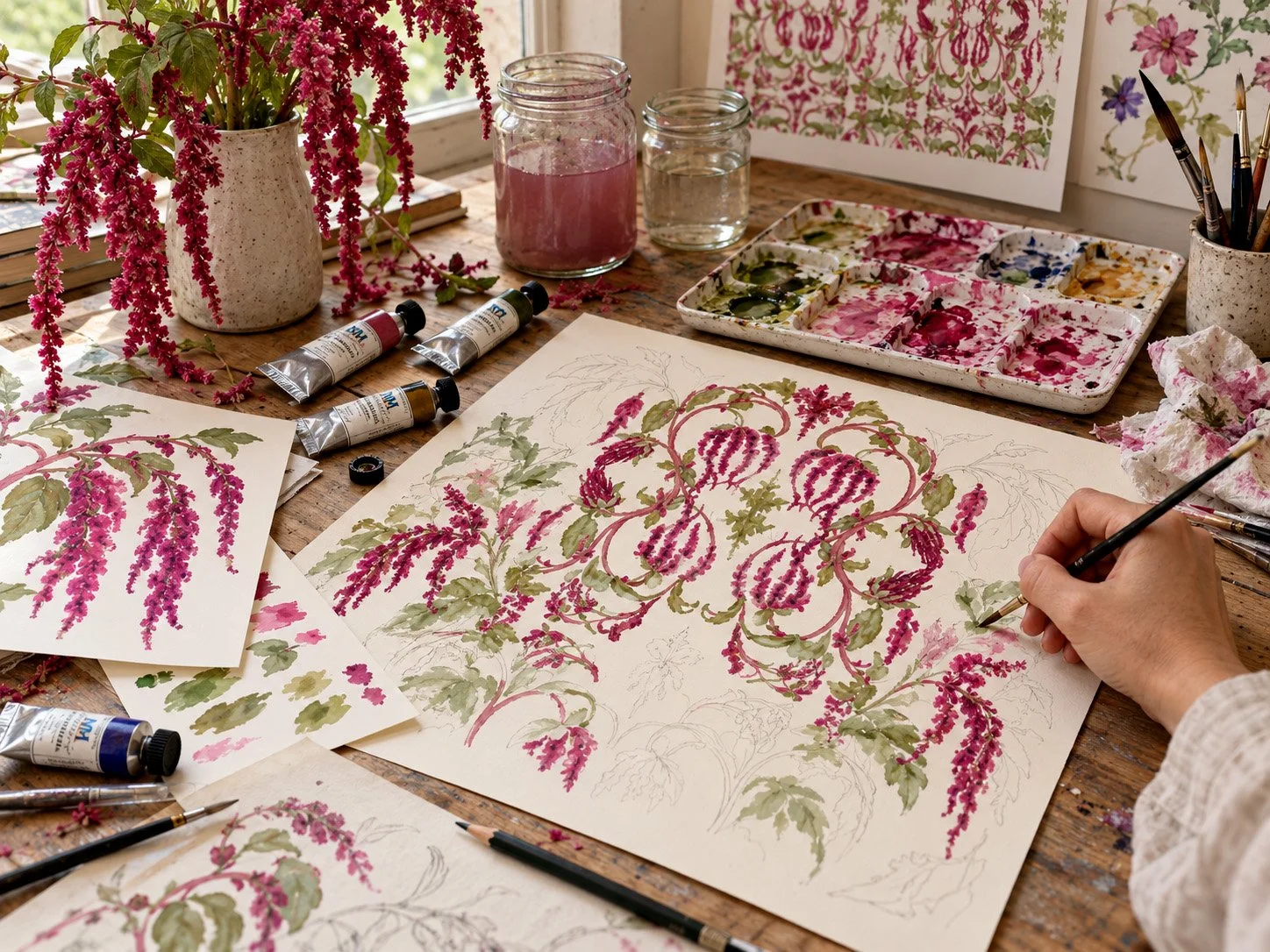
Developing the amaranthus motif through drawing, colour and painted studies.
Between Collaboration and Solitude
One of the slightly strange things about designing wallpaper is that it is both collaborative and solitary.
I work with interior designers, private clients, printers, production teams and other specialists. There are conversations about rooms, colour, scale, materials, architecture and all the practical questions that come with making something for a particular interior.
A client may have a very clear instinct for what belongs in a room — and an equally clear sense of what does not. An interior designer may see immediately how a pattern needs to sit alongside a fabric, a piece of furniture or a particular quality of light. Printers and makers bring an entirely different kind of knowledge.
All of that becomes part of the work, but eventually, I return to the studio alone.
The drawing, the painting, the endless small adjustments to colour, proportion and rhythm happen quietly. There are days when something comes together almost effortlessly and others when I can look at the same drawing for hours without understanding why it feels wrong.
Then I come back the next morning and see it immediately. I enjoy that part enormously. I always have.
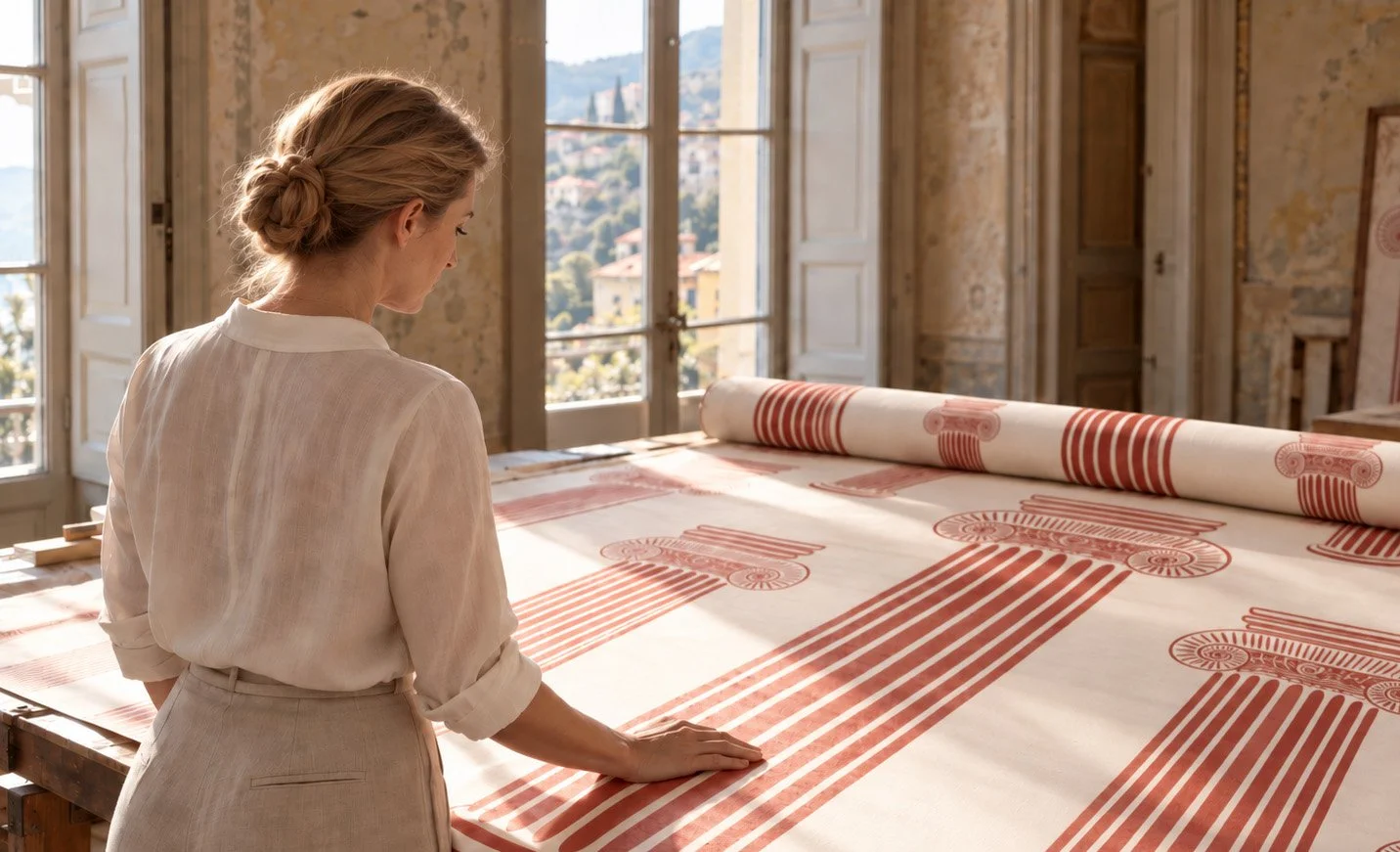
Exploring scale, surface and pattern on paper-backed silk for wallcovering.
What the Studio Teaches
Recently I have found myself thinking about what happens to everything we learn during those solitary hours. Creative practice is peculiar that way. The longer you work, the more you understand — and at the same time the more aware you become of everything you still do not know.
Each project adds something. A material behaves in an unexpected way. A mistake turns out to be useful. A colour changes completely when it moves from paper onto a wall. Something that looked beautiful at drawing scale loses all its energy when enlarged. You adjust, try again, remember it for next time. And gradually, almost without noticing, you build up a great deal of knowledge.
Some of it is technical. Some of it is instinctive. Some of it comes from questions I remember asking myself when I first began: Where do I start? How do I know when a drawing is finished? Why does a repeat feel mechanical? How much colour is too much? What happens when the material itself begins to influence the design?
Those are the things I have started thinking I would like to share.
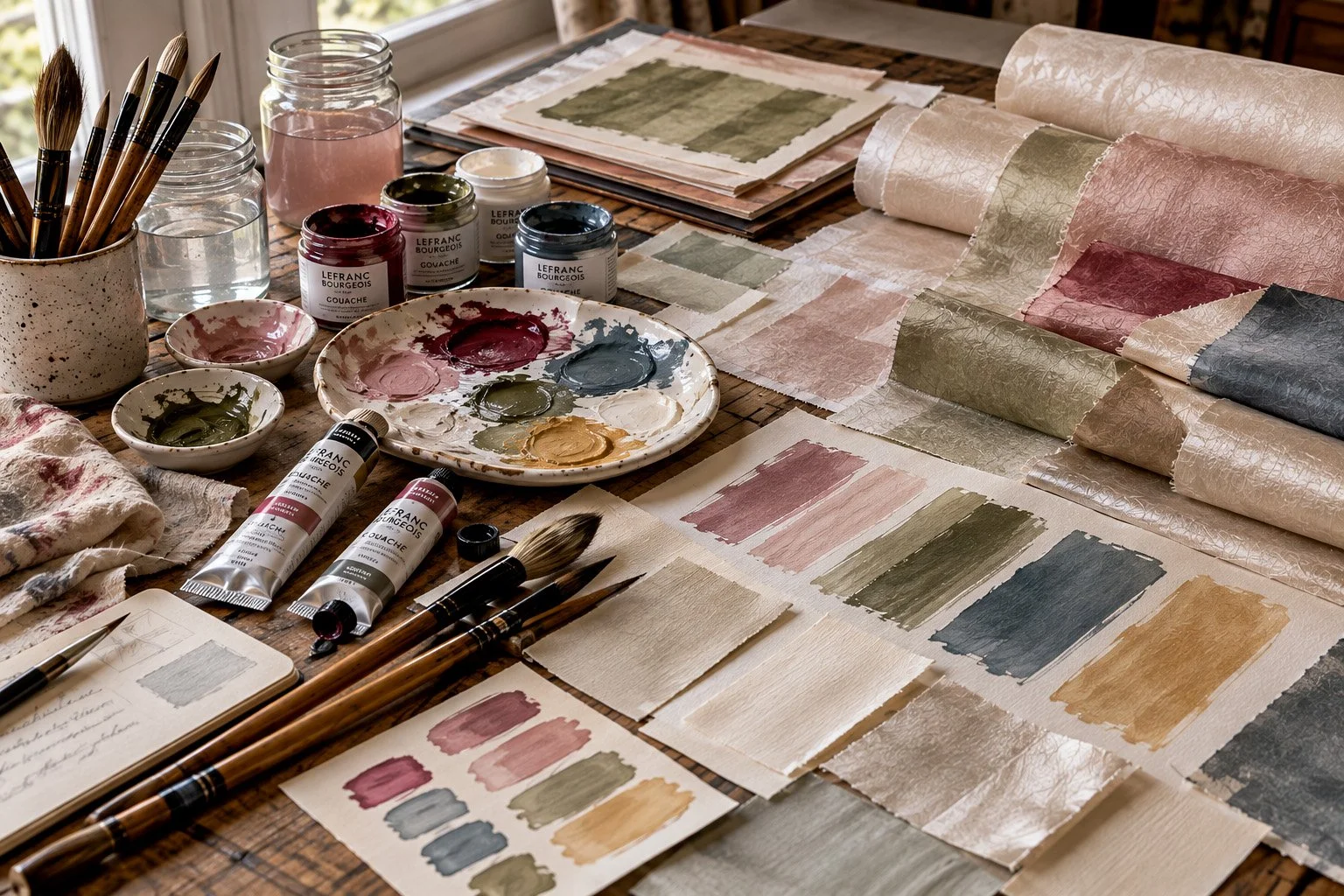
Testing paper-backed silk, gouache, colour and different surfaces in the studio.
A Workshop in Liguria
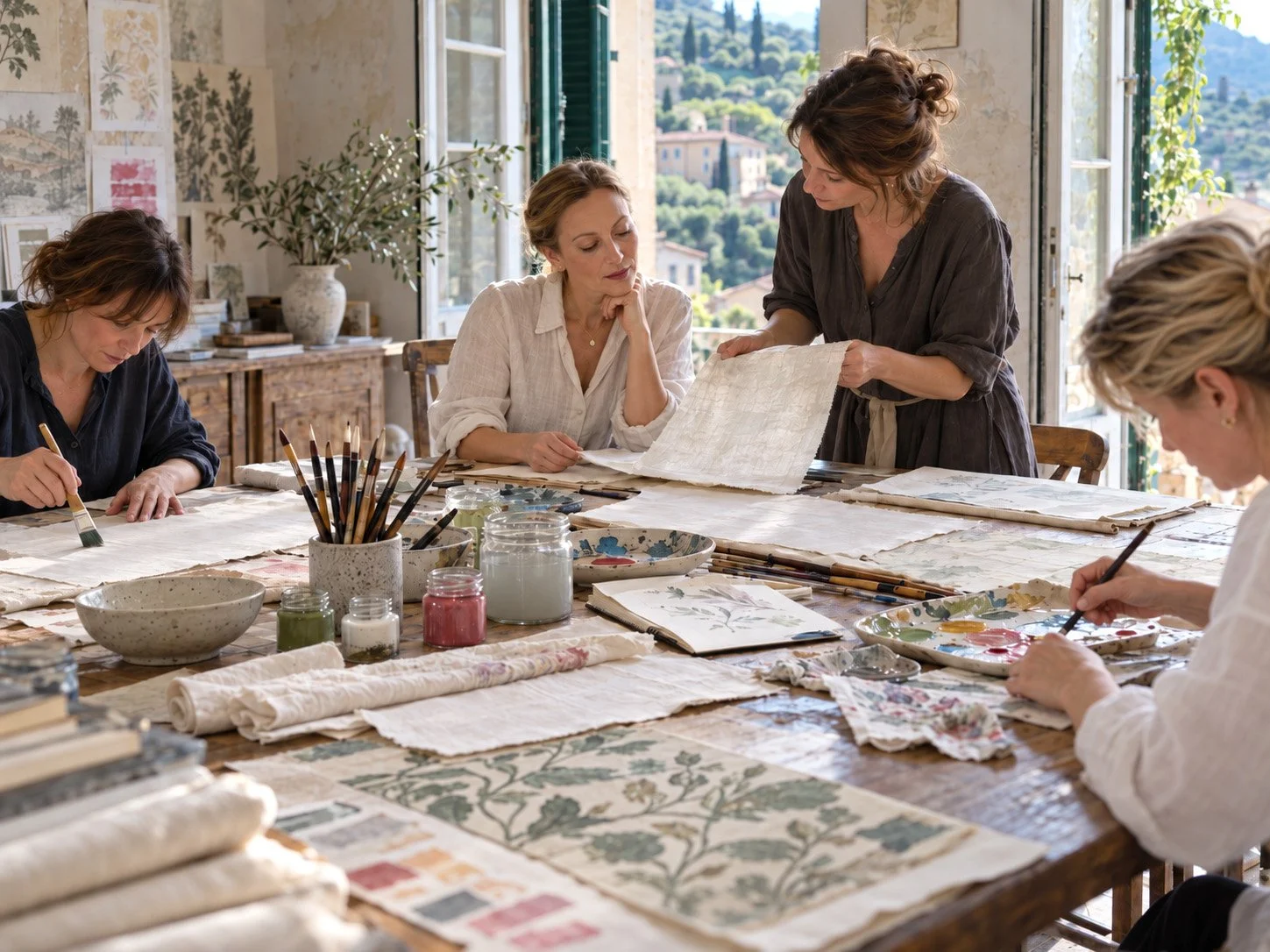
And this is where the idea of workshops in Liguria began. I can already see them quite clearly. A small group rather than a large class. A table covered with drawings, brushes, pigments, samples and different surfaces. People working, talking, comparing what is happening in front of them. Enough structure to give the day direction, but enough freedom for somebody to wander off in an unexpected direction and discover something better.
I would teach what I know, of course. I think I have a great deal to offer now. But I do not imagine it as knowledge travelling neatly in one direction. That would probably be the least interesting version of it.
Put a group of curious people together and ideas begin to move very quickly. Somebody asks a question you had never thought to ask. Somebody approaches a problem completely differently. Somebody uses a material in a way you would have dismissed and suddenly it works.
You teach. You watch. You learn as well. That exchange is becoming as important to me as the idea of teaching itself.
Perhaps because so much creative work happens privately, there is something very attractive about opening part of that process up. Not performing it, and not turning it into a formula, but working alongside other people and allowing the conversation to become part of the making.
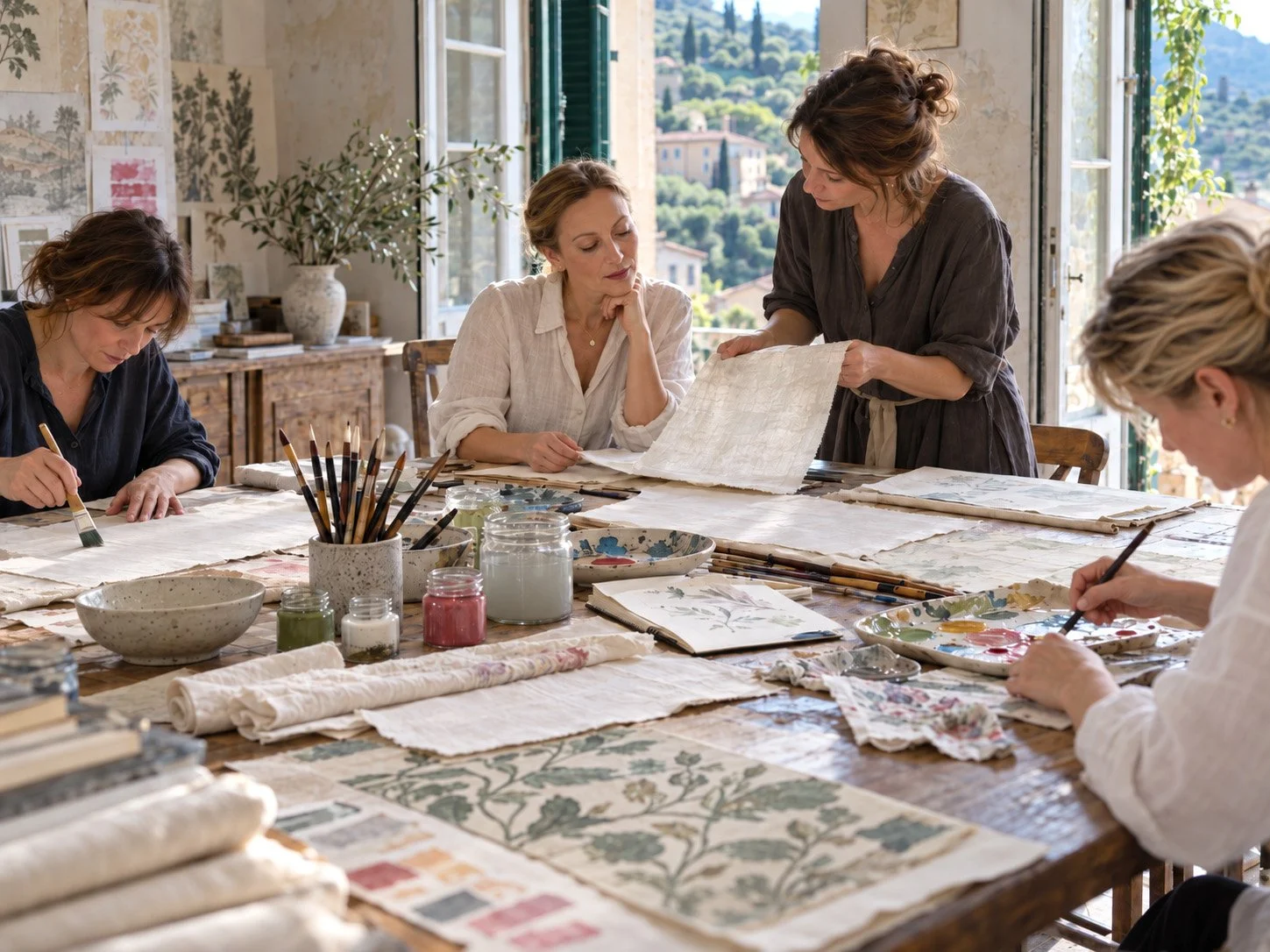
Ligurian workshop — making, testing materials and exchanging ideas around the table.
Why Liguria
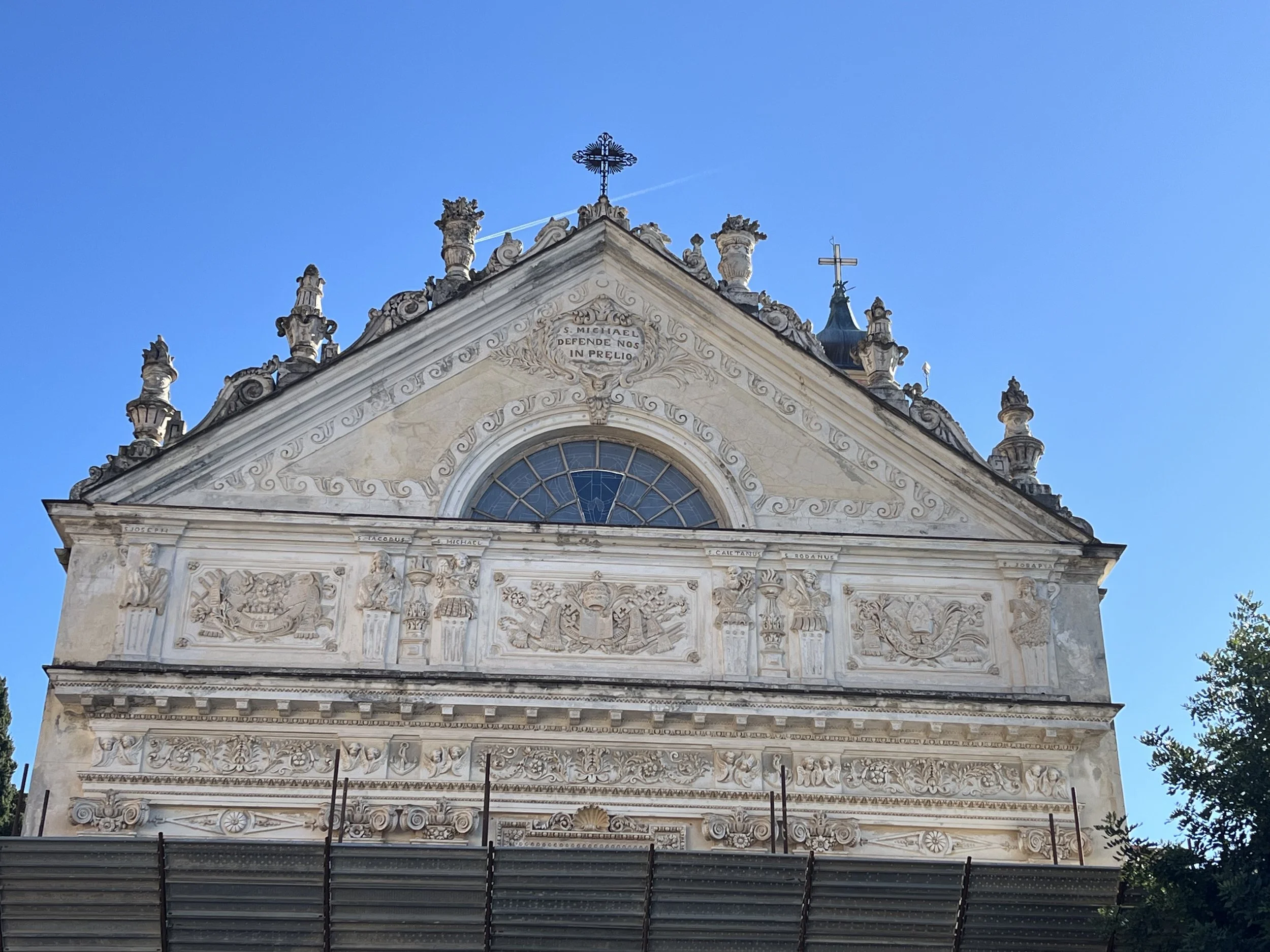
Liguria feels like the right place for it. There is visual material everywhere here: faded painted facades, fragments of decoration, old plaster, stone, shutters, churches, gardens, the colours of the sea and the rather extraordinary Ligurian light. It is difficult to live here without noticing surfaces.
I like the thought of that entering the room too. The idea is no longer quite as vague as it was when it first appeared.
I know there are things I want to teach. I have begun thinking about the materials, the scale of the group, the kind of space I would want to create and what people might actually make while they are there. There is still a great deal to work out, and that is part of what interests me.
I am not only thinking about how to pass on what I know. I am also learning how to shape the whole experience around it — how to make it useful, generous, stimulating and, above all, worth coming to Liguria for.
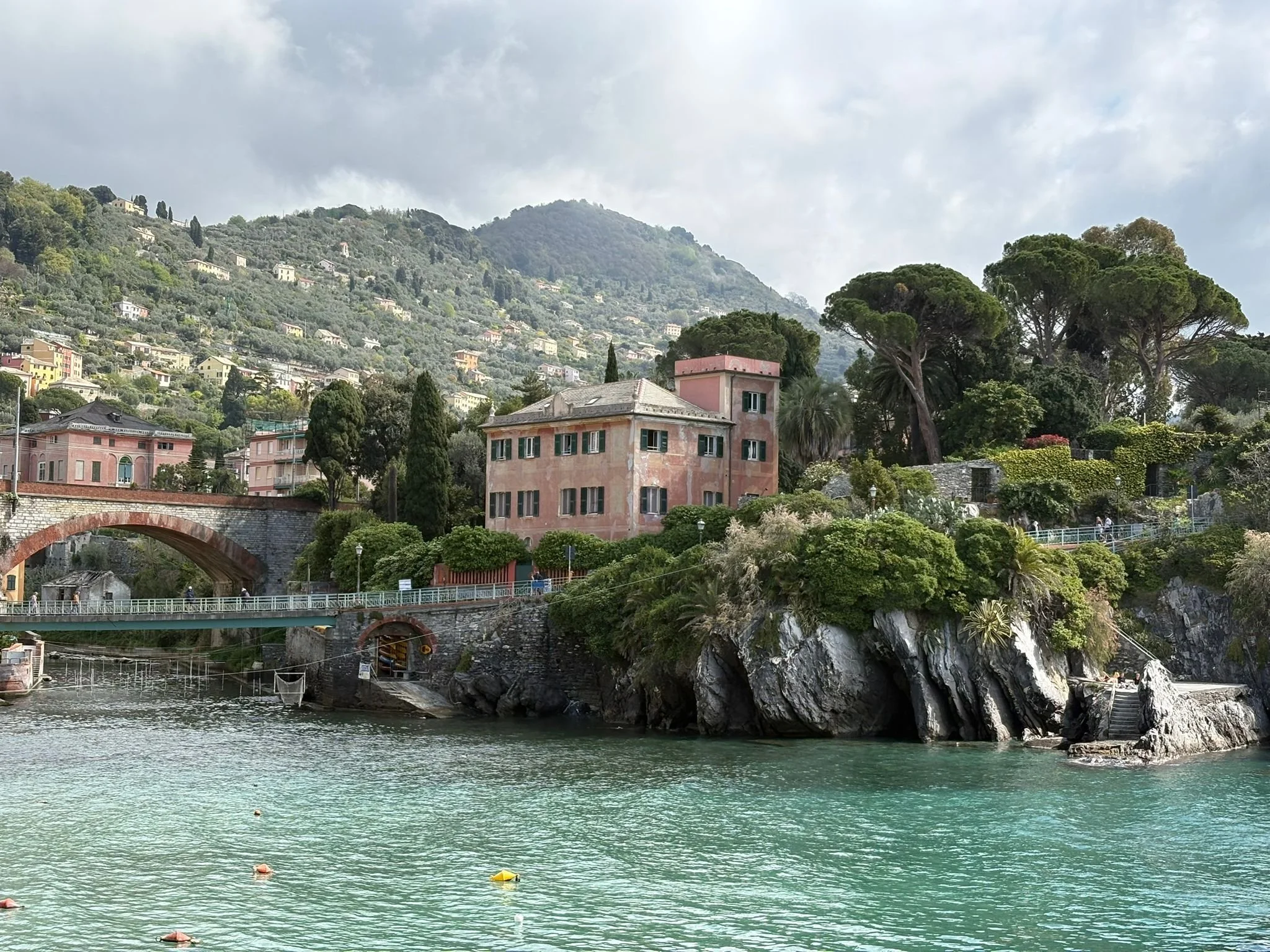
Genova Nervi on the Ligurian coast
Learning to Share the Process
There is another part of this which comes rather less naturally to me. I know that opening up the studio process also means learning to show more of it. Filming, sharing work in progress, perhaps making videos that allow people to see how something develops rather than only seeing the finished result.
I understand the value of that very clearly. I am simply much more comfortable with a brush in my hand than a camera pointed at me. That, I suspect, will be another part of the learning process.
If I am asking other people to arrive curious, experiment, make mistakes and work outside what already feels familiar, then perhaps I should be prepared to do some of that myself. Learning how to communicate the process, not just make the work, will be part of the experience for me too.
At the moment all of those thoughts are beginning to settle into something more solid. This is usually the stage I enjoy most: when an idea has moved beyond fantasy, but is still open enough to change.
I can see the table now. I can see the materials. I can imagine the conversations, the questions, the moments when somebody discovers something neither of us expected.
What I do not know yet is exactly what form all of it will take. And perhaps that is where the conversation becomes interesting.
If you have ever imagined joining something like this, I would genuinely like to know what you would hope to learn, what you would want to make, or what would make a workshop feel genuinely worthwhile to you.
I have no shortage of ideas of my own — that has never really been the problem. The harder part is giving them shape. And this one is beginning to have one.
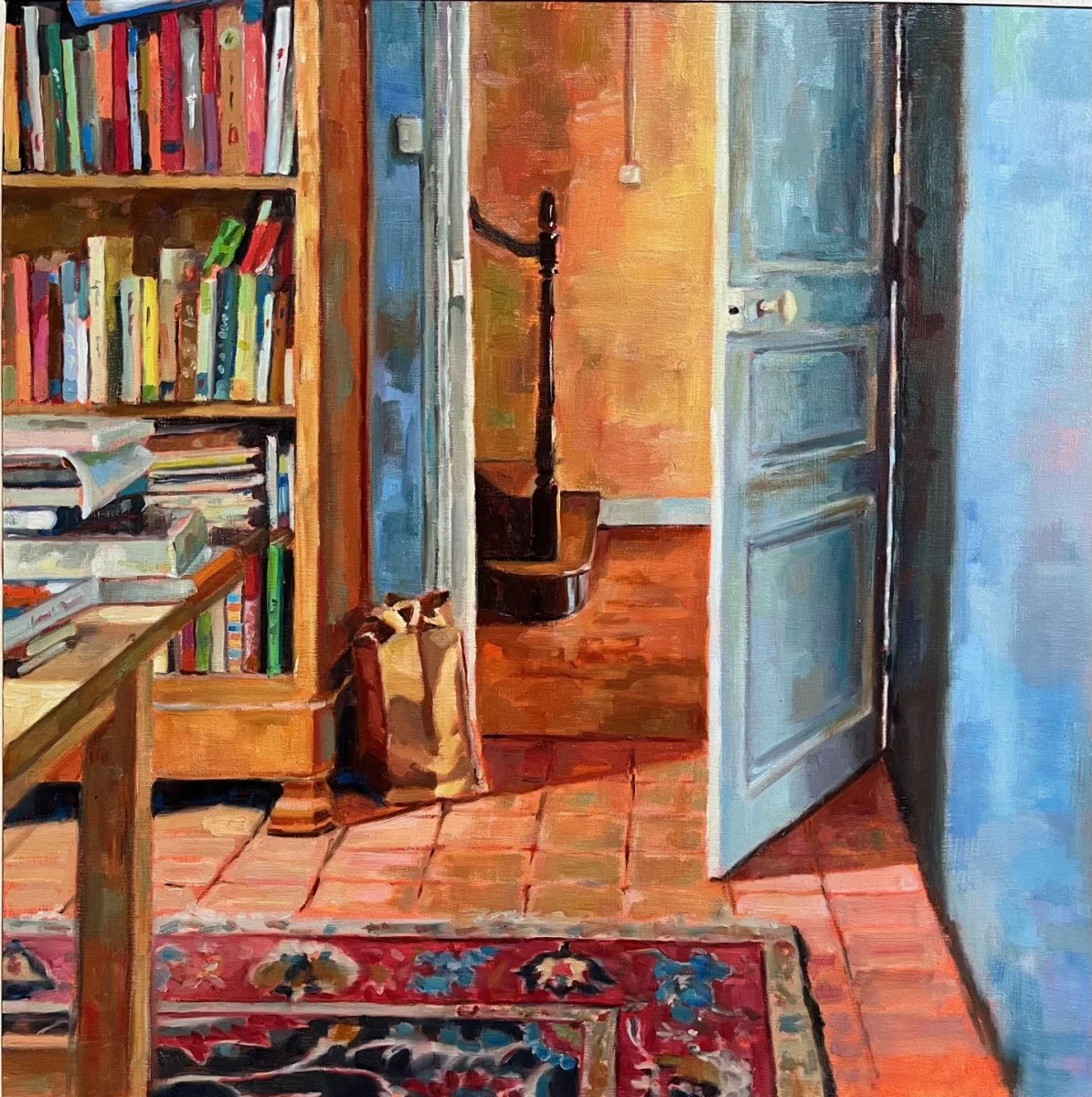
Painting from Life: Janette Hayhoe on Colour, Pattern and Domestic Space
Artist and interior designer Janette Hayhoe reflects on painting from life, colour, pattern and domestic space, following a week of painting at Circle of Misse in the Loire Valley.
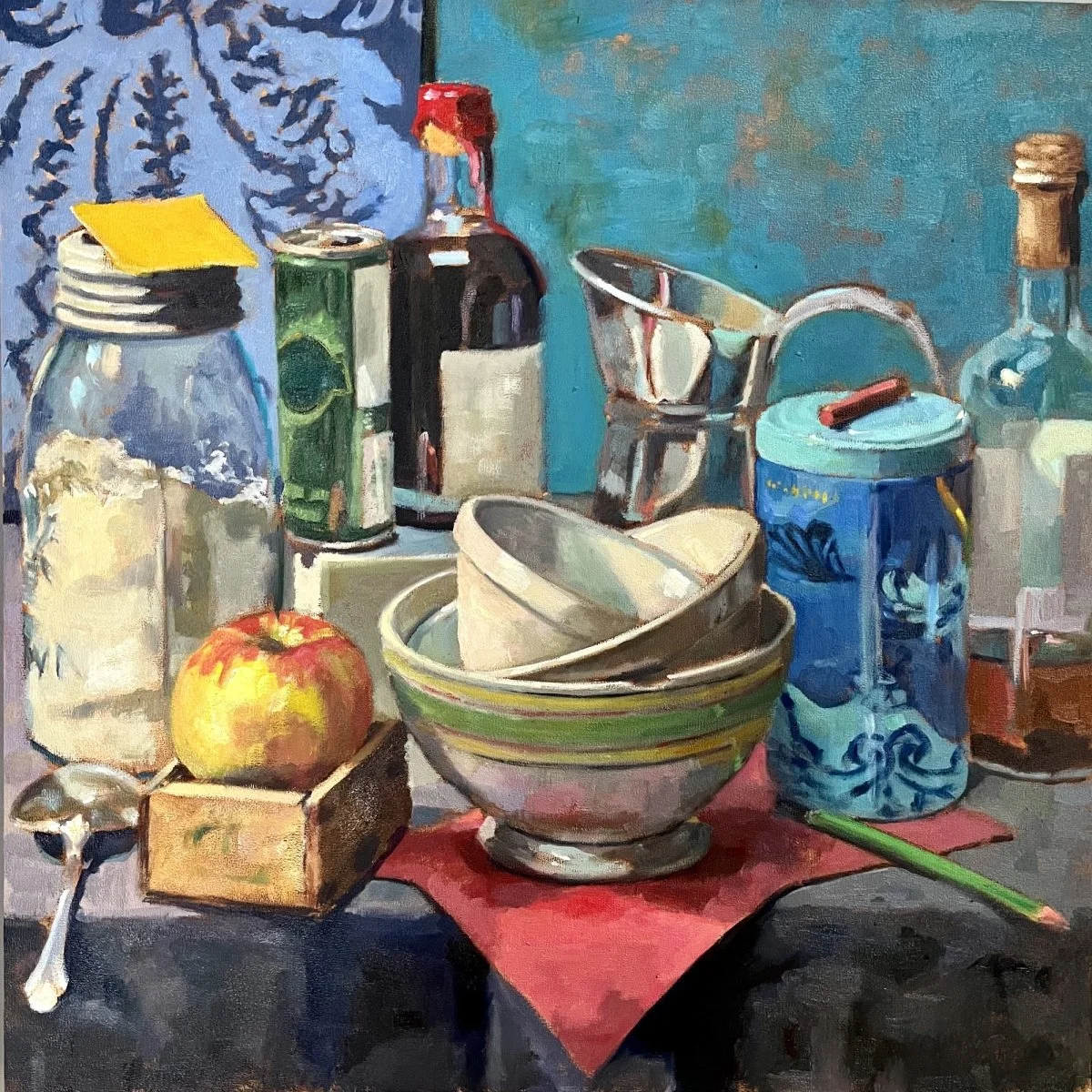
Still Life with Bowls, oil painting.
Janette Hayhoe
I was familiar with Janette Hayhoe’s paintings before I knew her well, and I became a fan quite quickly. What attracts me to her work, beyond the quality of the painting itself, is her sense of colour and the objects she chooses to paint. She notices things many of us would walk past without giving them much thought, and then makes them worth looking at.
Janette is an artist, an interior designer, and a friend. This spring, I joined her painting course at Circle of Misse in the Loire Valley, and it gave me the chance to see not only how she paints, but how she teaches others to look. That became the starting point for this conversation: colour, pattern, interiors, France, and the emotional life of ordinary objects.
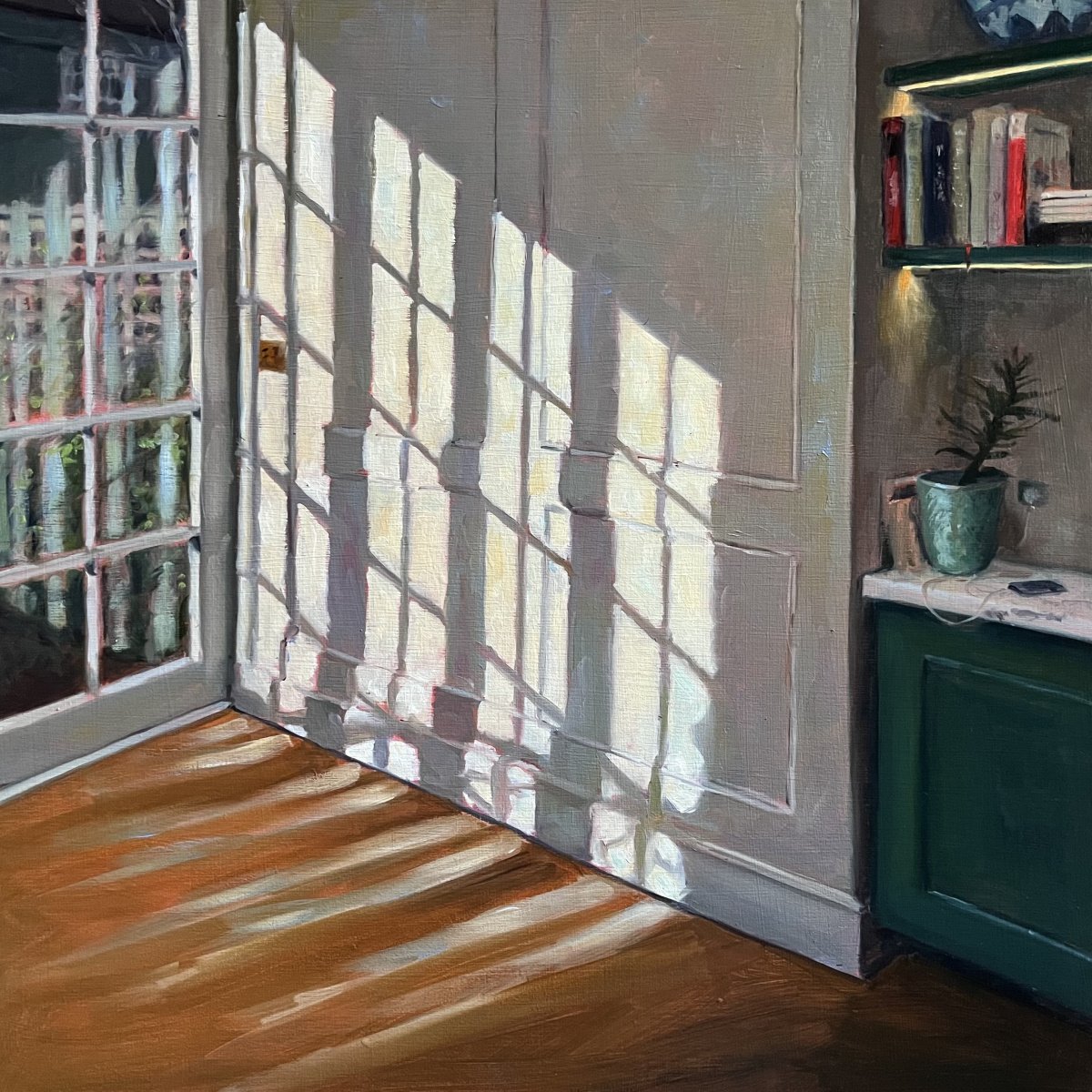
Breakfast Room, oil painting.
Janette Hayhoe
At Circle of Misse
Circle of Misse was the right setting for that kind of conversation. It is not a glossy, over-designed retreat, but a place where creative work, food and hospitality seem to belong together. The house is in Missé, on the southern edge of the Loire Valley, and Circle of Misse hosts creative holidays, courses and retreats, with writing and painting on one side and Loire Kitchen, its culinary and hospitality side, on the other. The food was a serious part of the pleasure. Aaron, our host, cooked with real assurance, moving comfortably between different cuisines, but never in a way that felt like a performance. Many of the recipes seemed to carry a place, a journey, or a memory with them, and often there was a story behind what arrived at the table.
That made the meals feel personal as well as excellent — part of the rhythm of the week, and not separate from the painting at all. In fact, it felt very close to the world Janette paints: a table after lunch, a stack of dishes, cloth, pattern, light, conversation, traces of people who had just been there. In her hands, any of that could become the beginning of a painting.
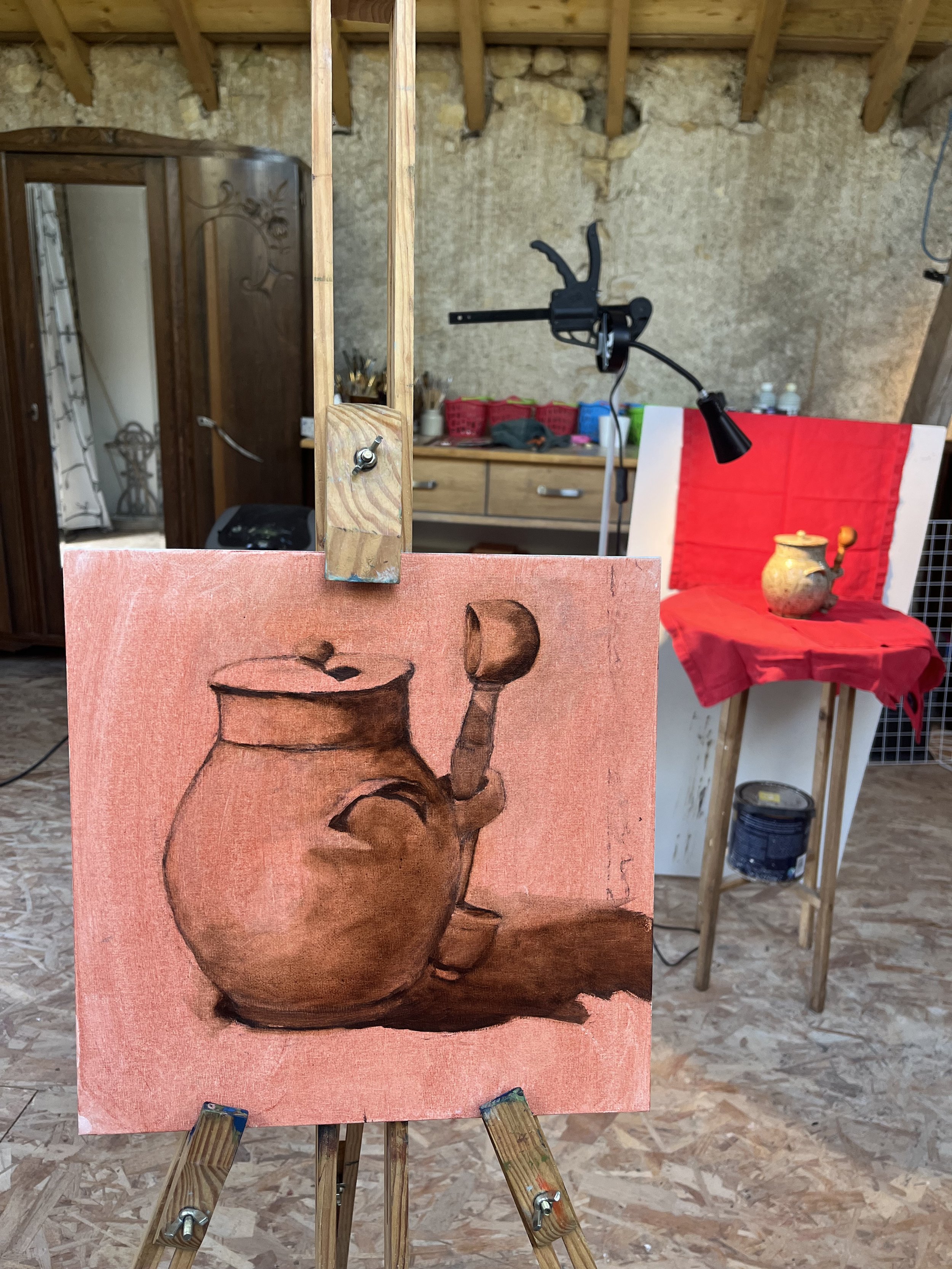
Nataliya Andrienko, Olive Jar Study,
painting from life at Circle of Misse.
Learning to See Colour
So when I asked Janette about colour, she did not speak about it as something added to a painting. She spoke about attention, and about painting from life. Her training was classical, and for her the eye sees differently from a camera. It keeps finding reflected tones, warmth, coolness and small shifts that only appear when you stay with the subject.
Then came the line that stayed with me.
“You look at a white object, like a porcelain object,” she said, “and it is either reflecting colours, or there is warmth and coolness. Everything is in there. To paint a white object, I need a full palette.”
That explains a great deal about Janette’s paintings. Her colour is not decorative. It comes from looking.
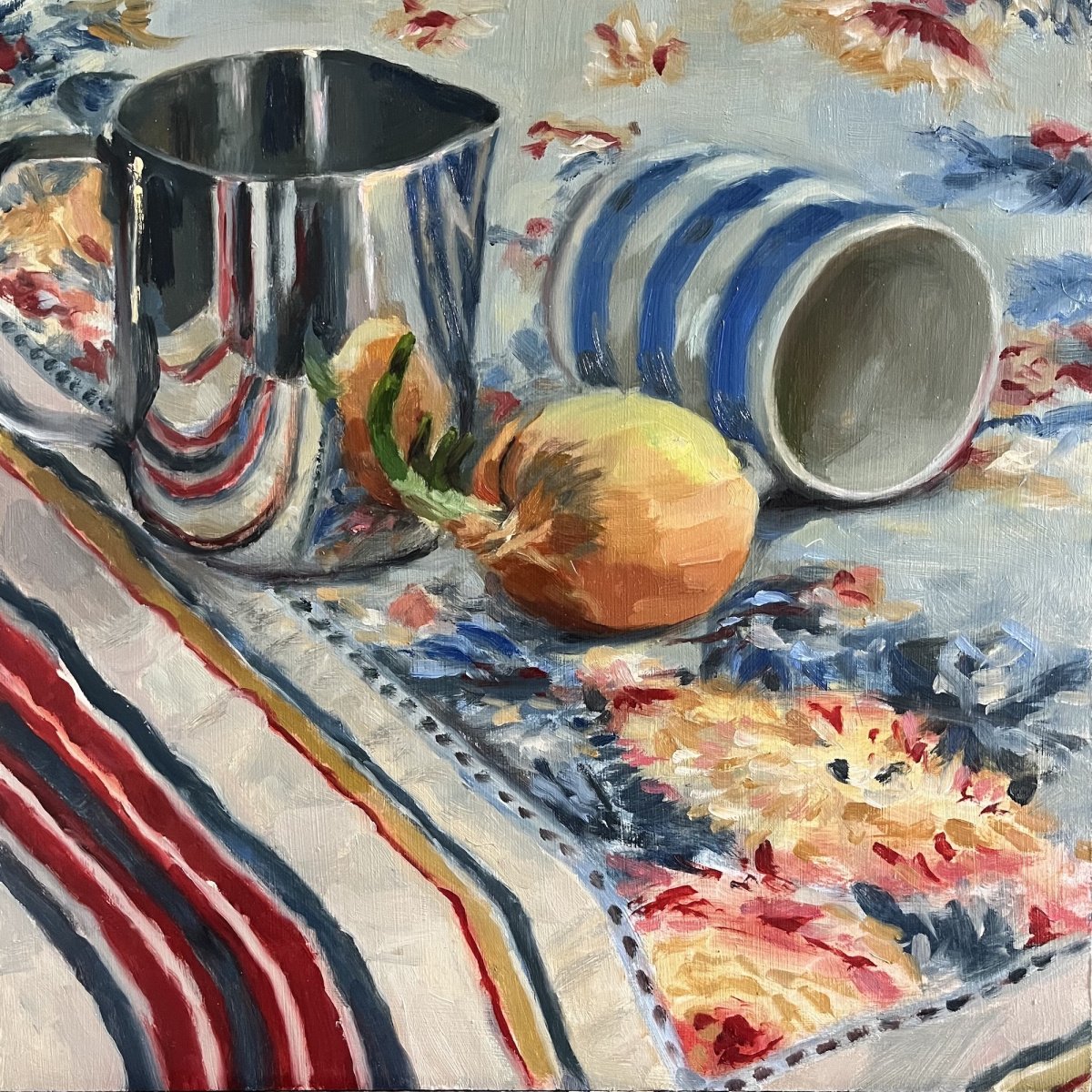
Sprouting Onion, oil painting.
Janette Hayhoe
The Light of the Loire Valley
Because Janette trained and lived in France, and because the course took place there, I wanted to ask whether France itself had changed the way she sees colour. Was it the place, the light, the landscape — or was that sense of colour already part of her? She was careful not to make it too romantic.
“That’s hard to say,” she said. “I suppose the area in France where I lived, the Loire Valley, is known by artists as having a particularly wonderful light. The quality of light is lovely. It has a softness.”
But she returned to the most important thing.
“A lot of what painting is,” she said, “is training your eyes to see.”
That was very much the feeling of the course. We were in France, with all the pleasure that brings — the landscape, the buildings, the changing weather, the possibility of painting outside — but the real work was not simply to record what was in front of us. It was to learn how to look.
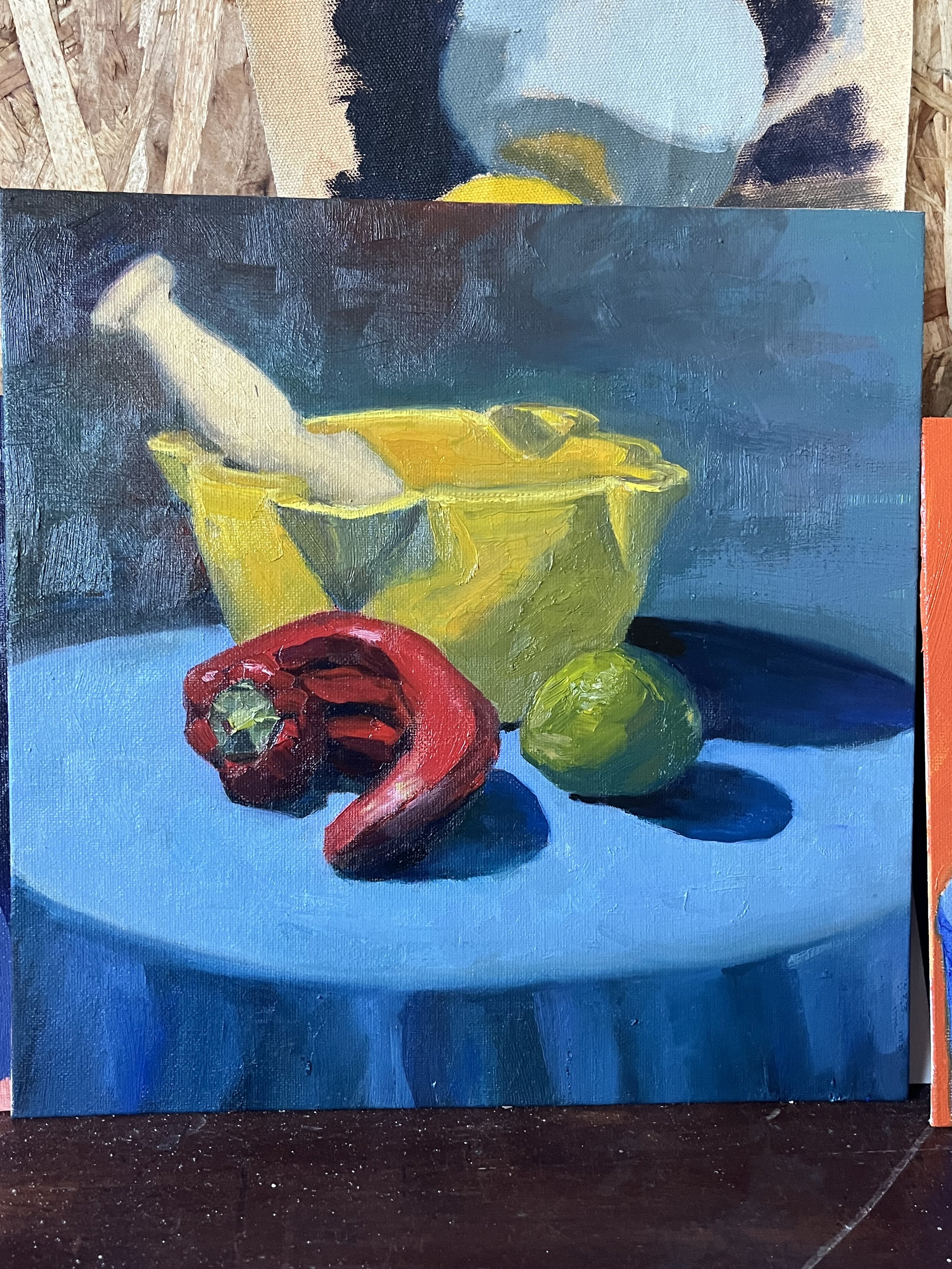
Nataliya Andrienko, Pepper and Lime Study, painting from life at Circle of Misse.
Janette told me that her courses in France began mostly with plein air painting, because working outside there is such a joy. Now, with studio space as well, the course can move between landscape and still life depending on the weather.
“The principles are basically the same,” she said. “The drawing, the colour theory, creating form, creating three dimensions on a two-dimensional surface. It is much the same whether you are painting landscape or still life.”
It sounds straightforward when Janette says it. Having been there and tried it, I can confirm that it is not straightforward at all.
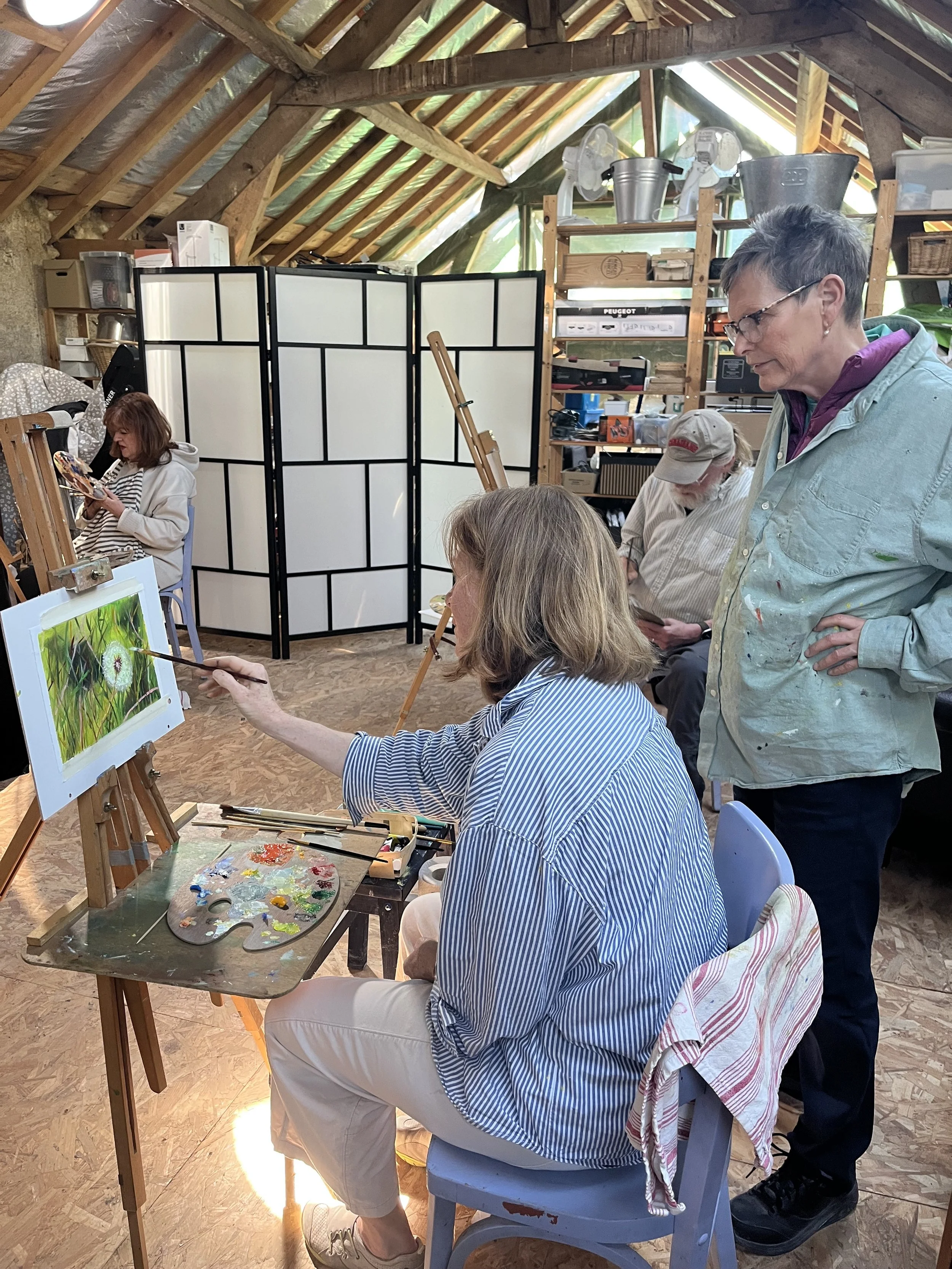
Janette Hayhoe teaching in the studio at Circle of Misse.
Pattern and the Life of Interiors
One of the things I have always loved in Janette’s paintings is her use of pattern. It appears again and again: in cloth, ceramics, interiors, backgrounds, table surfaces and domestic objects. But it never feels as though it has been placed there only to decorate the painting. It feels connected to the life of the objects and the space around them.
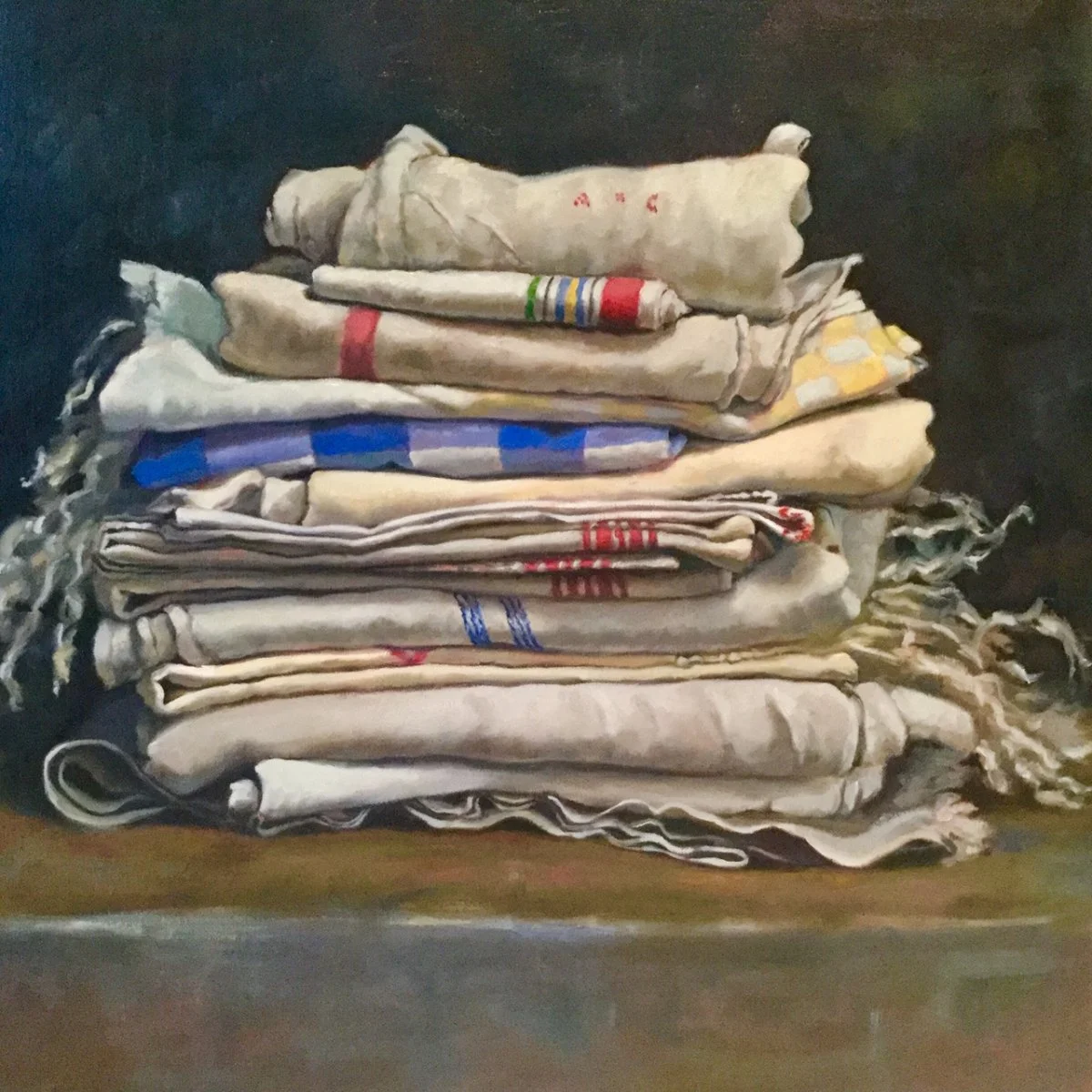
Stacked Linens II, oil painting.
Janette Hayhoe
This makes sense because Janette is not only a painter, but an interior designer. She has spent years thinking about rooms, fabric, furniture, light, surfaces and how all these elements affect the feeling of a place.
When I asked her about pattern, she said:
“I think the love of pattern is probably coming from my love of interiors and design.”
But again, she brought the conversation back to light.
“With interiors, it is often about light as well,” she said. “How it comes into a space, whether it is through a window or a doorway. That is often what I am looking at.”
That is what makes her interiors interesting to me. They are not simply paintings of rooms or objects arranged inside rooms. They are paintings of relationships: between light and surface, object and memory, pattern and feeling.
What interested me even more was that Janette did not separate pattern from domestic life. It was not only a visual device. It belonged to the rooms we occupy, the fabrics we live with, the objects we keep, and the way a home can hold more than one feeling at the same time.
What a Room Can Hold
From there, Janette began talking about domestic space — not as something automatically cosy or pretty, but as something more complicated.
“As a woman,” she said, “I think we respond to the domestic space. It says something about how you feel about the space you occupy.”
She spoke about trying to create an affect for the viewer — a feeling, not just an image. That felt important, because it moved the conversation away from subject matter alone. A bowl is not only a bowl. A pillow is not only a pillow. These objects can carry memory, comfort, discomfort, tension, or something more private, depending on who is looking.
“I’ve painted bowls and people say, ‘Oh, my grandmother had a pudding bowl like that.’”
That is where everyday objects become personal. They carry associations, even when the artist does not explain them.
But Janette also said that domestic space is not always comforting. It can be welcoming, but it can also feel slightly off. It can hold tension.
“There can be tensions,” she said. “In every domestic set-up, there can be tensions.”
She gave the example of stacked objects, where the arrangement itself can suggest something precarious. She also spoke about a series of eggshell paintings, drawn to their fragility and to the idea of “walking on eggshells”.
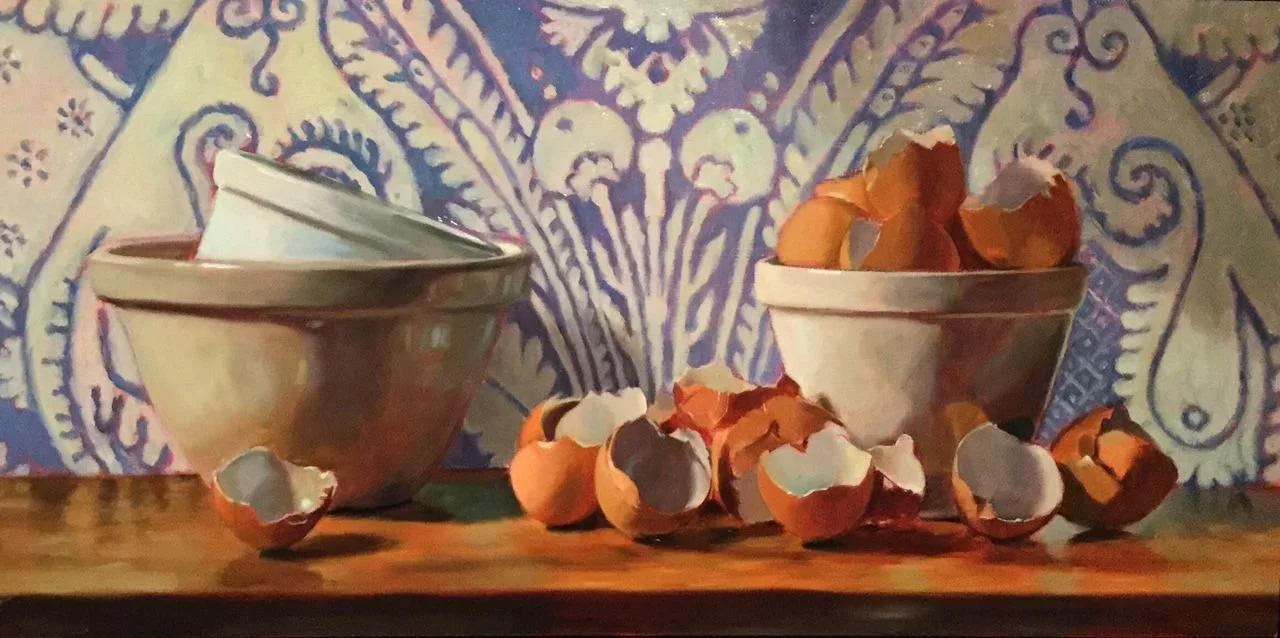
More Egg Shells, oil painting.
Janette Hayhoe
That image stayed with me. Eggshells are ordinary. We throw them away without thinking. But in a painting, they can become something else: fragile, exposed, slightly uncomfortable.
She also described a series of paintings of pillows. In one, the pillows were neat and orderly. In another, they became dishevelled. Then they were torn, old feather pillows, with the feathers coming out. In the final painting, they were packed away in a plastic bag.
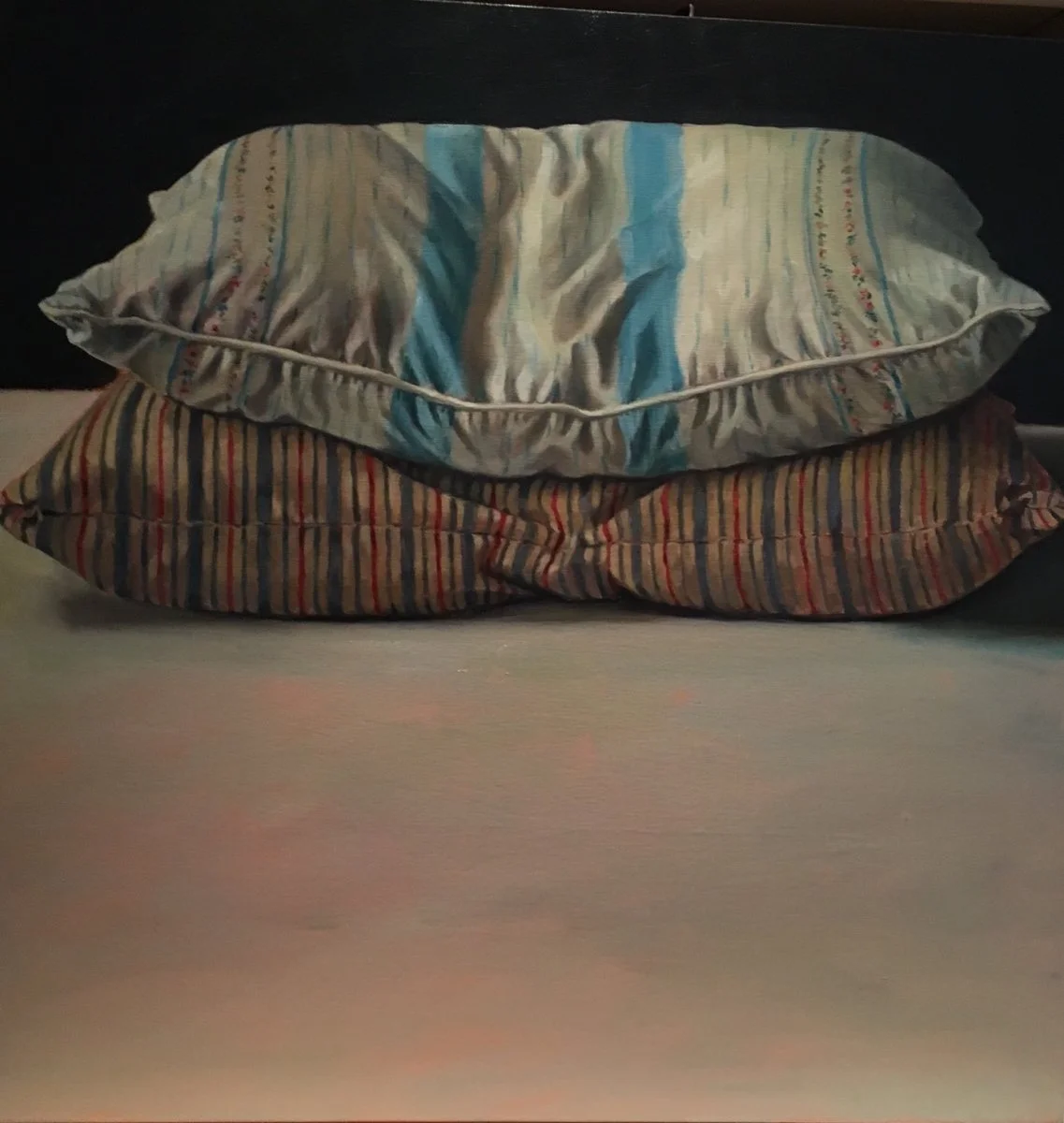
Pillows III, oil painting.
Janette Hayhoe
“These things can happen in relationships too,” she said.
I found that fascinating, because it changes how you look at the work. At first, you might see a domestic object. Then slowly you realise it may also be about comfort, disorder, strain, fragility, or something coming apart.
Room for the Viewer
Janette said that sometimes there is a subtext in the work, but she does not want to force it too strongly onto the viewer.
“Sometimes I like to leave it open enough that the viewer can bring their own subtext to it,” she said. “Or maybe there isn’t one for them.”
That openness feels important. A painting may come from something very personal for the artist, but once it is seen by someone else, it becomes part of their experience too. A subject that was upsetting to the artist might look beautiful to another person. A chipped bowl might remind someone of family. A room filled with light might feel comforting, or it might feel unsettling.
So perhaps that is what Janette’s paintings offer: not one fixed meaning, but a place where colour, light, pattern and memory can meet.
Near the end of our conversation, I tried to summarise it back to her: through light, colour and everyday objects, the same artwork can offer very different experiences depending on who is looking at it.
“Yes,” she said. “Absolutely.”
And then she added something that felt like the right place to leave the conversation.
“You always want to have room for the viewer too.”
That line says a great deal about her paintings. They are carefully observed, but not closed. They are personal, but not private. They invite you in, but they do not tell you exactly what to think.
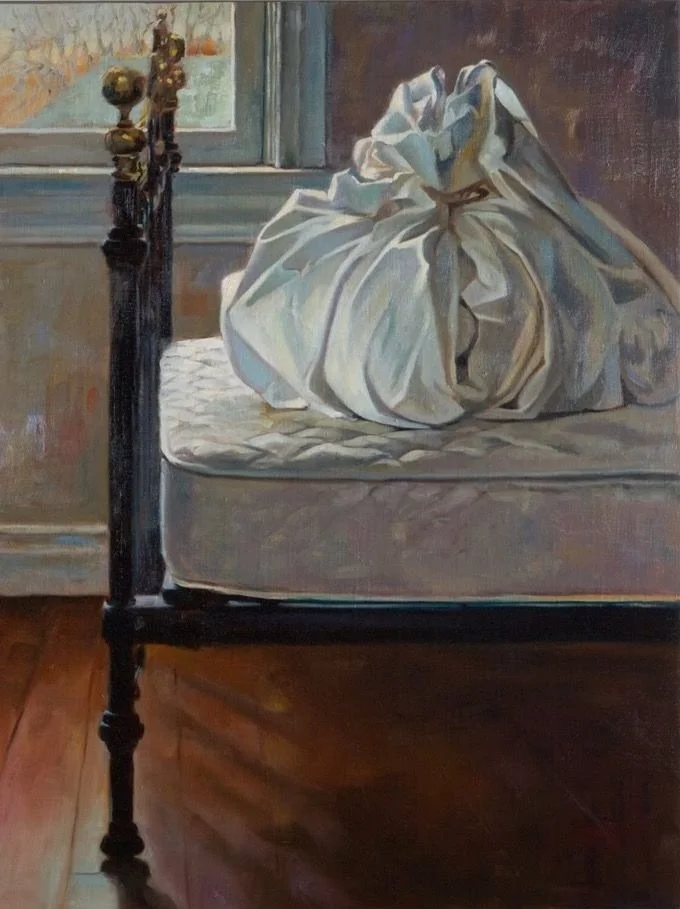
Bundled, oil painting.
Janette Hayhoe
You can see more of Janette Hayhoe’s work on her website, and I have also linked the Circle of Misse course page, where she teaches painting in France. I feel fortunate to have shared that week through Janette’s teaching, her work, the place itself, and the people gathered there. It is an experience I will not forget.
Further links:
Janette Hayhoe Interiors
Circle of Misse
Loire Kitchen / Circle of Misse
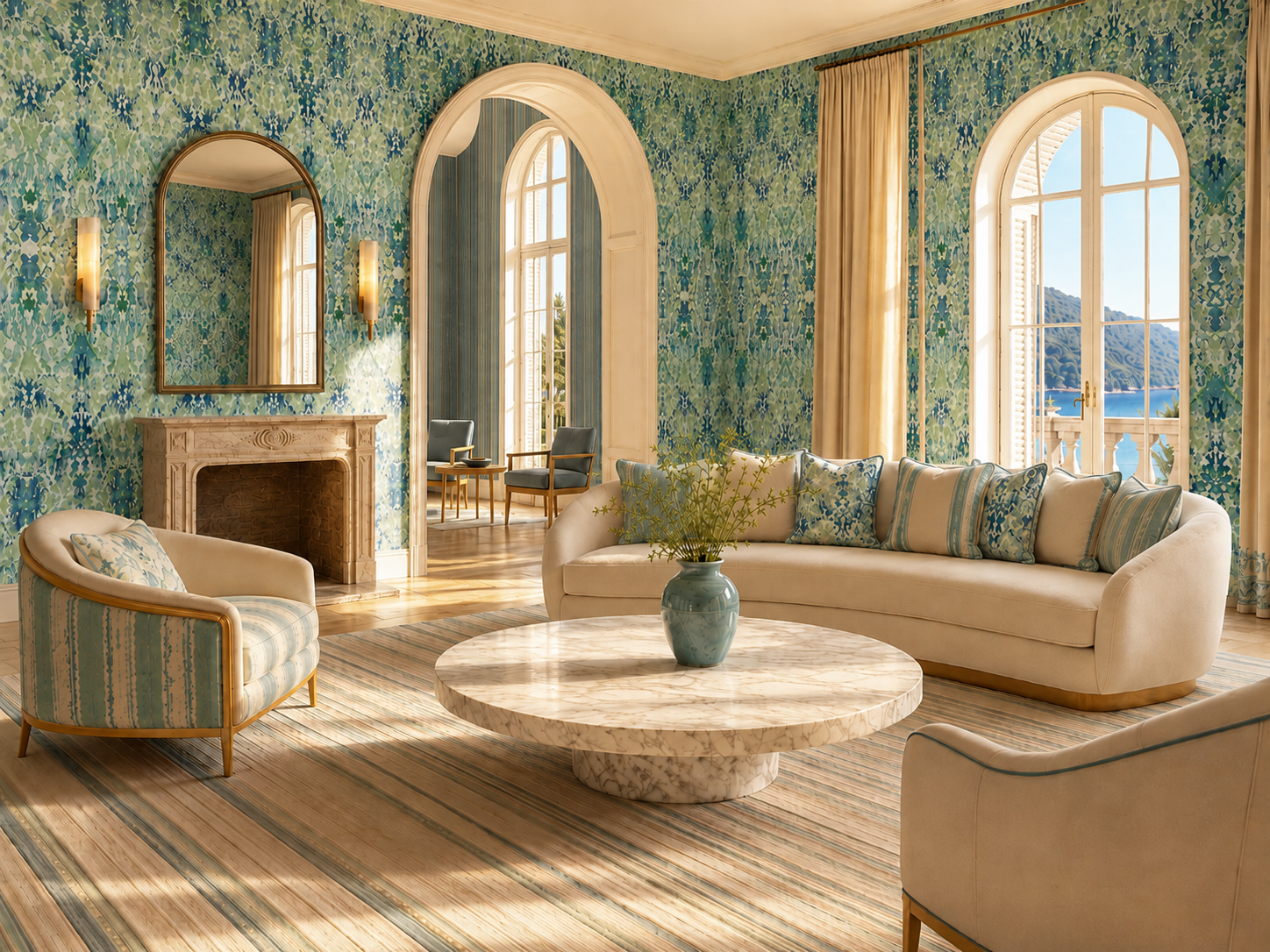
When Pattern Becomes Place
How pattern is shaping hotels, restaurants, resorts and private interiors — and how bespoke wallpaper and custom wallcoverings can create atmosphere, identity and a stronger sense of place.
Some rooms stay with us because they seem to have been thought through in one language. A colour returns in the hem of a curtain. A line reappears in the curve of a chair. A border above a doorway answers the table linen below. Nothing has to shout, yet everything belongs.
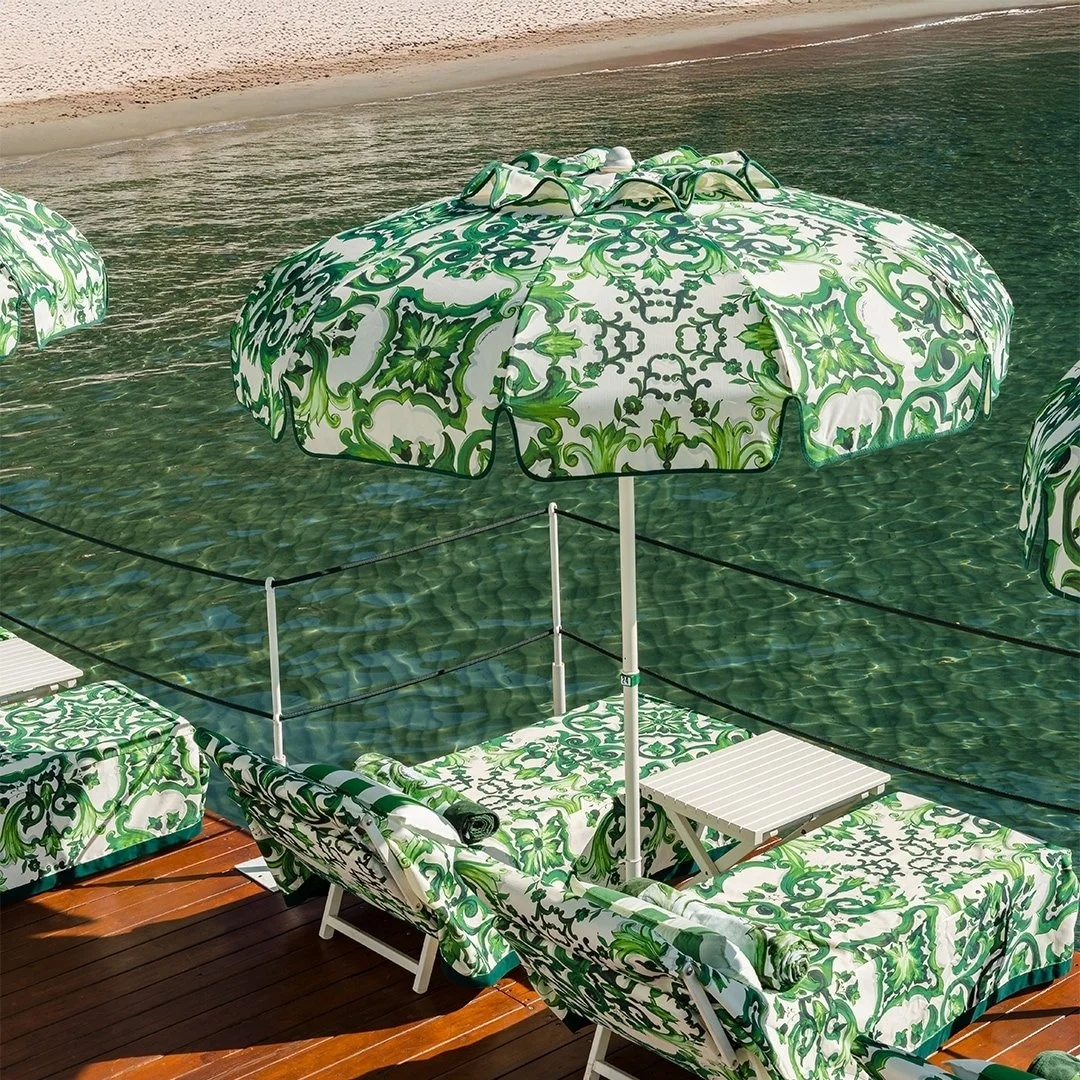
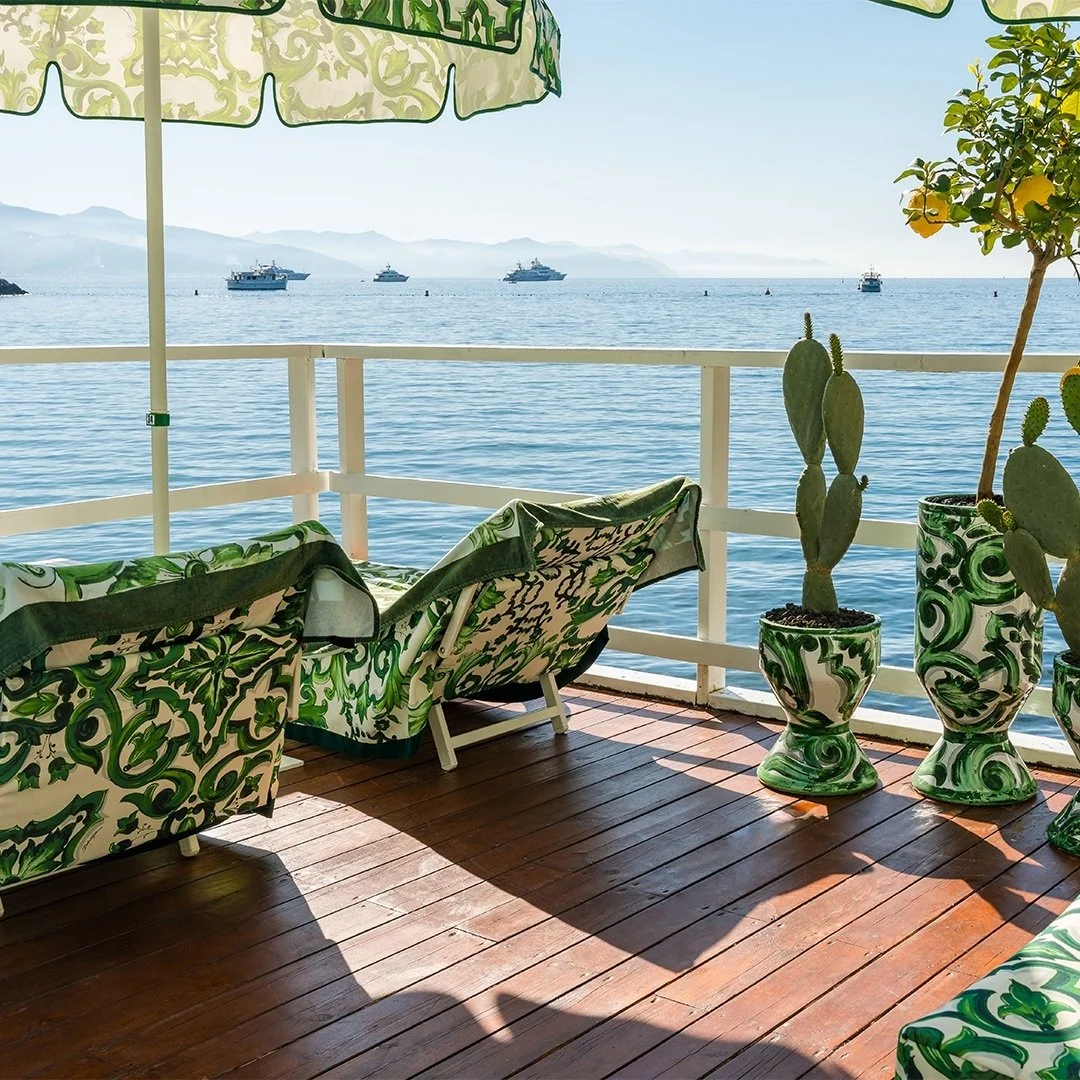
This is becoming more visible in hospitality design. Pattern is no longer expected to remain on a wall, a cushion or a printed fabric. It now moves across terraces, parasols, ceramics, furniture, floors, ceilings and the small details through which a guest remembers where they have been.
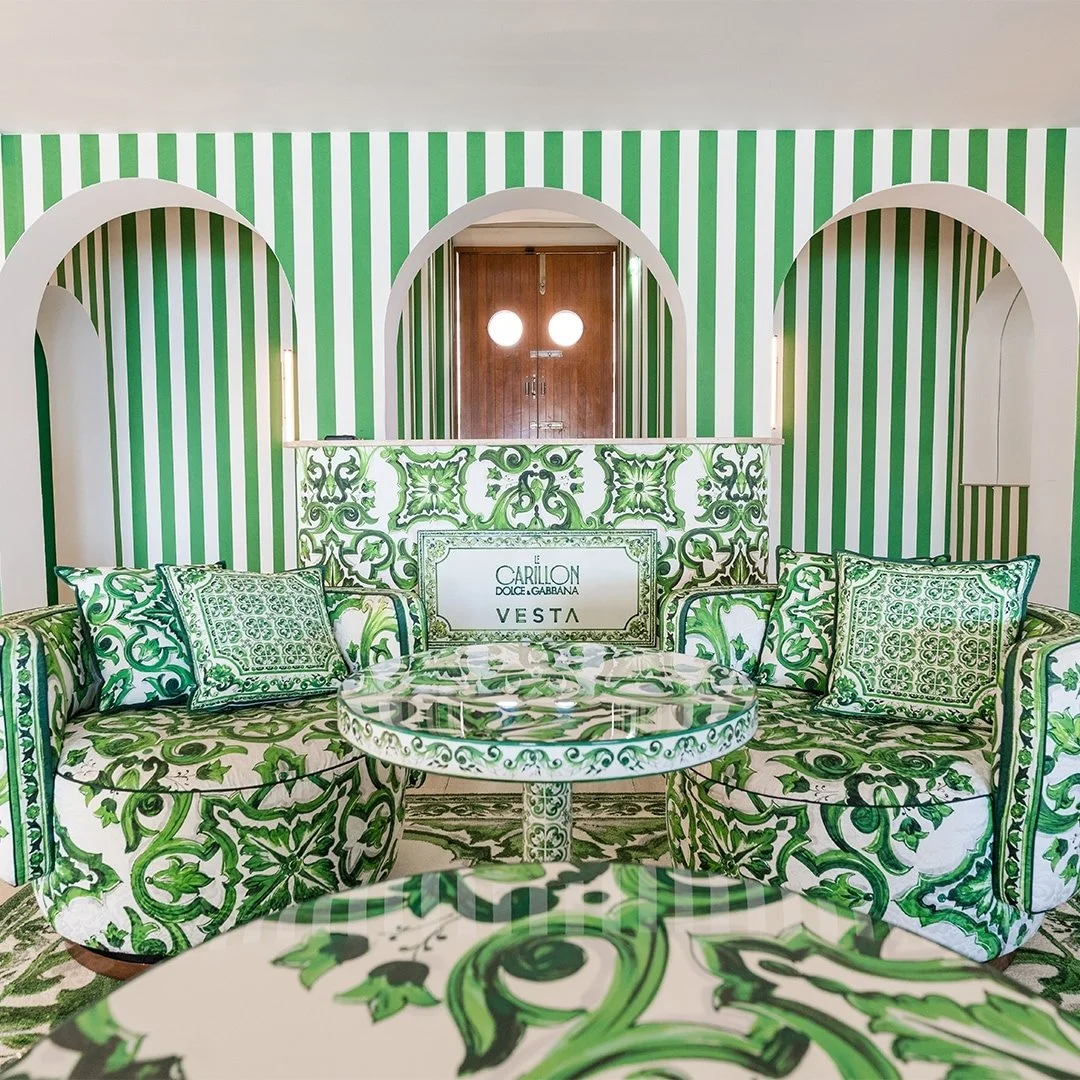
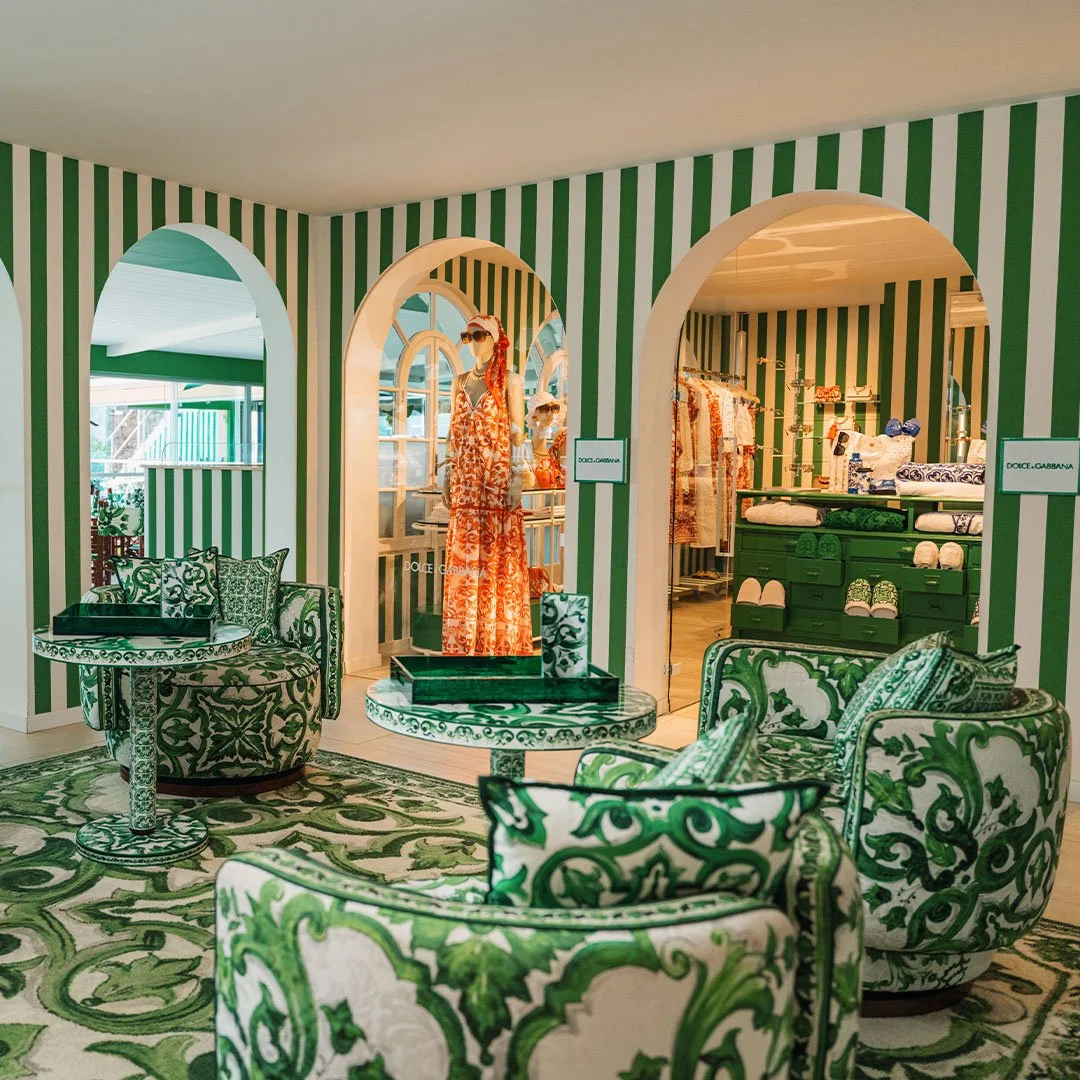
The clearest recent signals come from fashion houses and hotels with a strong decorative identity. At Le Carillon in Paraggi, Dolce & Gabbana’s Verde Maiolica extends across a resort setting. Burberry’s summer presence at Hôtel Belles Rives in Cap d’Antibes brings its house language to the Riviera. Gucci’s Flora motif in Monaco, Dioriviera’s seasonal spaces, Broadwick Soho in London, Le Grand Mazarin in Paris, The Fifth Avenue Hotel in New York and immersive Milan design-week installations all suggest the same wider movement: surface, colour and ornament are being used to give places atmosphere, identity and memory.
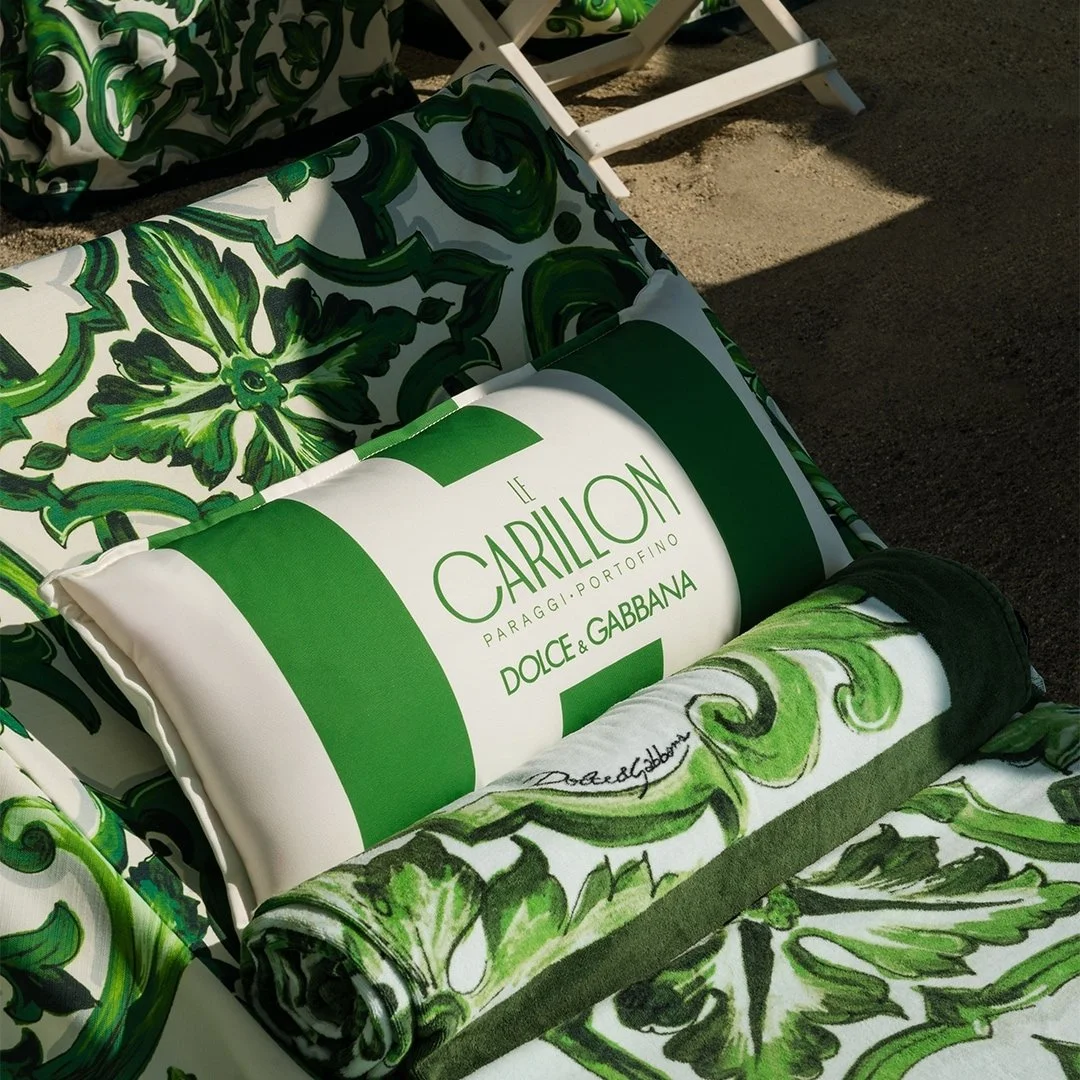
Le Carillon, Paraggi — Dolce & Gabbana Casa Resort, Verde Maiolica. Source: Dolce & Gabbana.
For boutique hotels, restaurants, private clubs and residential projects, the useful inheritance is coherence. The scale may be smaller, the gesture more personal, but the principle is just as valuable: a place becomes more memorable when its details appear to belong to one idea.
How can pattern help a place become more itself?
From motif to memory
A late decorative choice can complete a room. A deeper approach changes how the space is read.
Pattern can influence proportion, rhythm, scale and mood. It can soften a wall, frame a view, create intimacy around a dining table or give a corridor a sense of intention. In a hotel or restaurant, it can also become part of the guest’s memory: the wallcovering behind a banquette, the painted border above a doorway, the repeated note on a terrace, the almost-tonal treatment in a bedroom.
This does not need to be dramatic. Some of the most compelling schemes are built from close-valued colour, softened ornament and surface detail held near the wall. Pattern can be strong without being loud. It can give depth and character while leaving the room space to breathe.
Beyond the branded moment
The large fashion-house projects are useful because they make a wider design instinct easy to see. They show how a motif can travel beyond product and become part of an environment. Yet the more interesting application lies in spaces that are not seasonal campaigns: a small hotel, a restaurant, a villa, a private dining room, a club, a house with its own rhythm and history.
In those settings, pattern becomes less about instant recognition and more about authorship. A wall panel can relate to a border. A ceiling line can answer a textile. A colour in one room can return elsewhere in a softer register. The result is not a matched scheme, but a sense of connection.
This is where bespoke wallpaper and custom wallcoverings become more interesting than a ready-made repeat. They can be designed around proportion, wall divisions, ceiling height, furniture, natural light and the atmosphere of the space. A decorative idea can become architectural without becoming rigid, personal without becoming theatrical.
A room-led approach at Patterned Design
At Patterned Design, this way of thinking can move in many directions, according to the architecture, client and mood of a project. The studio’s work begins with original artwork, yet the wall is never treated as a blank surface waiting to be filled. Scale, movement, print, sampling and installation all affect how a design will live in a real room.
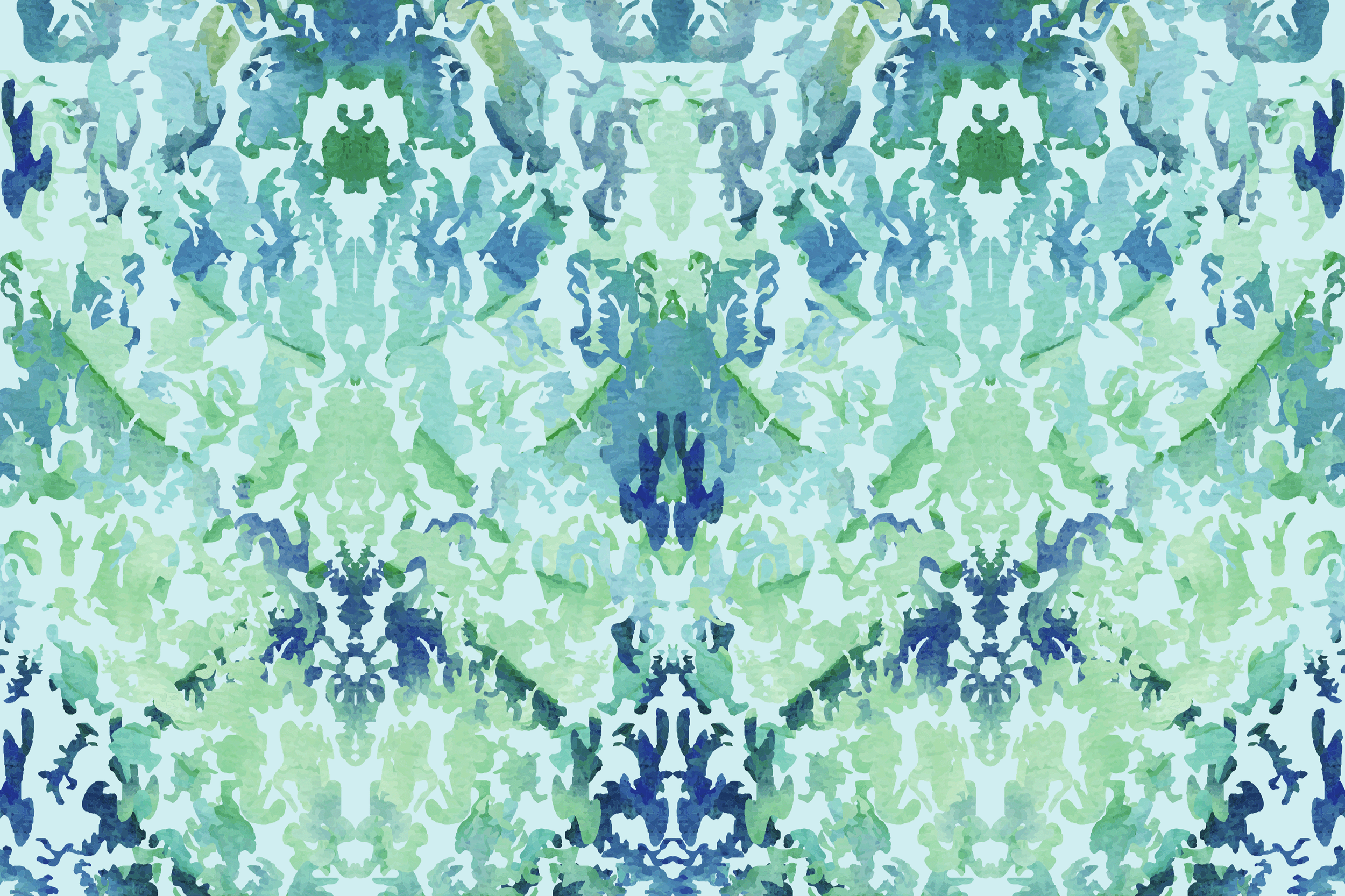
Sea Garden in Aqua Green, from the Gallery of Dreams Collection by Patterned Design.
Within the studio, one developing direction explores how fresco structure, garden detail, painted grounds and softened colour might become a flexible decorative language: panels, borders, stripes, lower wall sections, ceiling details and more restrained surfaces for boutique hotels, restaurants and private homes.
Before motif comes architecture. The rhythm of a room, the height of a wall, the pause above a doorway, the weight of a lower panel, the way light crosses a surface — these decisions shape the pattern as much as the drawing itself. Flowers, leaves and ornamental details bring life, but the room gives them discipline.
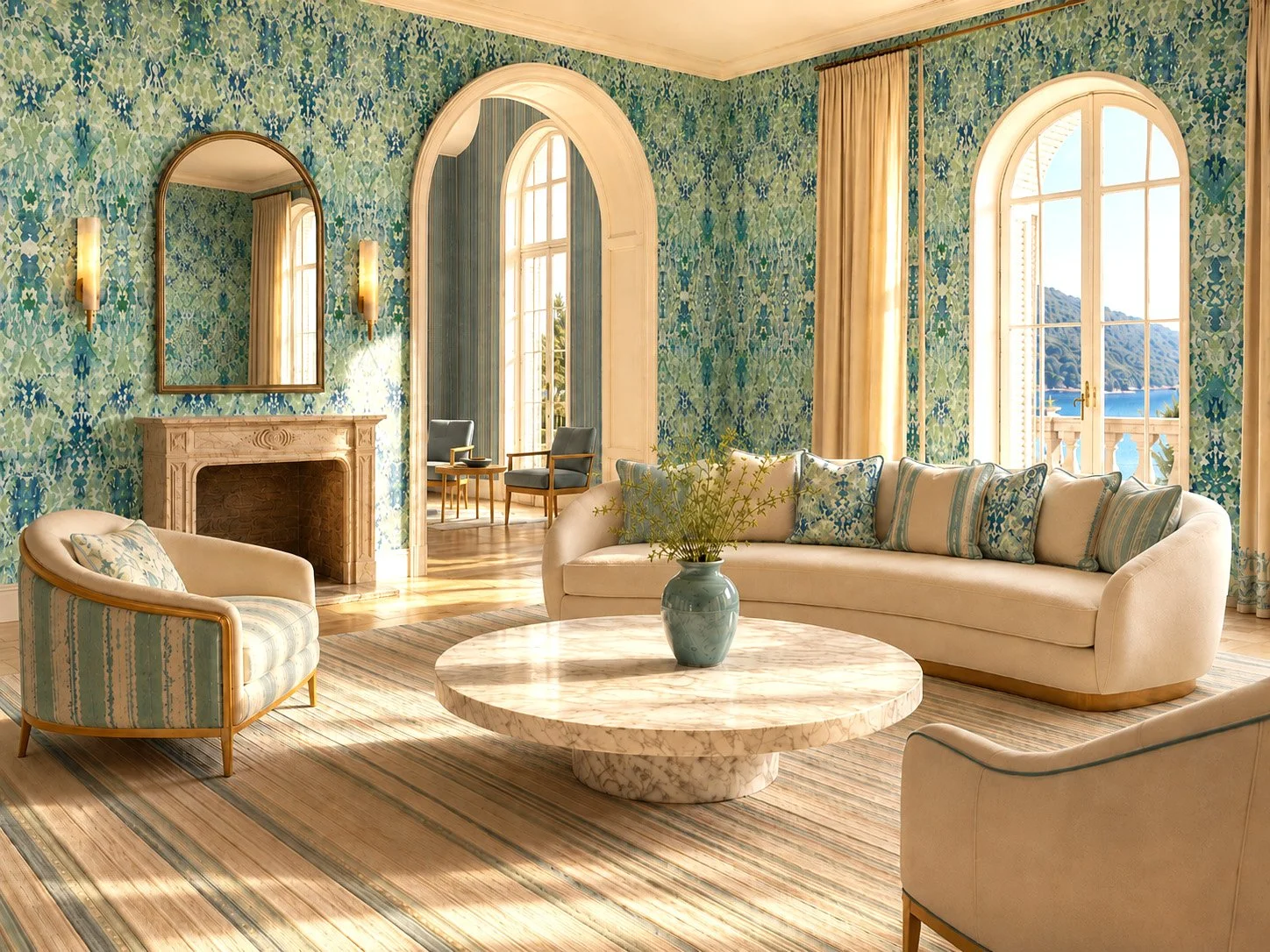
Sea Garden in Aqua Green, shown as a bespoke wallcovering concept for a private interior in Rapallo, Liguria.
One language, many forms
A successful wallcovering language should be able to change scale without losing its character.
One space may call for a large decorative panel. Another may ask for a frieze, stripe, repeat, underbody section, ceiling framework or monochrome treatment. Hospitality interiors often need that range. Entrances, dining rooms, suites, corridors and private corners each require a different weight, while still belonging to a related family.
The same thinking can serve a house. Every room does not need to match, but a related palette, a recurring line, a garden detail or a border language can give continuity without sameness.
This is the difference between applying a pattern and developing a decorative language.
The value of the hand-drawn
Hand-drawn wallcoverings bring judgement to the process. They allow for adjustment, irregularity, softness and scale. A line can be refined. A motif can be opened up. A repeat can be made less mechanical. A panel can answer an awkward elevation rather than imposing a standard design upon it.
For bespoke wallpaper and custom wallcoverings, the practical stages matter as much as the first idea: original artwork, colour development, repeat engineering, sampling, print preparation and installation planning. These decisions are not separate from the atmosphere of the finished room. They are part of it.
In hospitality interiors, this matters especially. An artwork may be beautiful in isolation, but it has to live across real walls, corners, light conditions, furniture heights and guest movement. It must read from across the room, reward attention close up and hold its place without exhausting the eye.
The best wallcoverings understand both image and architecture.
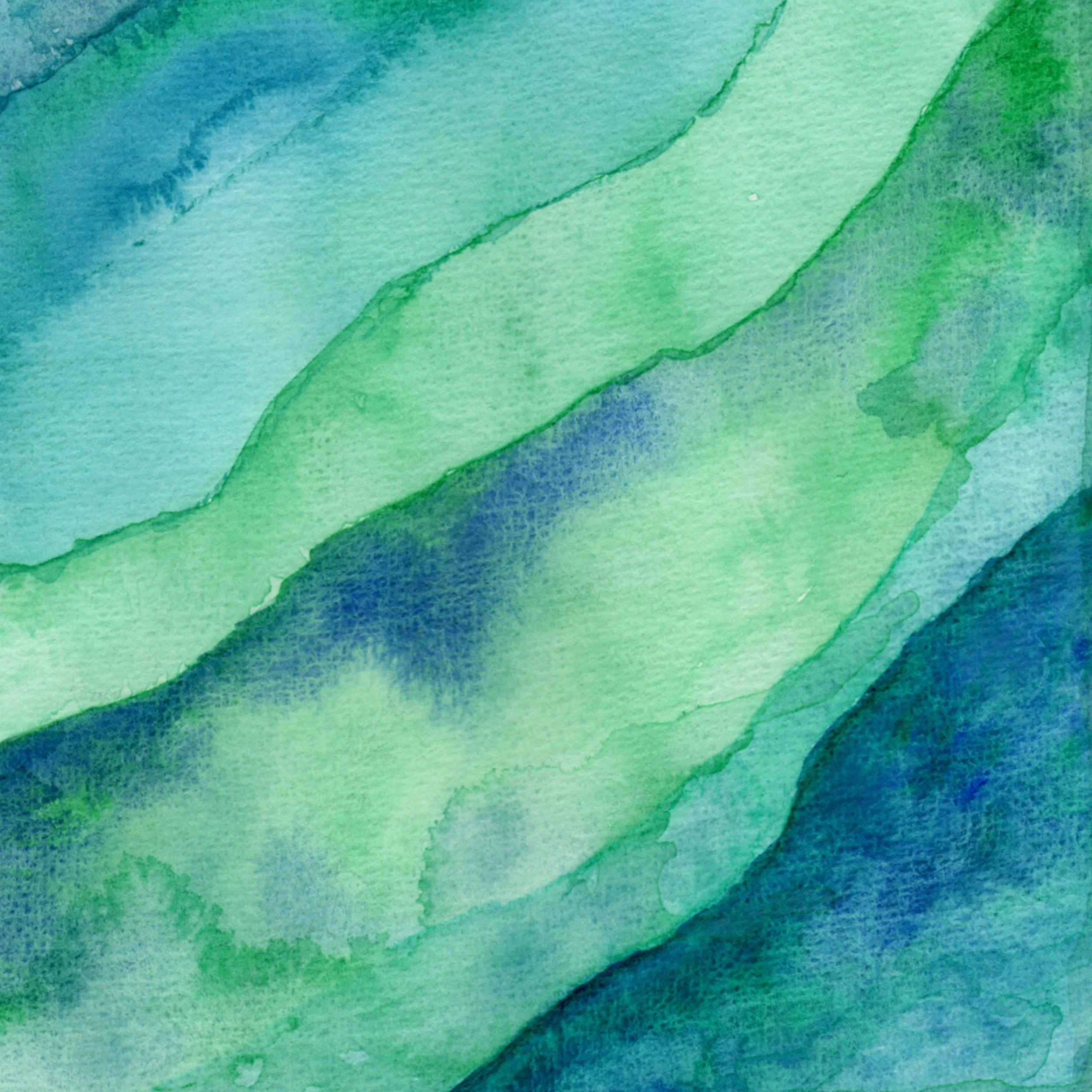
Watercolour texture study used in the development of Sea Garden, a hand-drawn pattern from the Gallery of Dreams collection.
Pattern as place
The renewed interest in pattern-led hospitality reflects a wider desire for rooms with identity. After years of neutral spaces that could belong almost anywhere, designers and clients are again drawn to interiors rooted in a location, a story, a mood, a house, a garden, a restaurant, a view or a way of living.
Pattern can create that specificity. It gives a space recognisable rhythm. It connects surfaces and details. It allows a hotel suite, dining room or private salon to feel authored rather than assembled.
When pattern becomes place, it is no longer only something seen. It enters the way a room is remembered.
For Patterned Design, this is the territory that feels most alive: bespoke wallpaper and custom wallcoverings developed as part of a room’s visual language. A motif can be drawn, scaled, coloured and adapted until it belongs to the architecture, the atmosphere and the people who will use the space.
That is where a wallcovering begins to do more than cover a wall.
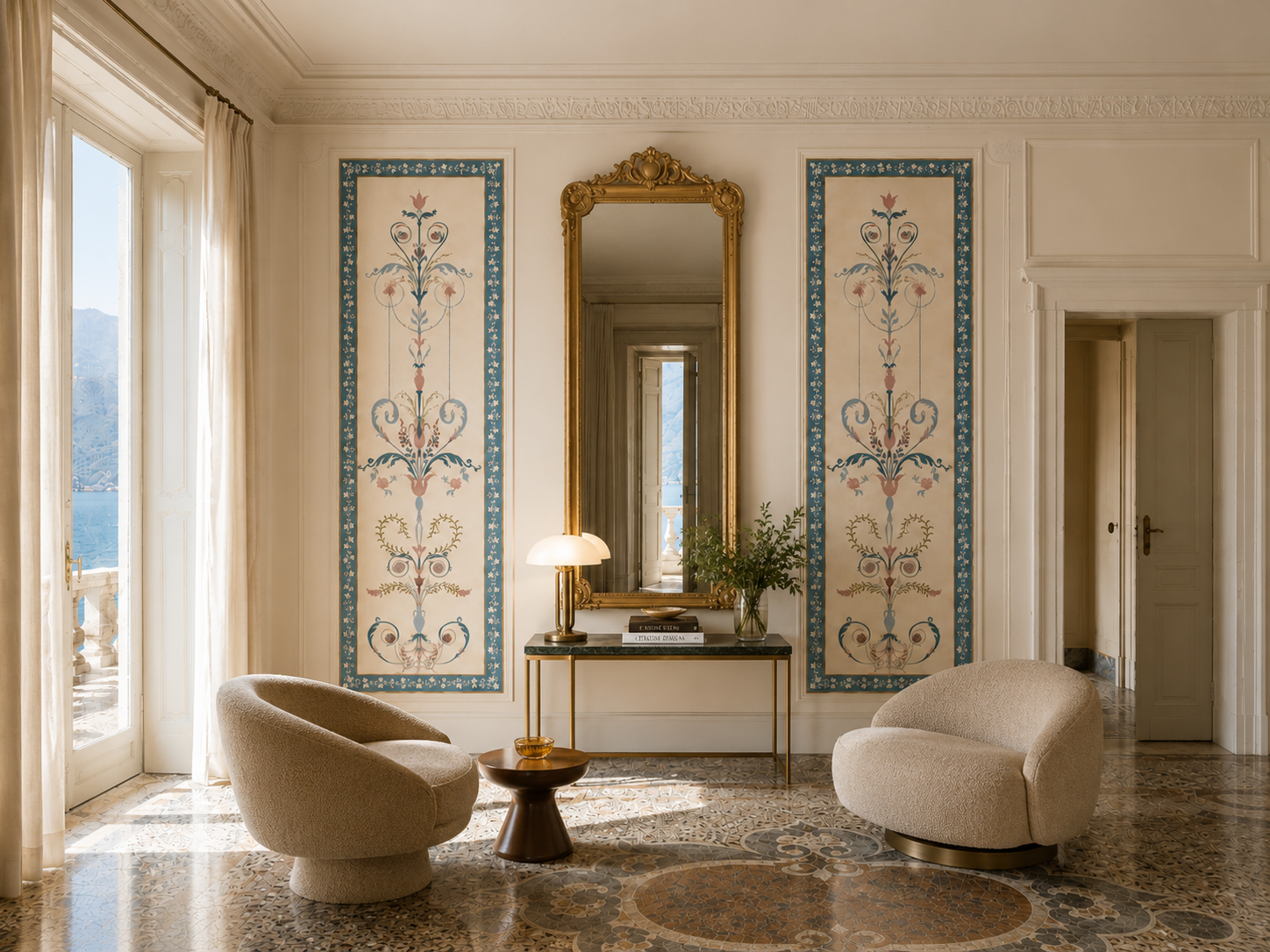
Bespoke Wallpaper Begins with the Room
How a hand-drawn bespoke wallcovering begins with the room: architecture, light, scale and original artwork, shown through classically inspired ornamental panels for a refined interior.
A bespoke wallcovering begins long before a motif is drawn. It begins with the room.
Before any artwork is developed, there is the architecture to understand: the height of the ceiling, the rhythm of windows, the position of doors, the depth of a cornice, the fall of natural light across plaster, timber or stone. Then come the more personal details: a favourite fabric, an inherited chair, a garden beyond the window, a colour already belonging to the house, or a particular atmosphere the room is meant to hold.
This is where a commissioned design differs from choosing a ready-made roll. It is not simply selected and applied. It is developed in response to proportion, light, existing materials, decorative history and the way people move through a space. The result may be decorative, but it should never feel detached from the interior.
Patterned Design creates hand-drawn bespoke wallpaper and custom wallcoverings for refined residential and hospitality interiors. Each project is developed from original artwork through scale, colour, repeat, sampling, print preparation and installation planning, so the finished piece belongs naturally to its setting.
Beyond the Ready-Made Roll
Ready-made wallpaper has its place. When the colour, scale and pattern language are already right, it can resolve a room beautifully. A bespoke commission enters at a different point: when the interior calls for a more exact answer.
A private house may need a design drawn to sit with existing upholstery, antique furniture, panelling or curtain fabric. A dining room may require enough depth to hold evening light. A bedroom may call for a softer rhythm around a headboard, lamps and windows. A stair hall may need a repeat that travels gracefully across turns, landings and changing viewpoints.
For work of this kind, the right studio needs to understand both artwork and interiors. Drawing matters, but so do scale, repeat, colour, paper, print, sampling and the practical journey towards installation. A beautiful drawing is only the beginning. Once translated onto the wall, it must have the right proportion, the right visual rhythm and the right relationship with the architecture around it.
The value of bespoke work is not only originality. It is suitability. A custom design can be made more generous, more restrained, warmer, cooler, larger, smaller, more open or more detailed according to the room. It can support an existing scheme rather than compete with it.
How a Commission Usually Begins
A good commission starts with context. Photographs, approximate measurements, wall elevations where available, existing fabrics, paint colours, architectural details and furniture references all help the studio understand what the room needs.
Sometimes the brief is very clear: a hand-drawn design for a particular bedroom, dining room, hallway or powder room. Sometimes it begins more loosely, with a feeling, a period reference, a garden, a textile, or a colour palette that belongs to the house. In other cases, an existing collection design may already be close to the right direction and simply needs to be adapted in scale or colour.
This is why the first stage is not only about choosing a motif. It is about deciding the right route. A project may call for completely original artwork, a revised colourway, a change of repeat size, a coordinated scheme across several rooms, or print preparation for an interior designer’s wider project.
For private clients, the process can help turn a room into something more personal without making it over-decorated. For interior designers, decorators and architects, it gives more control over proportion, palette and how the design sits within a wider scheme.
Drawing for Architecture, Light and Scale
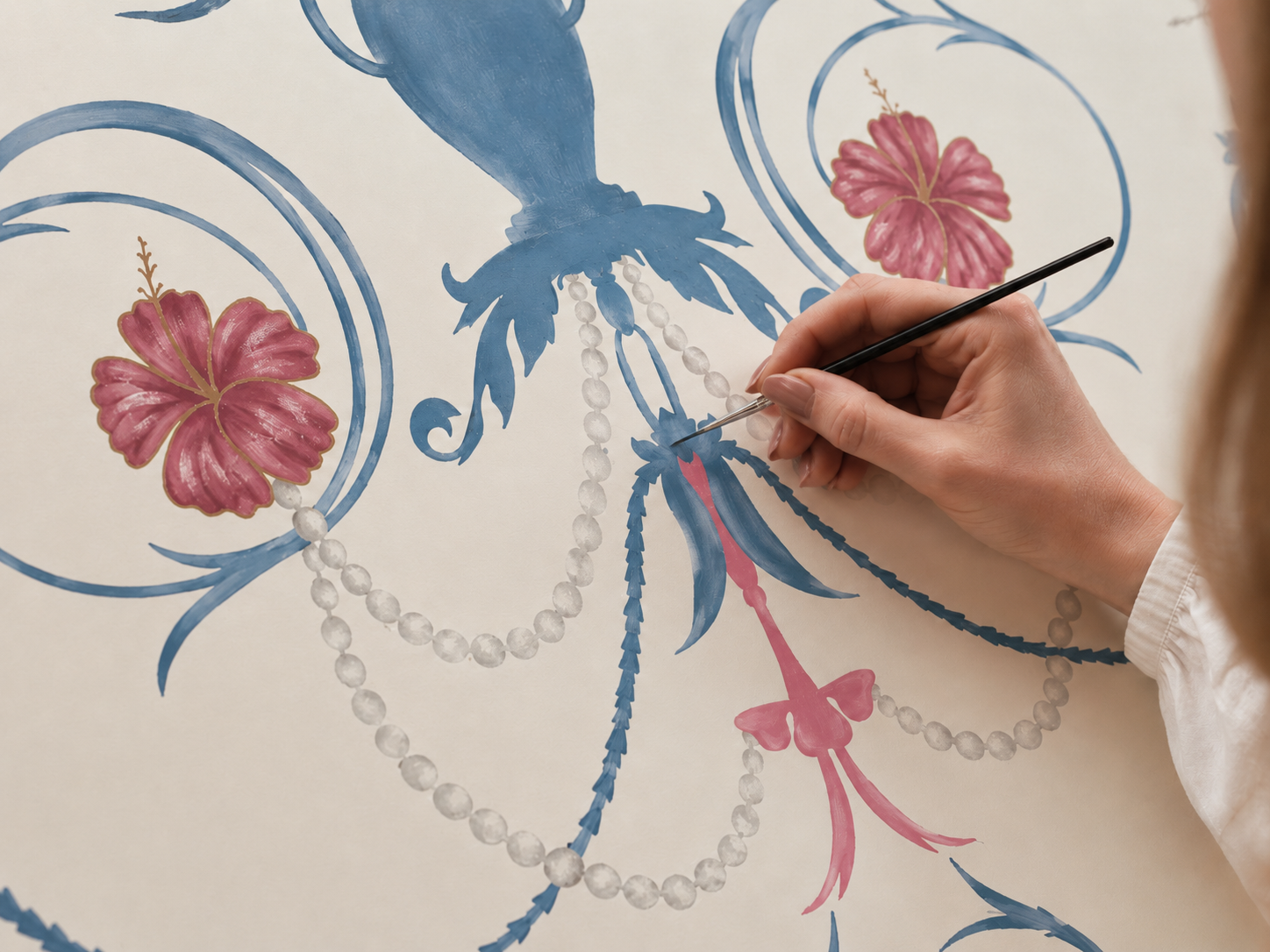
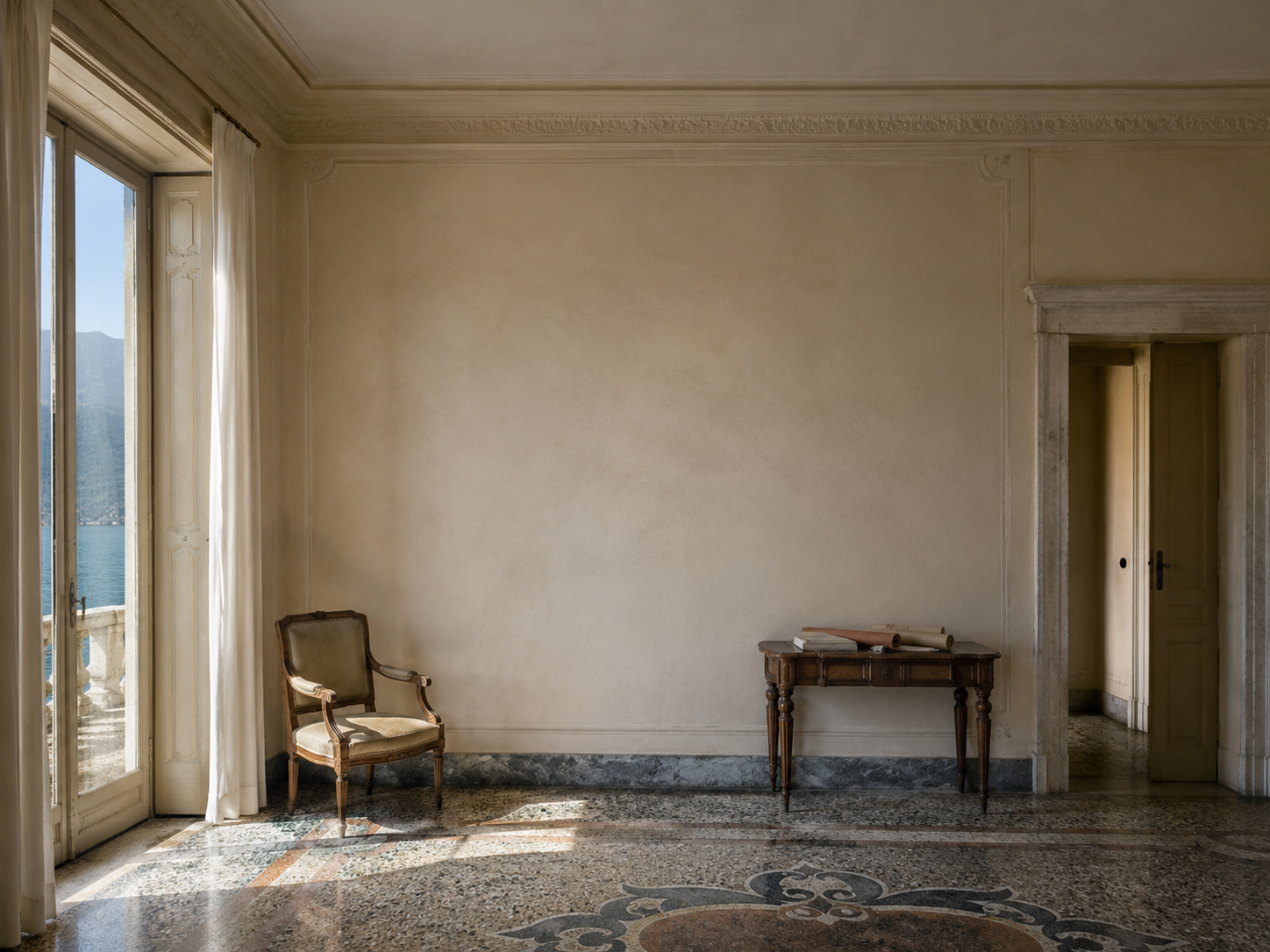
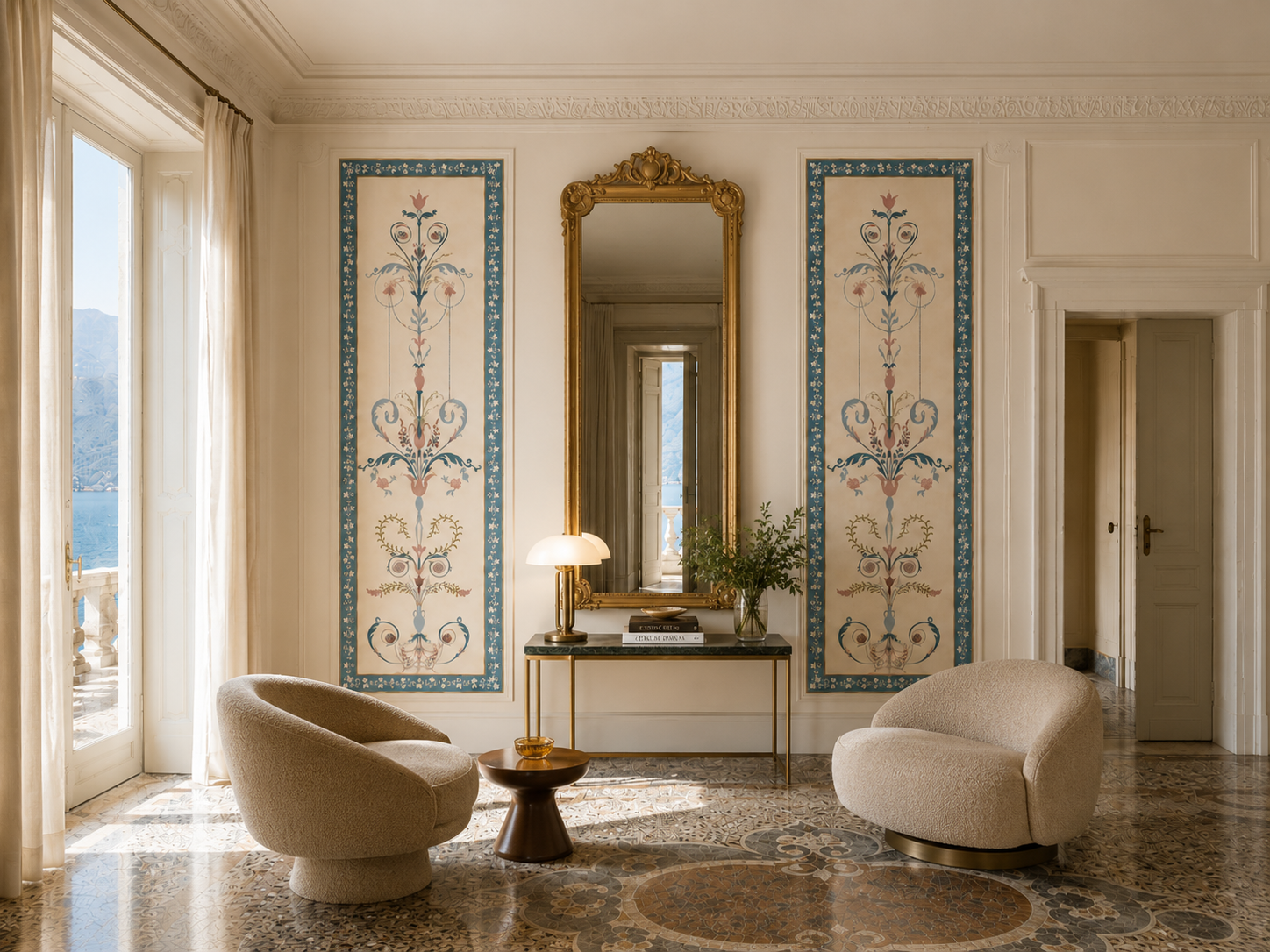
Hand-drawn work carries the movement of the hand. Its character comes from decisions that are almost invisible at first: the pressure of a drawn stem, the turn of a leaf, the discipline of an ornamental curve, or the restraint of the line itself. It may echo embroidery, old textiles, painted decoration, garden planting, historic ornament or something more particular to the client and the house.
But in a bespoke wallcovering, drawing has to become architecture’s companion. The artwork must be developed into a repeat that can wrap a room and make sense across real elevations. Motifs need space around them. Corners need thought. Doorways, fireplaces, cupboards, mirrors and thresholds all affect how a design is read.
Scale is one of the most important decisions. A small pattern can become restless across a large wall. A generous repeat can feel too grand in a narrow corridor or small bedroom. The right proportion depends on ceiling height, wall width, furniture placement, viewing distance and the character of the interior.
This is where bespoke design becomes especially useful. The repeat can be adjusted before printing. Motifs can be given more air. A border, panel, colourway or layout can be reconsidered. The design is not forced onto the room; the room helps shape the final piece.
Colour, Surface and Sampling
Colour is never independent in an interior. It changes with daylight, shadow, lamps, paint, timber, stone, upholstery and surrounding architecture. A shade that appears balanced on screen can become too cool, too sharp or too flat once printed on a particular surface.
A printed sample is therefore not a formality. It is the first real conversation between the design and the room. It allows the client and designer to judge colour, contrast, paper surface and scale in the actual light of the space. A ground may need more warmth. A line may need softening. A motif may need clearer definition.
Print preparation is also part of the design process, even when it is less visible. Artwork must be prepared at the correct scale and resolution. Repeats must be checked. Colour needs careful handling for production. The choice of substrate matters too, especially where the project involves bathrooms, stair halls, corridors, hotel bedrooms or other areas with more practical demands.
Patterned Design can support this journey from original artwork to print-ready design, working with specialist printers and providing installation guidance or coordination where needed. Installation itself should be carried out by a suitable professional installer, with clear information supplied about the repeat, roll layout, surface and site conditions.
For Private Homes
In a private home, a commissioned wallcovering can create a closer relationship between the interior and the people who live there. The design may refer to a garden, a place, a textile, a period detail or a less obvious sense of mood. It can be personal without becoming literal.
A bedroom may need softness and rhythm rather than drama. A dining room may need enough presence to hold candlelight and evening shadow. A hallway or staircase may require movement and continuity. A bathroom or powder room can often take a more concentrated decorative idea, but still needs proper thought around surface, ventilation and installation.
Compared with a ready-made design, the advantage is fit: the colour can be developed around the scheme, the scale can respond to the architecture, and the pattern can be composed with the room’s purpose in mind. At its best, the result feels as though it belongs to the house, even when newly made.
For Boutique Hospitality Interiors
For boutique hotels, restaurants and other hospitality settings, custom wallcoverings have a slightly different role. They need to create atmosphere, but they also need to work across repeated rooms, public spaces, professional installation schedules and daily use.
Interior designers commissioning this kind of work usually need to consider more than the first impression. Repeat consistency, substrate, durability, light, cleaning requirements, installation planning and any relevant contract specifications can all affect the final result. A hotel bedroom, corridor, reception room and dining space may need related but distinct treatments.
A bespoke or adapted design can give a hospitality interior a more particular identity without relying on a widely recognisable pattern from a ready-made collection. It can respond to the building, the location and the wider interior scheme while still being properly prepared for production.
The strongest hospitality projects tend to be collaborative. The interior designer brings the spatial vision and the relationship between materials. The wallpaper studio brings drawing, pattern, colour and production knowledge. The printer and installer bring the technical expertise needed to turn artwork into a finished interior element.
London, the Italian Riviera and a Sense of Place
Patterned Design works with private clients, interior designers, decorators, architects and boutique hospitality projects, with a natural connection to London and the Italian Riviera.
These two settings offer different kinds of interiors. London brings layered architectural histories: townhouses, apartments, period renovations, Georgian proportions, inherited rooms and contemporary interventions. The Riviera suggests another kind of atmosphere: light, terraces, gardens, sea air, older buildings adapted for modern life.
A bespoke design does not need to describe its location literally. A house near the sea does not need shells or waves. A Georgian room does not need overt historical ornament. The connection can be subtler: a colour temperature, a botanical rhythm, a sense of proportion, a reference to old textiles, or the way a pattern holds light across a wall.
That is often where custom work is most valuable. It allows the design to be specific without becoming obvious.
From Drawing to Interior
Commissioning hand-drawn bespoke wallpaper does not need to feel complicated. The most useful beginning is a conversation around the room: photographs, approximate dimensions, existing design references, preferred colours or materials, and a sense of what the wallcovering should bring to the space.
From there, the right route can be defined. A project may call for original artwork, an adapted collection design, a custom colourway, a change of scale, sampling, print preparation, or broader support through installation planning.
The aim is always to create a design that sits naturally within the interior. Not a stock product placed onto a wall, but a wallcovering developed with the room in mind.
Questions Often Asked Before Commissioning
What kind of studio should I look for?
For a refined interior, look for a studio that understands both artwork and rooms: drawing, repeat, scale, colour, print preparation and how the finished wallcovering will be installed. Bespoke wallpaper is not only a printed image; it has to work with architecture, light, furniture, fabric and proportion.
How does a bespoke wallpaper commission usually begin?
It usually begins with the room. Photographs, approximate dimensions, existing fabrics, paint colours, architectural details and a sense of atmosphere are often enough to start the conversation. From there, the right route can be defined: original artwork, an adapted collection design, a custom colourway, sampling or print preparation.
Why choose bespoke wallpaper rather than a ready-made design?
Ready-made wallpaper can be beautiful when it already suits the space. Bespoke work is useful when the room needs a more exact response: a particular scale, colour, rhythm, motif or relationship with the interior. The value is not only originality, but fit.
What should interior designers consider for hospitality projects?
For boutique hotels, restaurants and other hospitality interiors, the wallcovering needs to create atmosphere while also meeting practical demands. Scale, repeat consistency, substrate, durability, light, installation planning and production schedules all need to be considered early.
Does Patterned Design work with projects in London and the Italian Riviera?
Patterned Design works with private clients, interior designers, decorators, architects and boutique hospitality projects, with a natural connection to London and the Italian Riviera. Projects may begin with a private house, a hospitality interior, an adapted collection design or a fully bespoke hand-drawn wallcovering.
For private residential, interior design and boutique hospitality projects, Patterned Design welcomes enquiries for hand-drawn bespoke wallpaper and custom wallcoverings developed from original artwork to print-ready design.
The Light of Liguria
A reflection on painted facades, frescoes, and the changing light that gives Ligurian colour its depth and atmosphere.
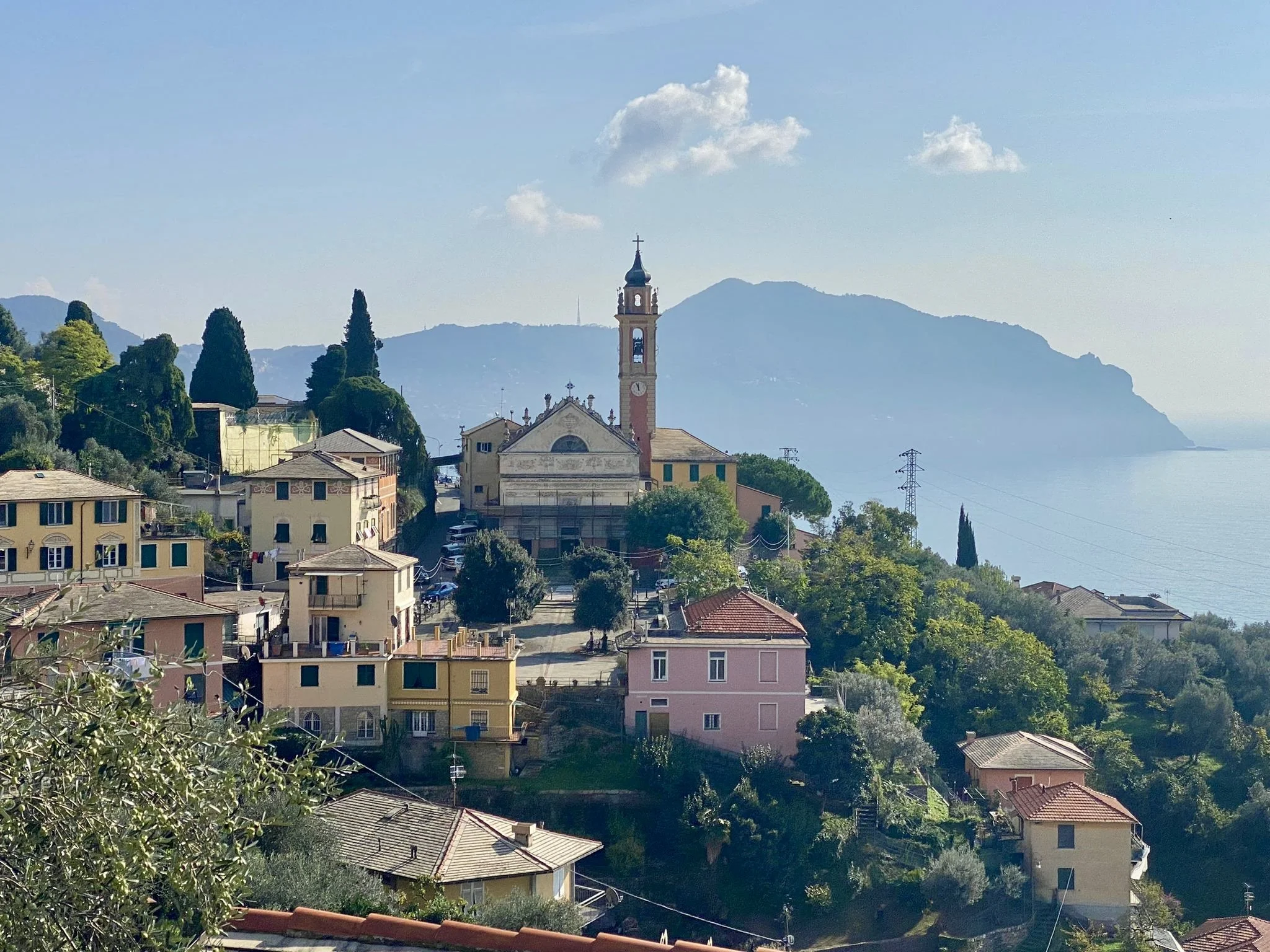
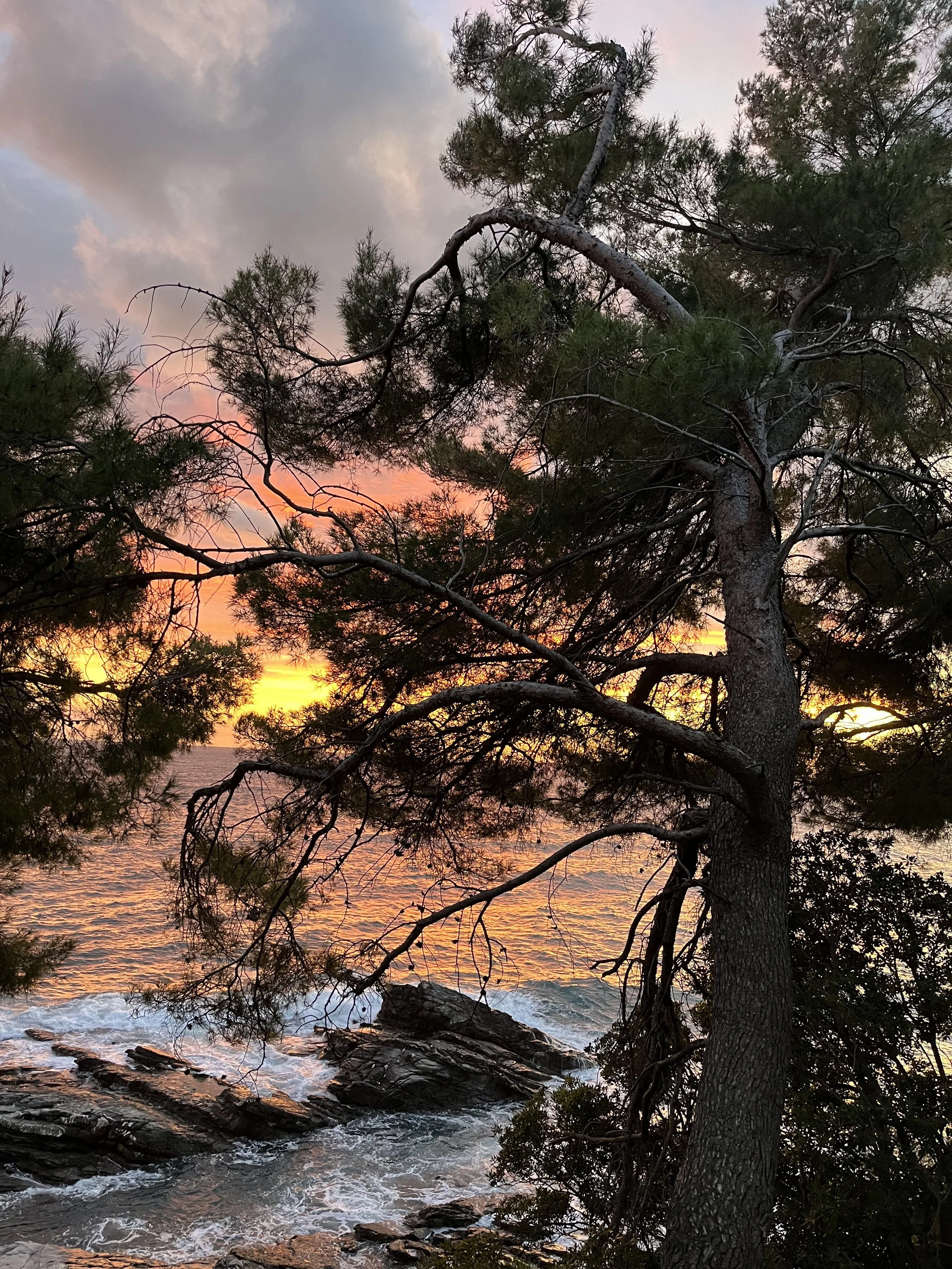
Poggio Favaro – San Bernardo,
Golfo Paradiso, Liguria
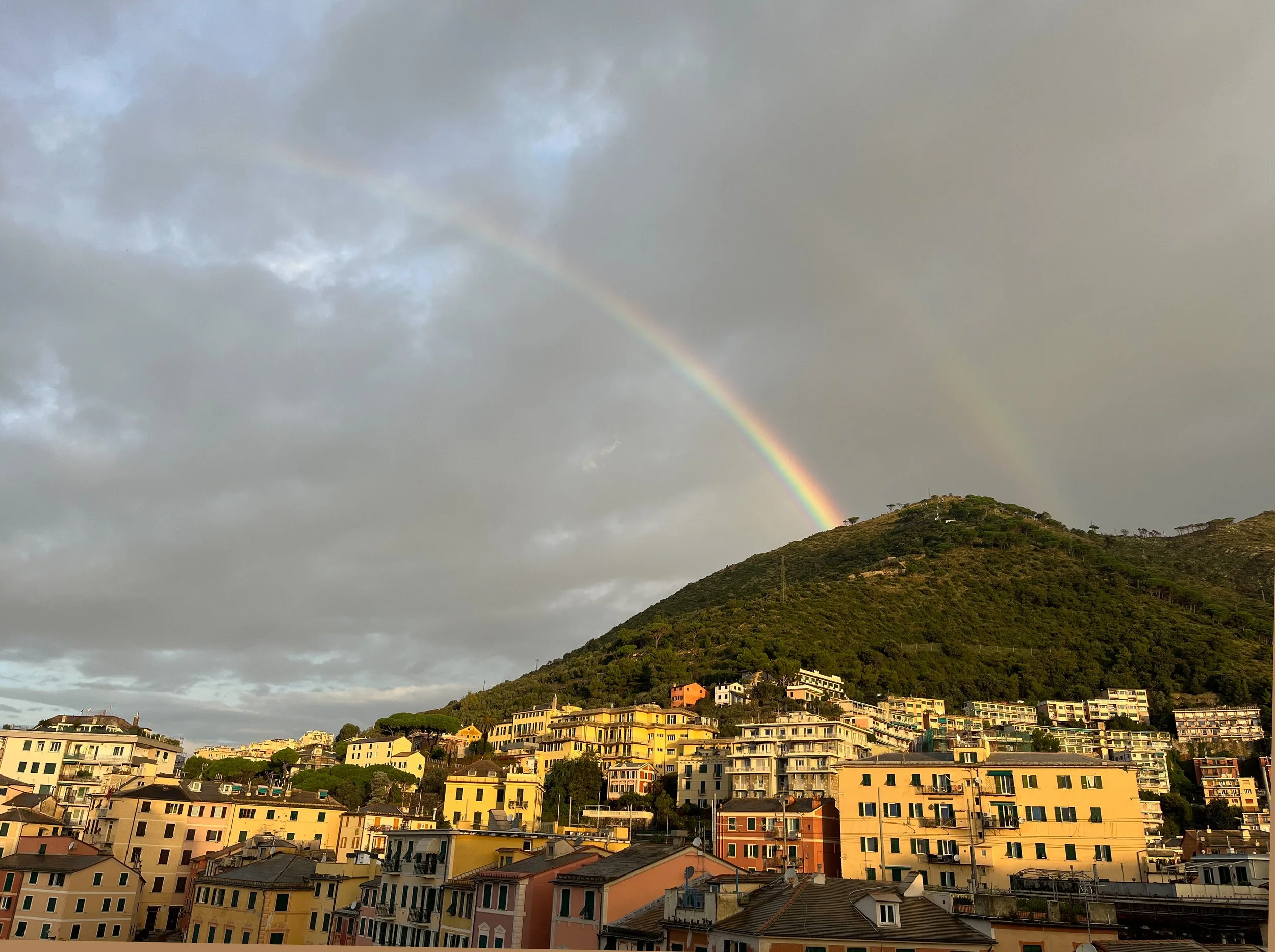
Liguria is often remembered for its painted houses and coastal villages, but what makes them so distinctive is not colour alone. It is the light. Sea haze, clear air after wind, and sudden brightness after rain constantly change the way facades, church walls, and old buildings are seen along the Ligurian coast.
That is what makes Ligurian colour so interesting. It is never static. The same building can look muted, luminous, soft, or sharply defined depending on the weather, the hour, and the atmosphere.
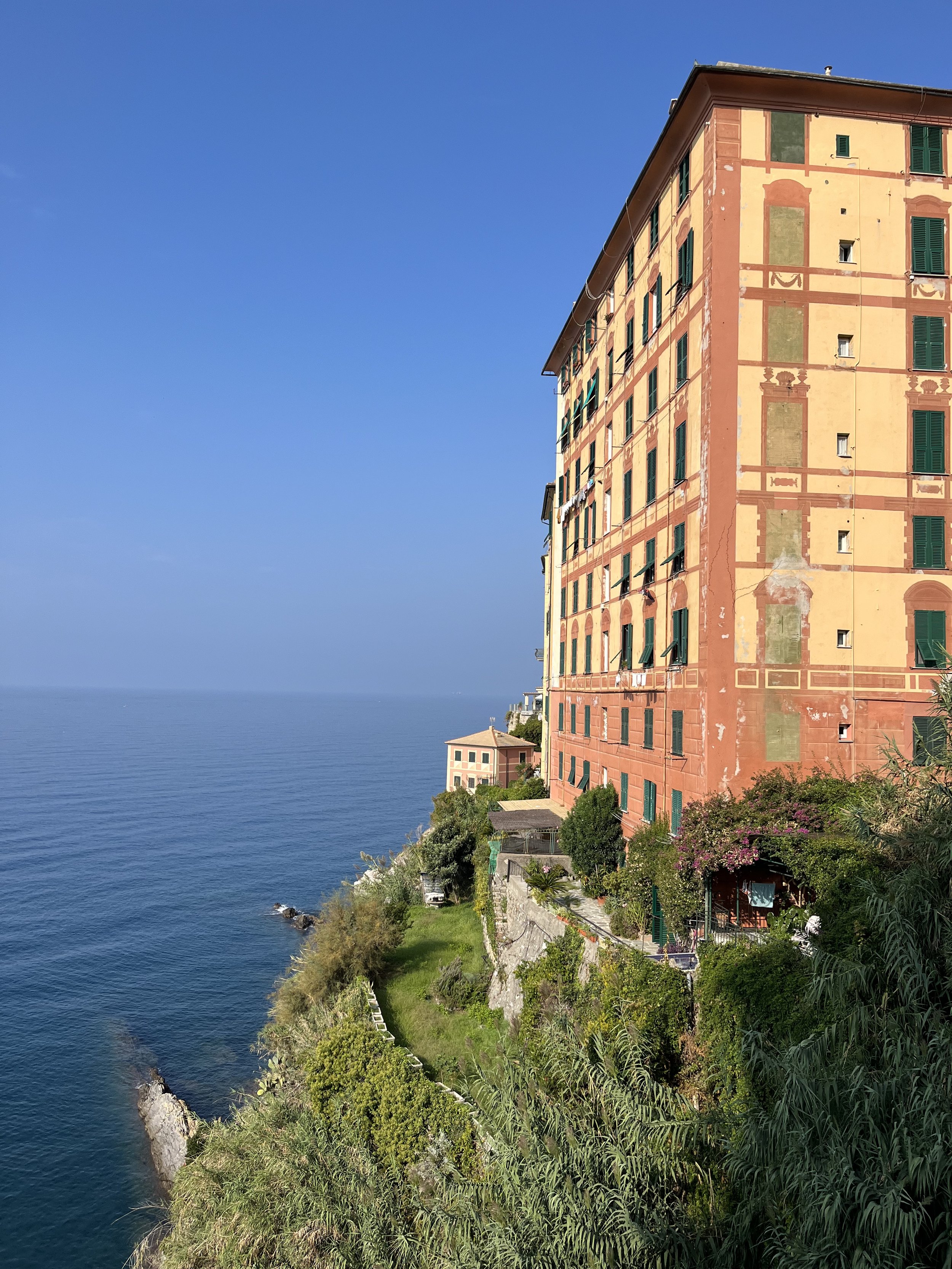
Painted facade above the sea,
Camogli, Liguria
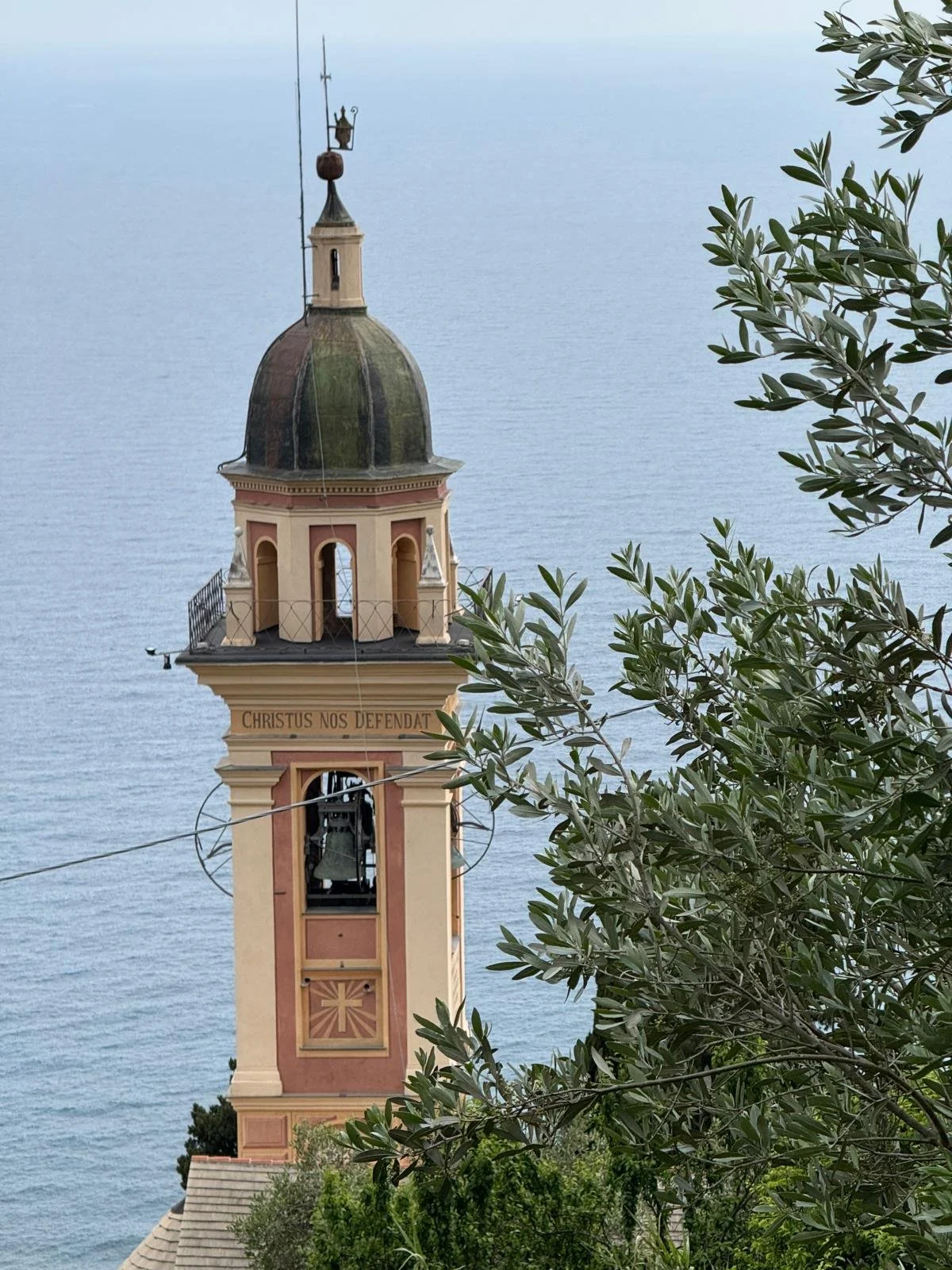
From afar, Ligurian light gives an entire village its atmosphere. Up close, it starts to do something more interesting: it reveals how these buildings are made to live with light. In Camogli, painted facades rise straight above the sea, exposed to open sky, salt air, and the changing brightness that comes off the water.
That is why their colours feel so alive. Ochres, terracottas, faded pinks, and soft stone tones do not sit heavily on the surface. They catch the light, soften in haze, and shift again as the day changes. Even before stepping inside, you can already sense the painted walls and decorative surfaces that run so deeply through Ligurian architecture.
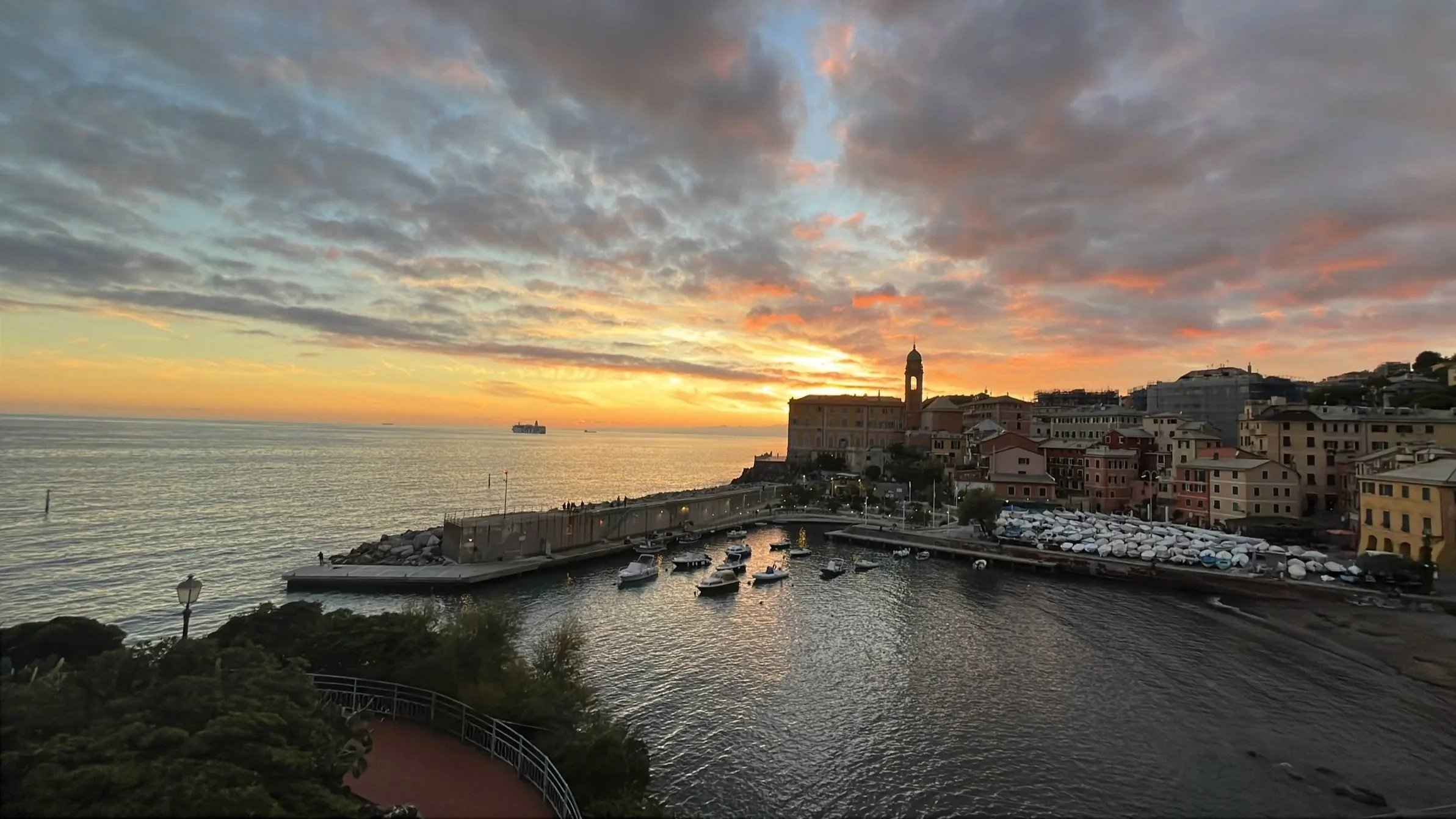
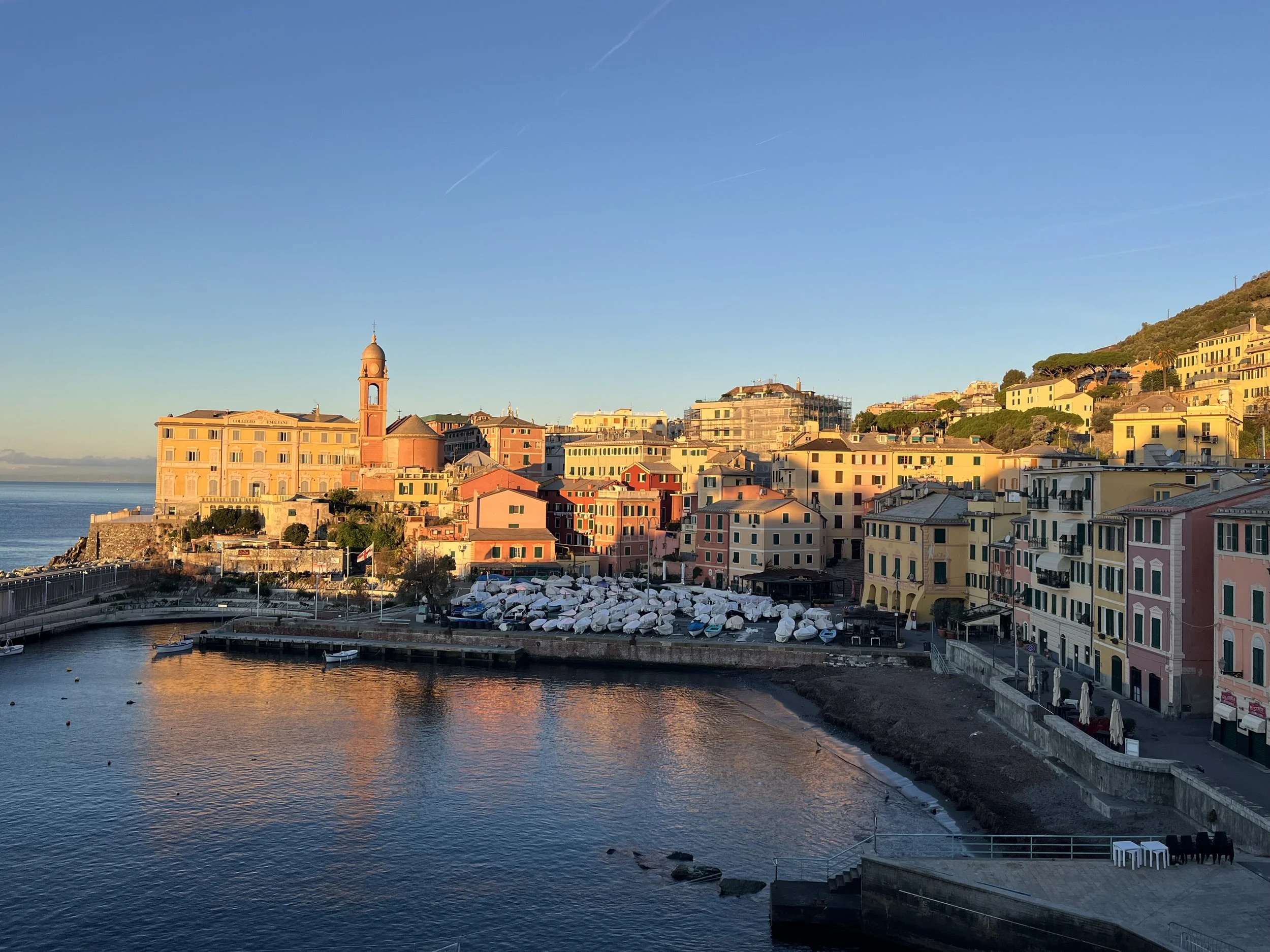
Evening light along the seafront, Genoa Nervi, Liguria
In places like Nervi, the colours of the buildings are only part of the story. What really gives them life is the way light keeps changing them. By evening, some surfaces catch warmth, others fall into shadow, and the whole row begins to separate into tone, reflection, and contrast.
That shifting quality matters. It is what gives painted walls their depth, and it is one of the reasons colour feels so alive in Liguria. Seen from the outside, these buildings already suggest a broader tradition of painted surface — one that continues beyond the facade itself.
Colour, in this way of thinking, shapes experience. It influences how a room holds light, how it settles at different times of day, how it affects mood without announcing itself. The spaces that remain with us are rarely defined by novelty. They feel grounded and layered.
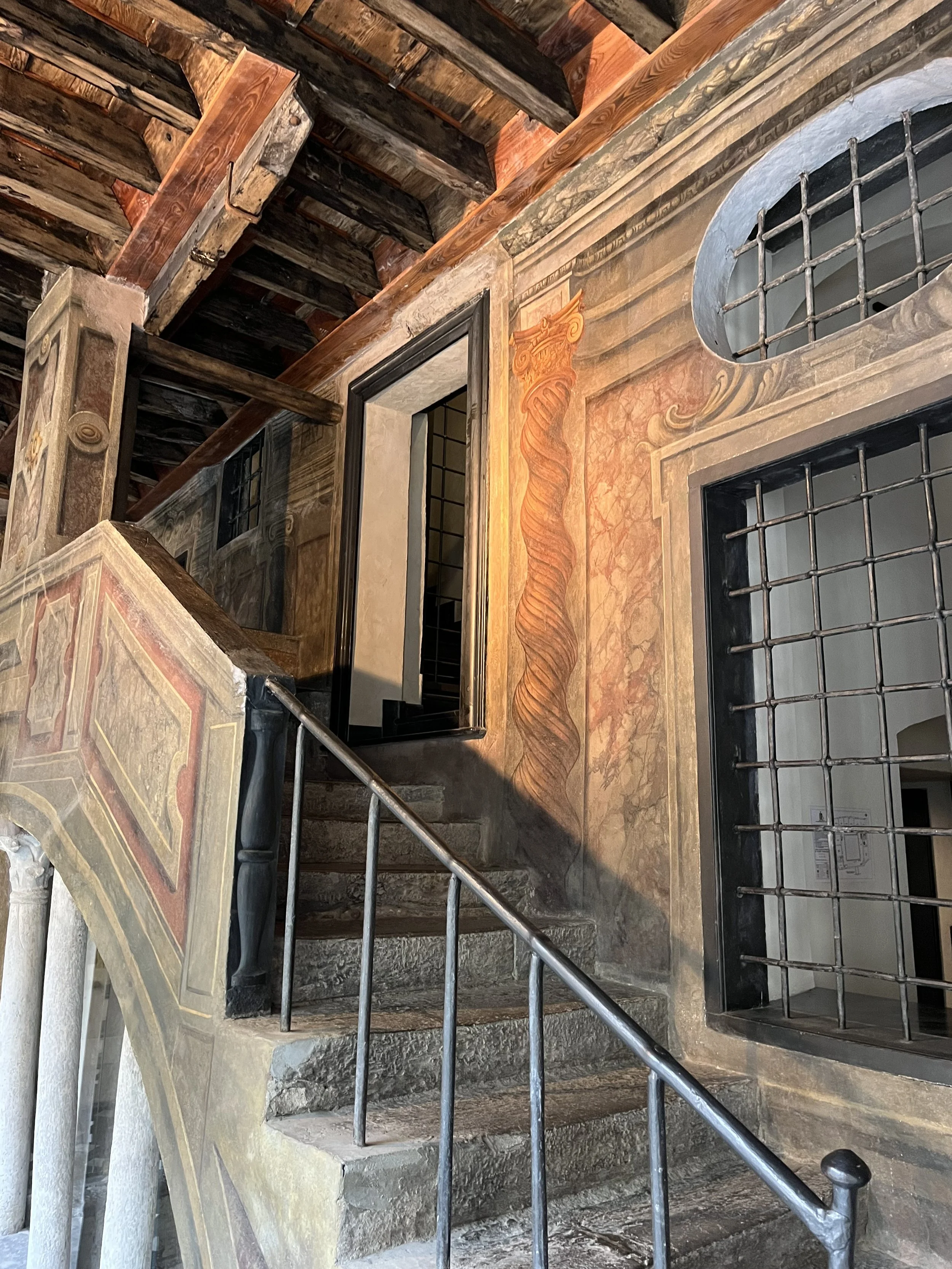
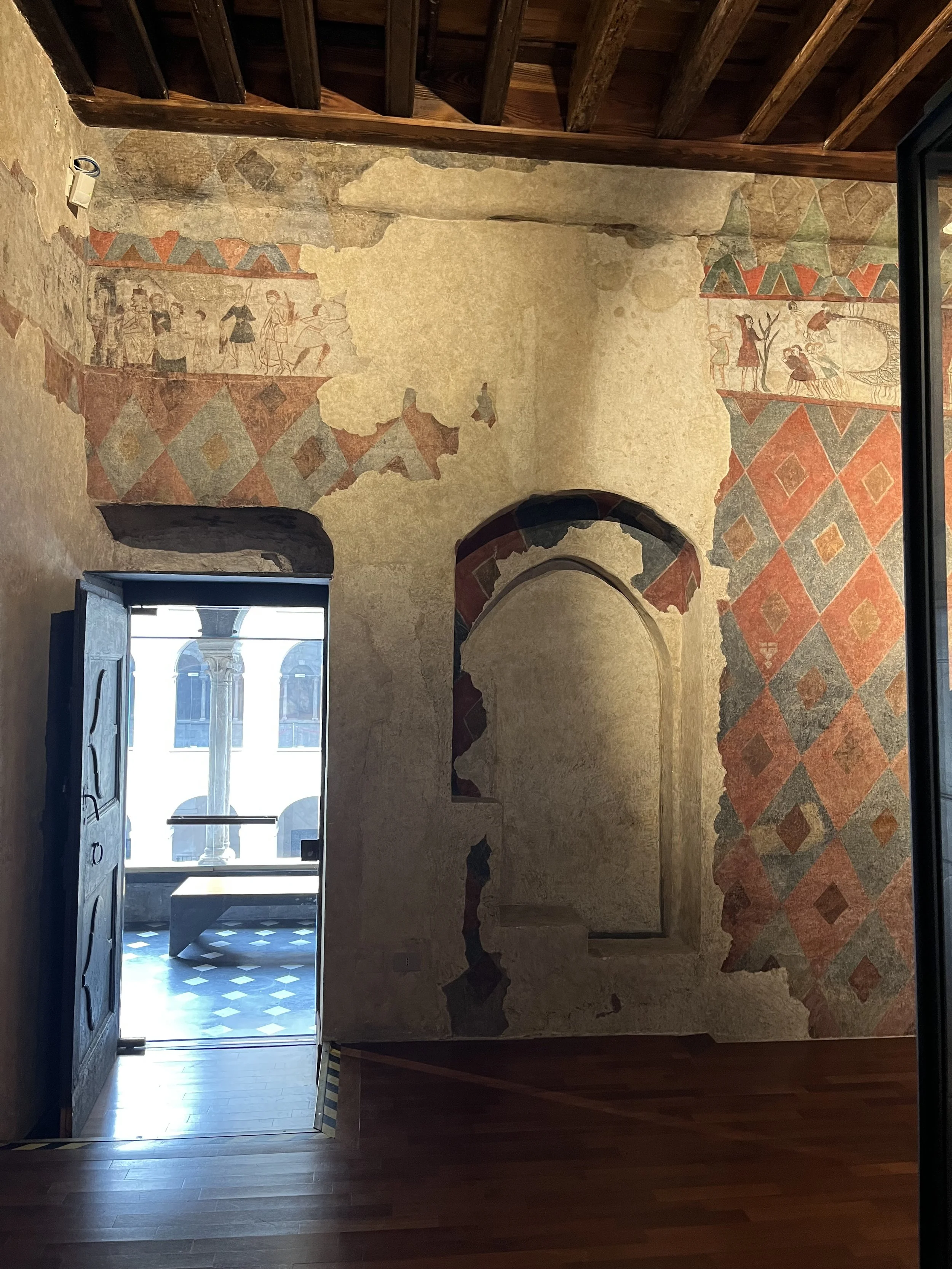
Painted courtyard walls, Museo Diocesano,
Genoa, Liguria
Away from the open seafront, the effect changes. Here the light is more contained and indirect, so the colours settle and the painted surface comes forward. Fresco, ornament, and wall decoration begin to matter more than shifting sky or reflection from the sea.
The palette remains recognisably Ligurian — warm, softened, and slightly muted — but the experience is more intimate. Instead of passing quickly across facades, the light lingers, and the eye begins to stay with the walls themselves.
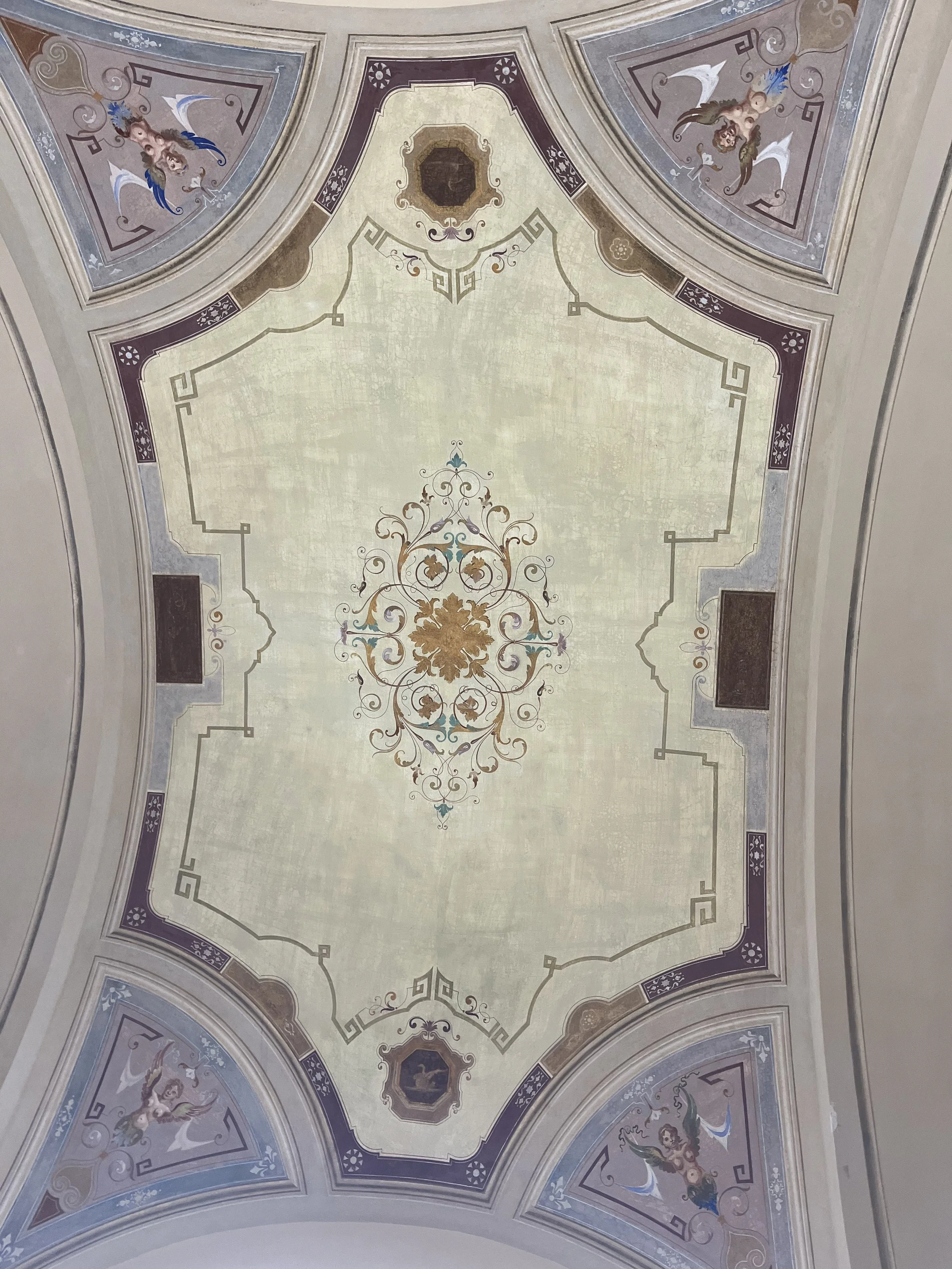
Ceiling frescoes in a Ligurian interior
Ceiling frescoes take the story further. Here, painting is no longer something seen on the outside of a building, but something built into the experience of the room itself. Colour becomes more ordered, more decorative, and more closely tied to pattern, ornament, and atmosphere.
That is why fresco matters so much in Liguria. In and around Genoa, painted ceilings and rooms were a central part of historic interiors, shaping not only how they looked but how they were felt. The colours may still relate to those seen outside, but indoors they become more composed and intentional.
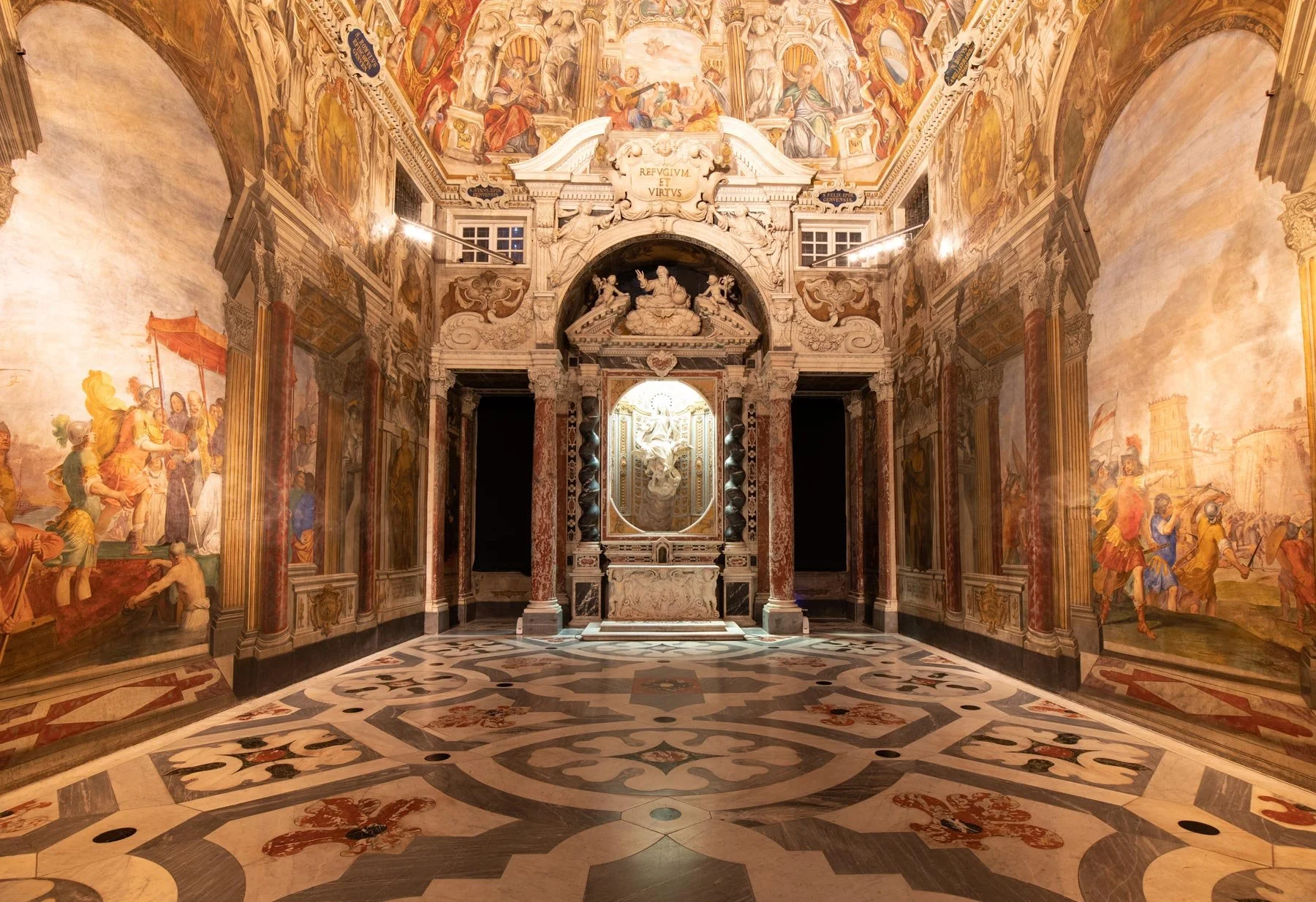
Frescoes by Giovanni Battista Carlone (1655)
The Doge's Chapel in the Ducal Palace (Genoa)
In Genoa, painted surface reaches its most ambitious form. What appears outside as colour on facades, and then inside as ornament on walls and ceilings, becomes here a complete interior language. Fresco is no longer a detail within the room; it helps define the room itself, extending architecture, directing attention, and turning colour into an immersive experience.
This is why Genoa’s palaces, chapels, and museums matter so much within the wider Ligurian picture. They preserve the region’s painted tradition at its most elaborate and accomplished. The scale is grander, the compositions more theatrical, but the same concerns remain: surface, tone, atmosphere, and the power of colour to shape how a place is felt.
From village facades to courtyard walls and painted ceilings, the same thread runs through it all: colour here is always being reshaped by the way it meets the light. Perhaps that is what stays with me most in Liguria: not colour on its own, but colour made visible, altered, and brought fully to life by light.
The Memory of Colour: Traditional Japanese Colours in Interiors and Textiles
A reflection on traditional Japanese colours in interiors and textiles, and on the quiet way colour deepens through surface, time, and memory
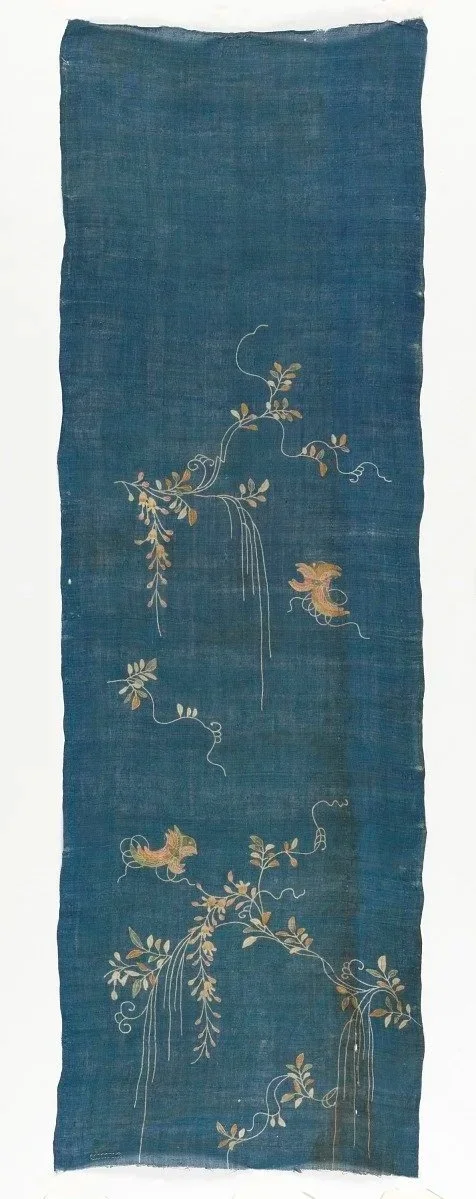
Kimono fragment
late 18th century, Kyoto
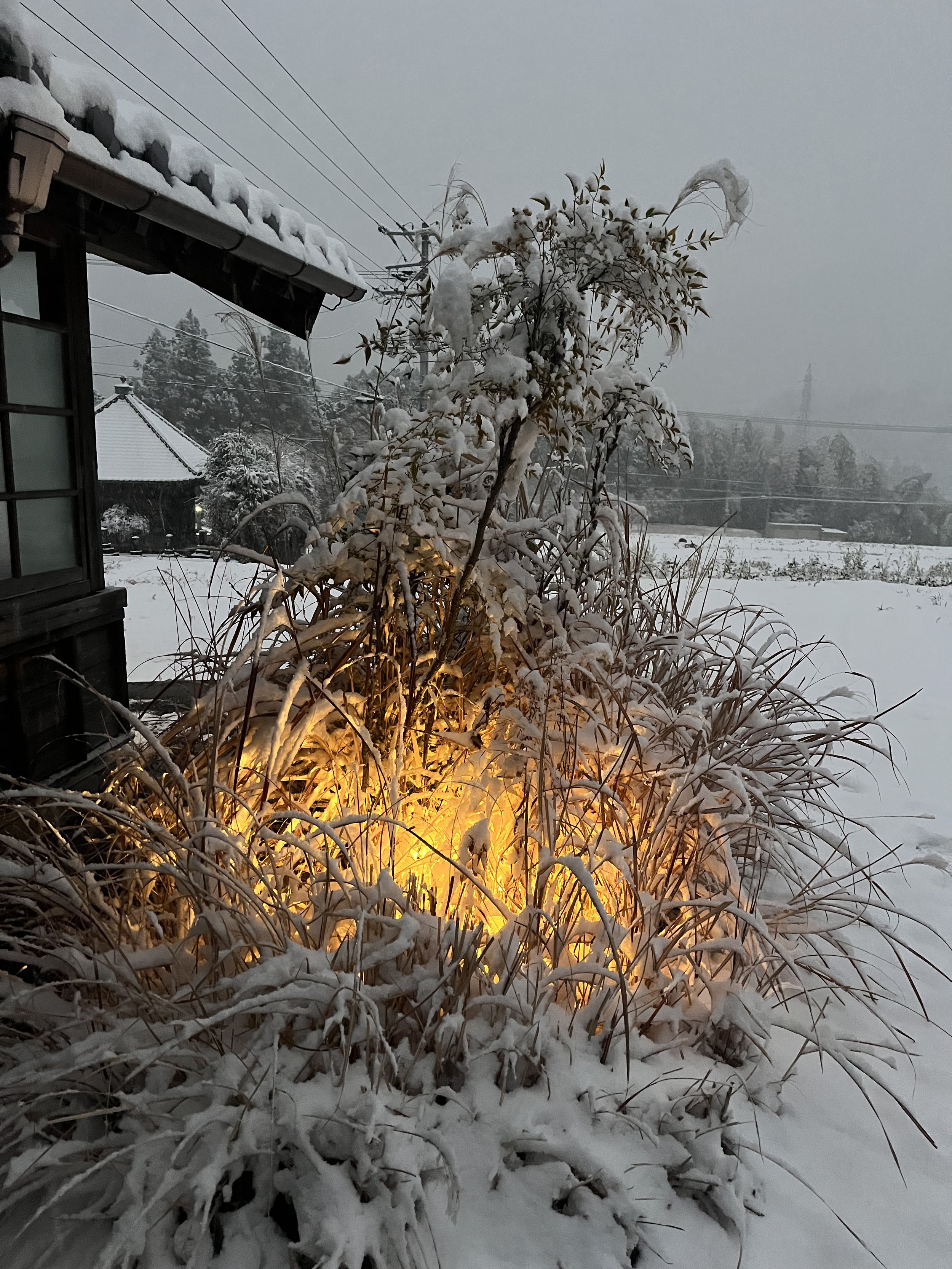
When we travel, we often remember places through images — architecture, food, landscapes. In Japan, what stayed with me most was colour.
It revealed itself gradually, through surfaces. Timber deepened by weather. Indigo fabric softened at the folds. Plaster holding warmth from the sun. The tones felt settled, as though they had grown into their surroundings rather than been applied to them. That sensation led me to look more closely at how colour is understood in Japan. Many traditional colour names refer to seasons, materials, or very specific moments. They are not abstract labels.
Sakurairo evokes the pale tone of cherry blossom.
Ruriiro refers to a deep lapis blue.
Kogecha suggests the brown of roasted tea.
Aijiro carries the faintest trace of indigo.
Each name anchors colour in experience. It connects tone to something tangible — something that has existed in the world.
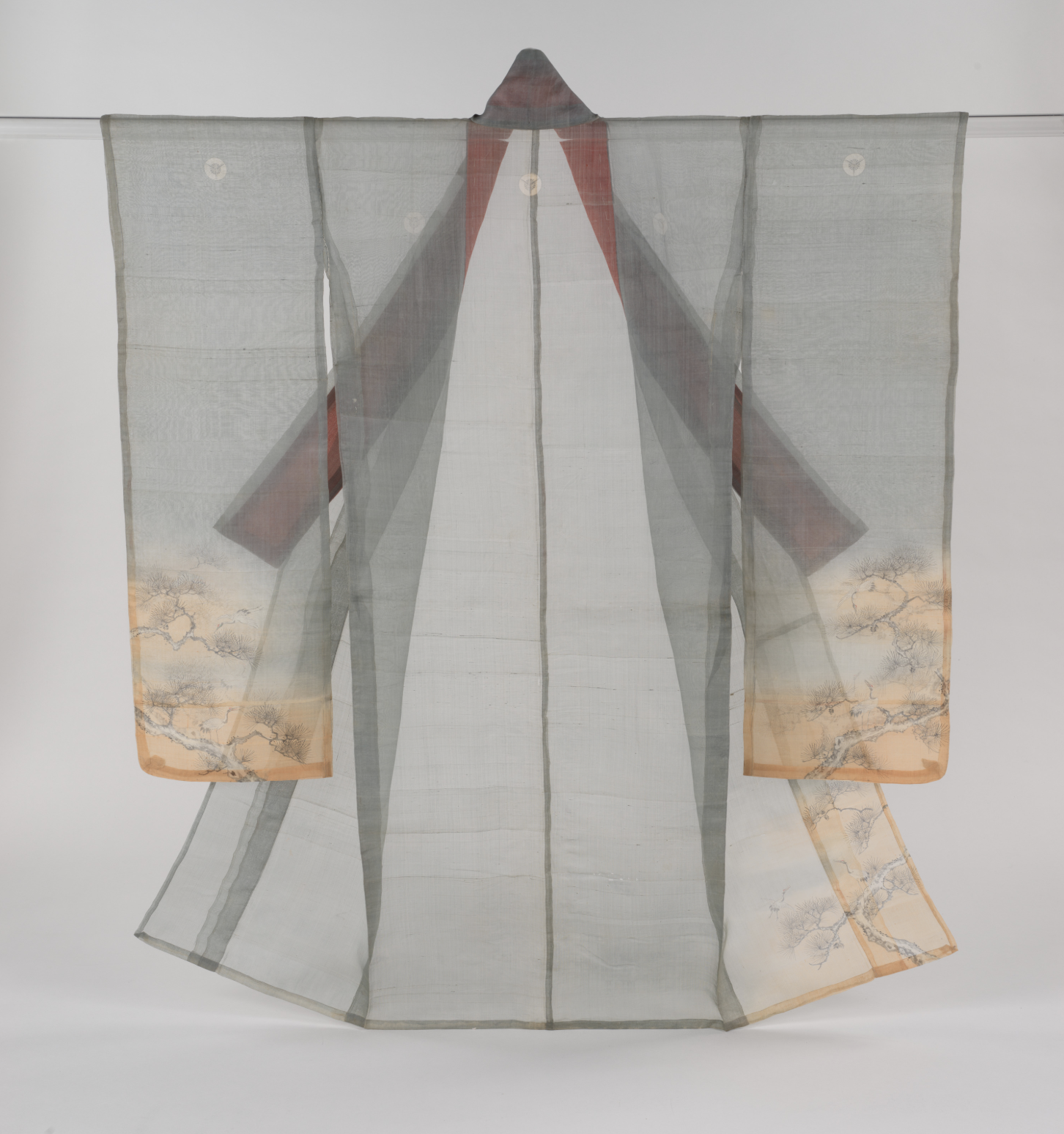
Summer robe (hito-e) with cranes and pines
Meiji period (1868–1912)
ca. 1870–80s
There is also an idea about blue that moved me deeply. Certain shades of indigo are considered most beautiful after time has softened them. The colour develops through wear, through exposure, through living. It cannot be rushed. It matures.
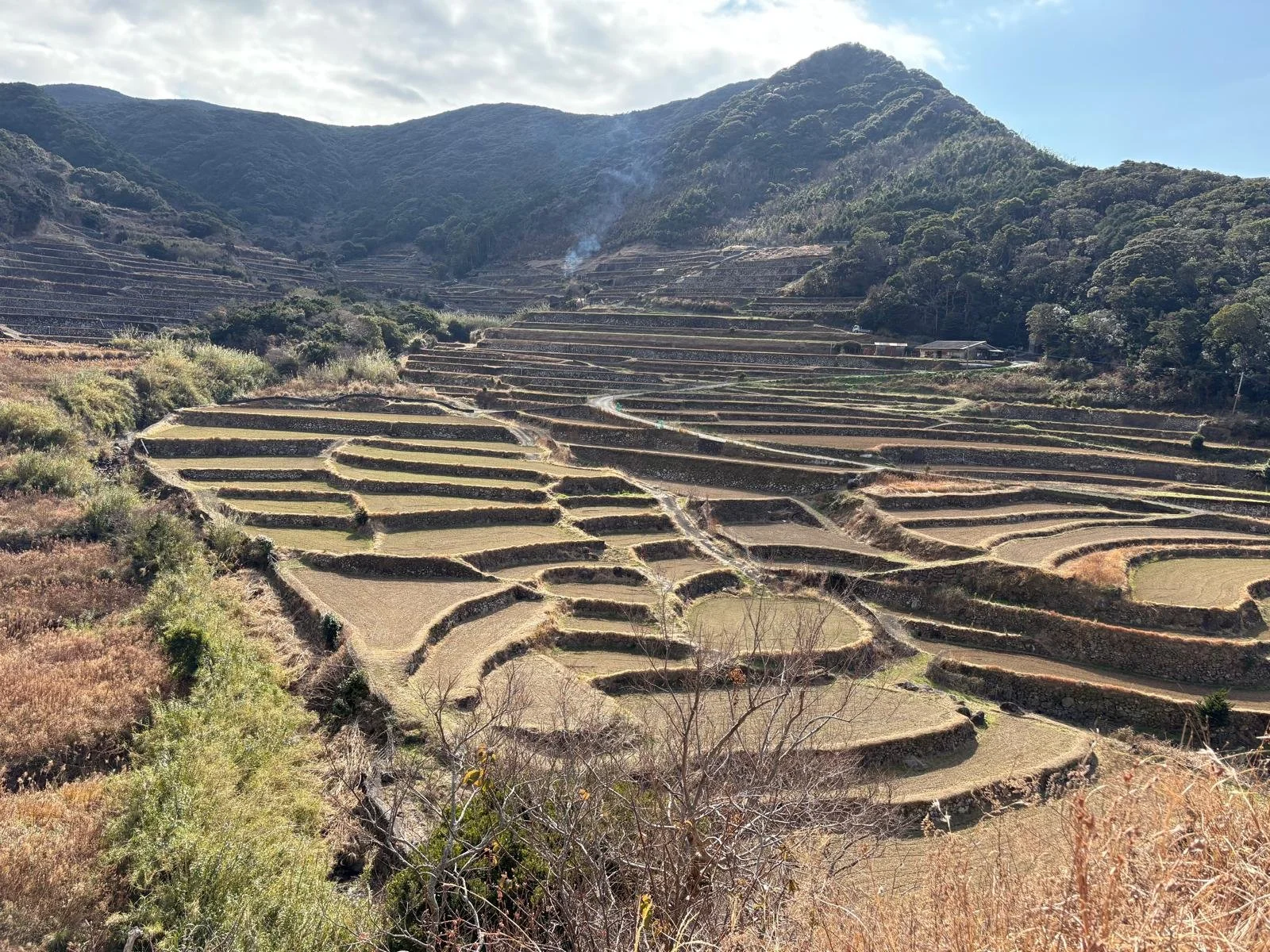
Terraced rice fields, Kyushu, Japan.
When I recognised this philosophy, it felt familiar. I have always been drawn to Munsell — a Western colour system that feels natural and organic in the way it arranges tone and light. It never felt mechanical to me. There is a calm logic in it. In Japan, I sensed that same respect for colour, extended further into memory and material.
Colour, in this way of thinking, shapes experience.
It influences how a room holds light, how it settles at different times of day, how it affects mood without announcing itself. The spaces that remain with us are rarely defined by novelty. They feel grounded. They feel layered.
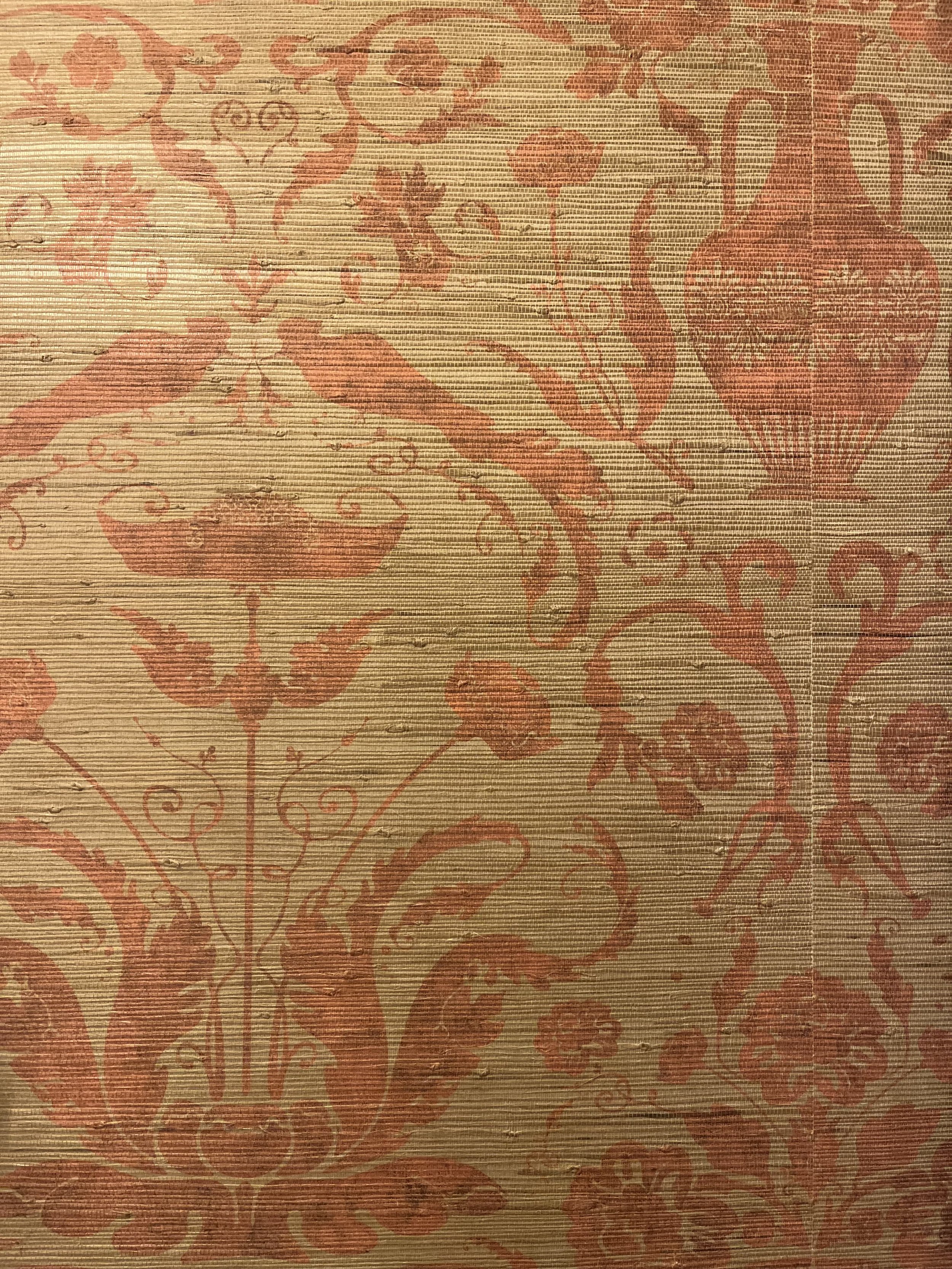
Custom Wallpaper for a Georgian House, Kensington, London
In my design Bird Fable, I worked with warm oranges that are slightly muted and textured. I didn’t want them to feel flat or freshly printed. I wanted the surface to feel layered, as though warmth had gathered into it over time.
Japan reinforced something I already believed: colour is not a trend, and it is not a decorative afterthought. It is one of the most powerful tools in design. It can create atmosphere, shape memory, and influence how we inhabit a space.
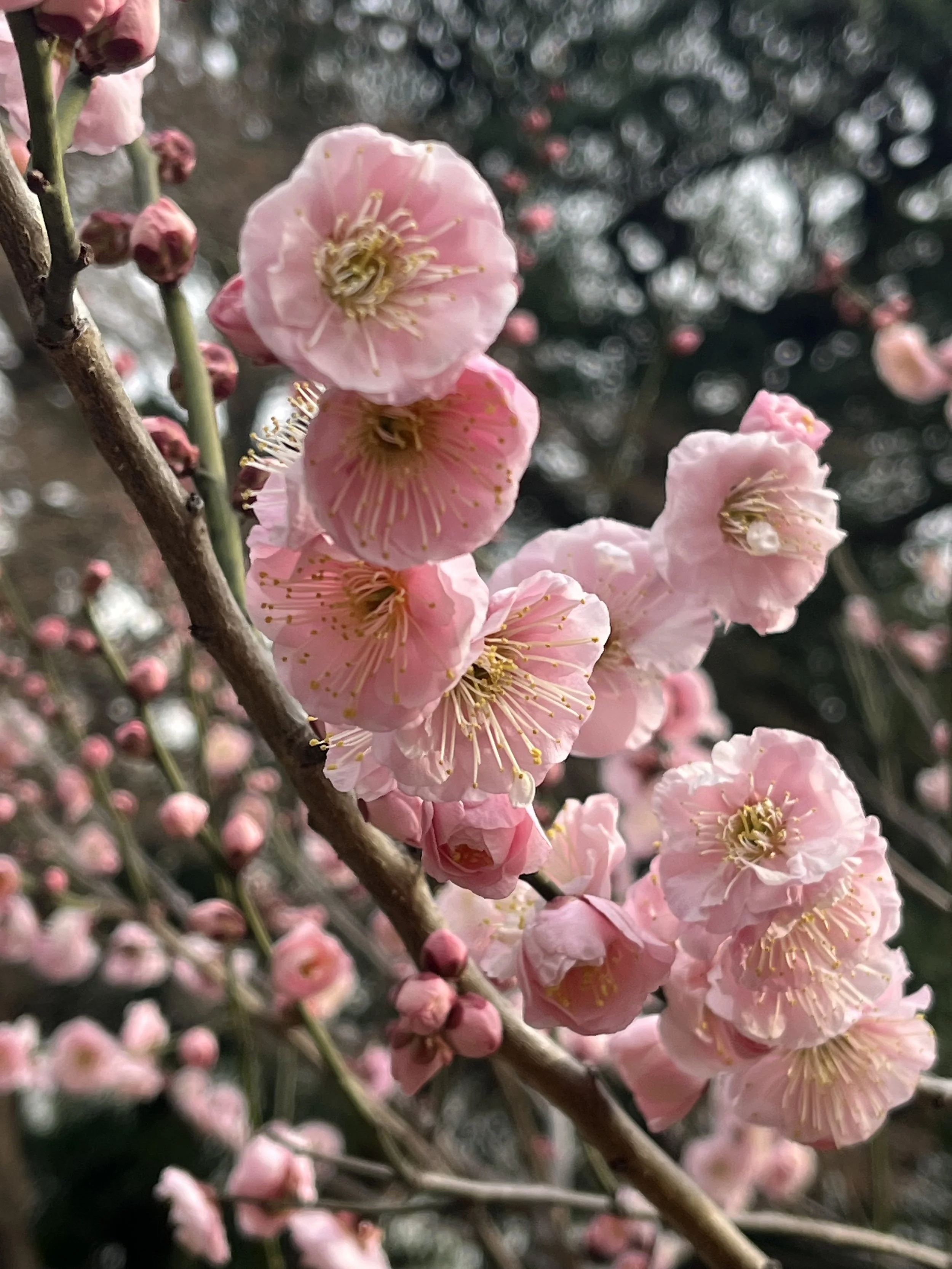
Sakura blossoms, Tokyo
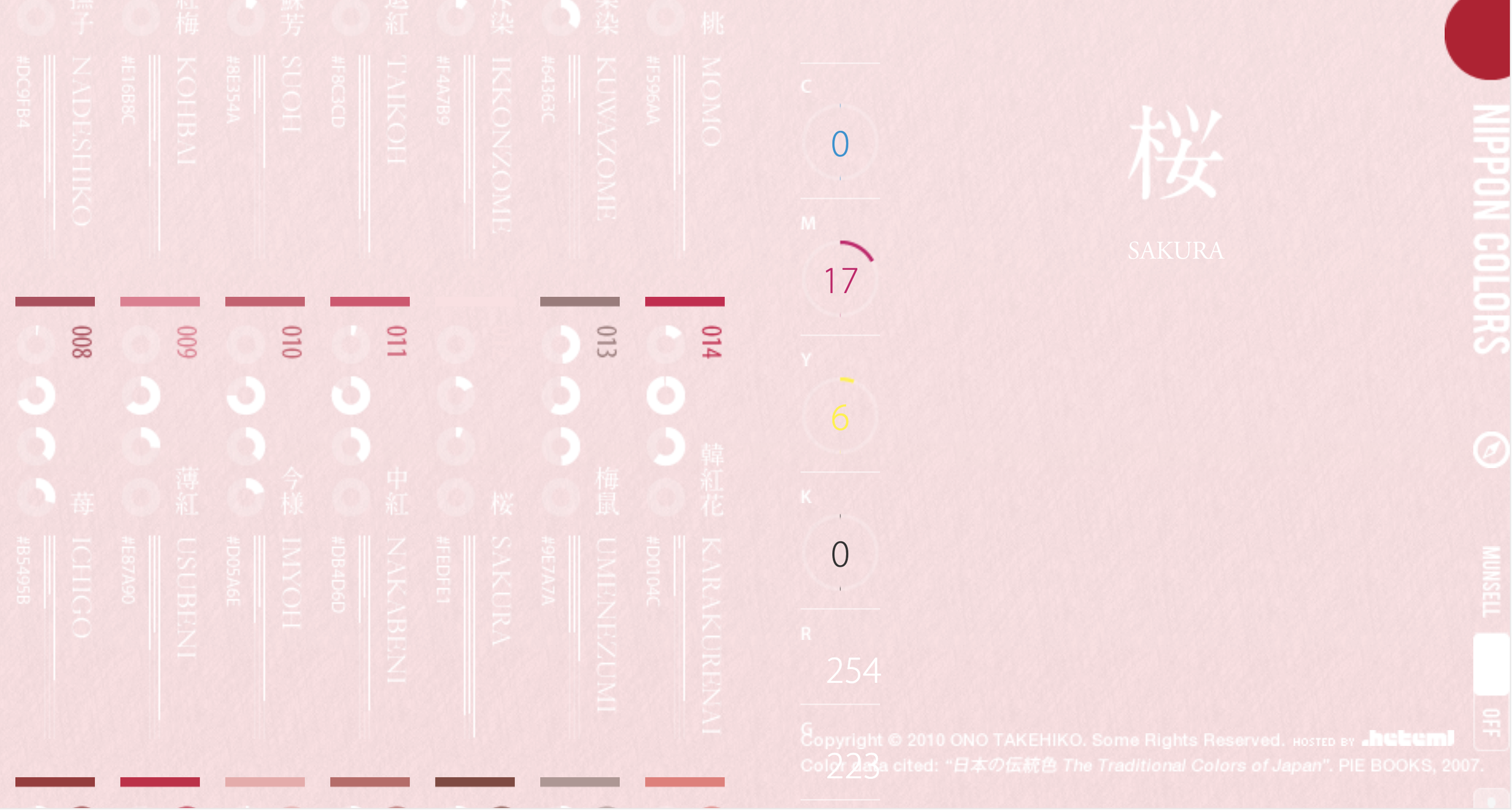
For readers who want to explore further, the Nippon Colors archive presents a wide range of traditional Japanese colour names with links to nature, season and material — offering a sense of how deeply colour has been woven into Japanese visual culture.
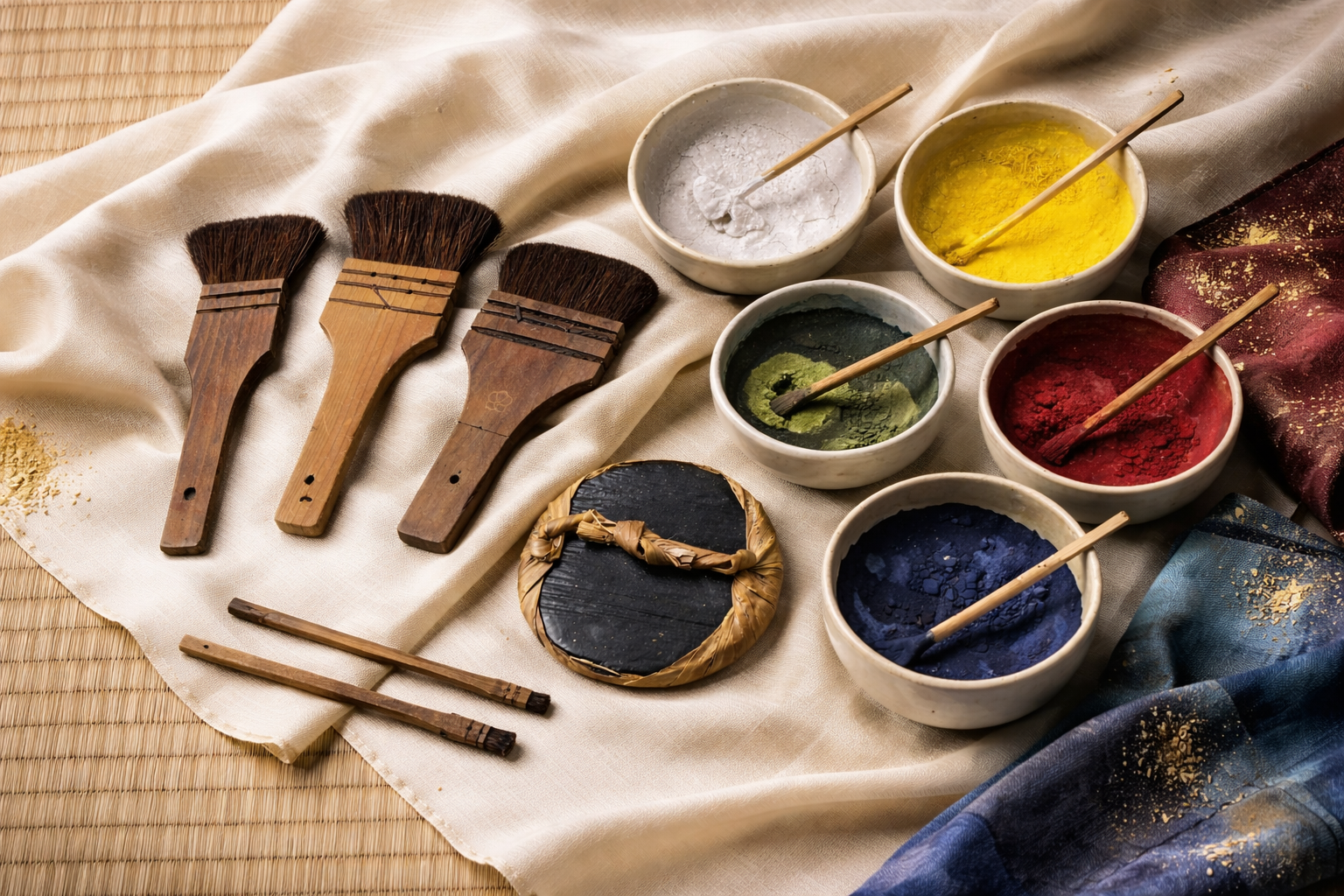
Hand-prepared natural pigments and brushes.
Perhaps the real question is not which colour we prefer this year.
It is how a colour will live with us — and what it will become.
If you are exploring bespoke wallpaper for a private home or hospitality project, you can view current collections here.