Wallcovering Workshops in Liguria: An Idea Taking Shape
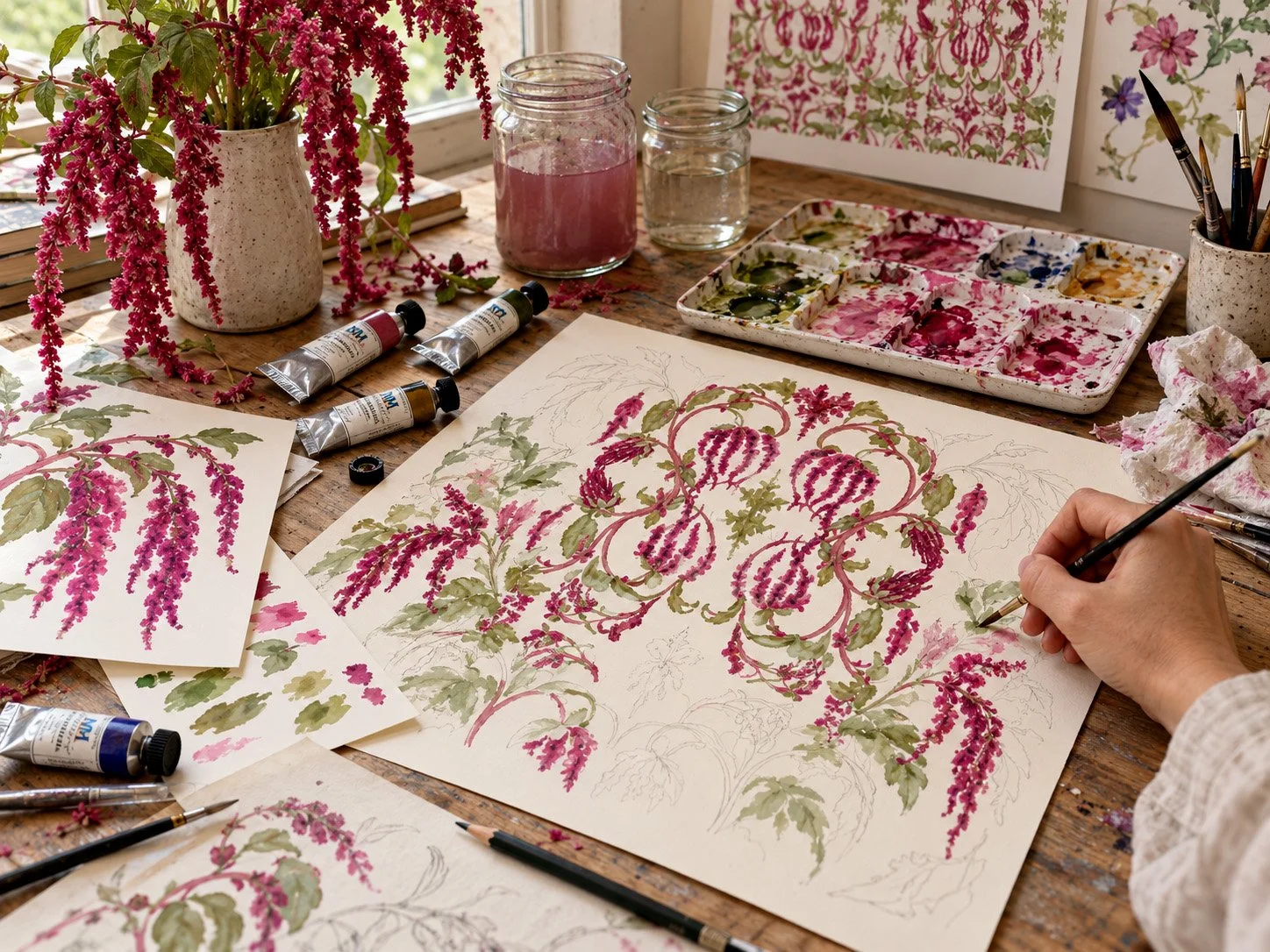
Developing the amaranthus motif through drawing, colour and painted studies.
Between Collaboration and Solitude
One of the slightly strange things about designing wallpaper is that it is both collaborative and solitary.
I work with interior designers, private clients, printers, production teams and other specialists. There are conversations about rooms, colour, scale, materials, architecture and all the practical questions that come with making something for a particular interior.
A client may have a very clear instinct for what belongs in a room — and an equally clear sense of what does not. An interior designer may see immediately how a pattern needs to sit alongside a fabric, a piece of furniture or a particular quality of light. Printers and makers bring an entirely different kind of knowledge.
All of that becomes part of the work, but eventually, I return to the studio alone.
The drawing, the painting, the endless small adjustments to colour, proportion and rhythm happen quietly. There are days when something comes together almost effortlessly and others when I can look at the same drawing for hours without understanding why it feels wrong.
Then I come back the next morning and see it immediately. I enjoy that part enormously. I always have.
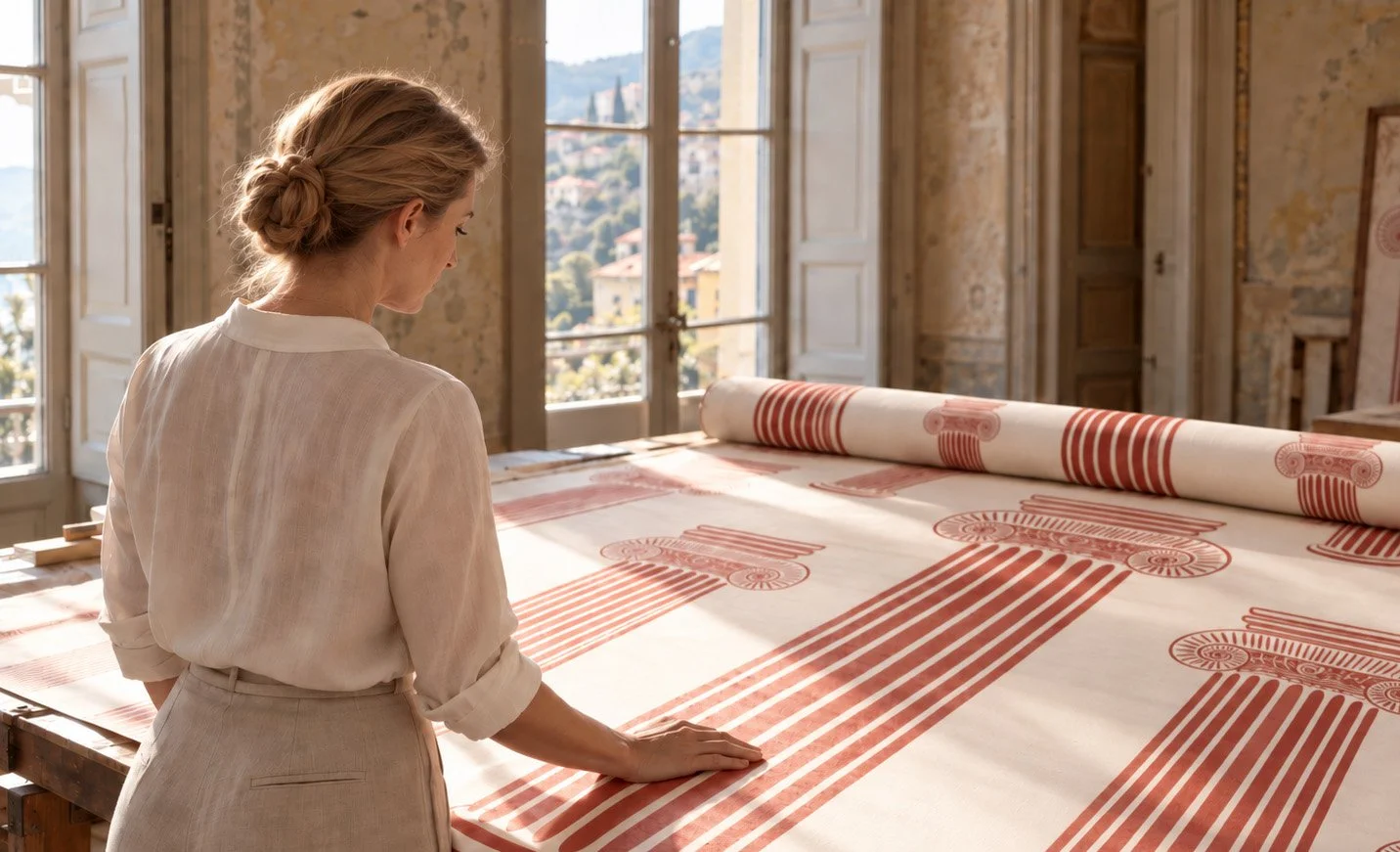
Exploring scale, surface and pattern on paper-backed silk for wallcovering.
What the Studio Teaches
Recently I have found myself thinking about what happens to everything we learn during those solitary hours. Creative practice is peculiar that way. The longer you work, the more you understand — and at the same time the more aware you become of everything you still do not know.
Each project adds something. A material behaves in an unexpected way. A mistake turns out to be useful. A colour changes completely when it moves from paper onto a wall. Something that looked beautiful at drawing scale loses all its energy when enlarged. You adjust, try again, remember it for next time. And gradually, almost without noticing, you build up a great deal of knowledge.
Some of it is technical. Some of it is instinctive. Some of it comes from questions I remember asking myself when I first began: Where do I start? How do I know when a drawing is finished? Why does a repeat feel mechanical? How much colour is too much? What happens when the material itself begins to influence the design?
Those are the things I have started thinking I would like to share.
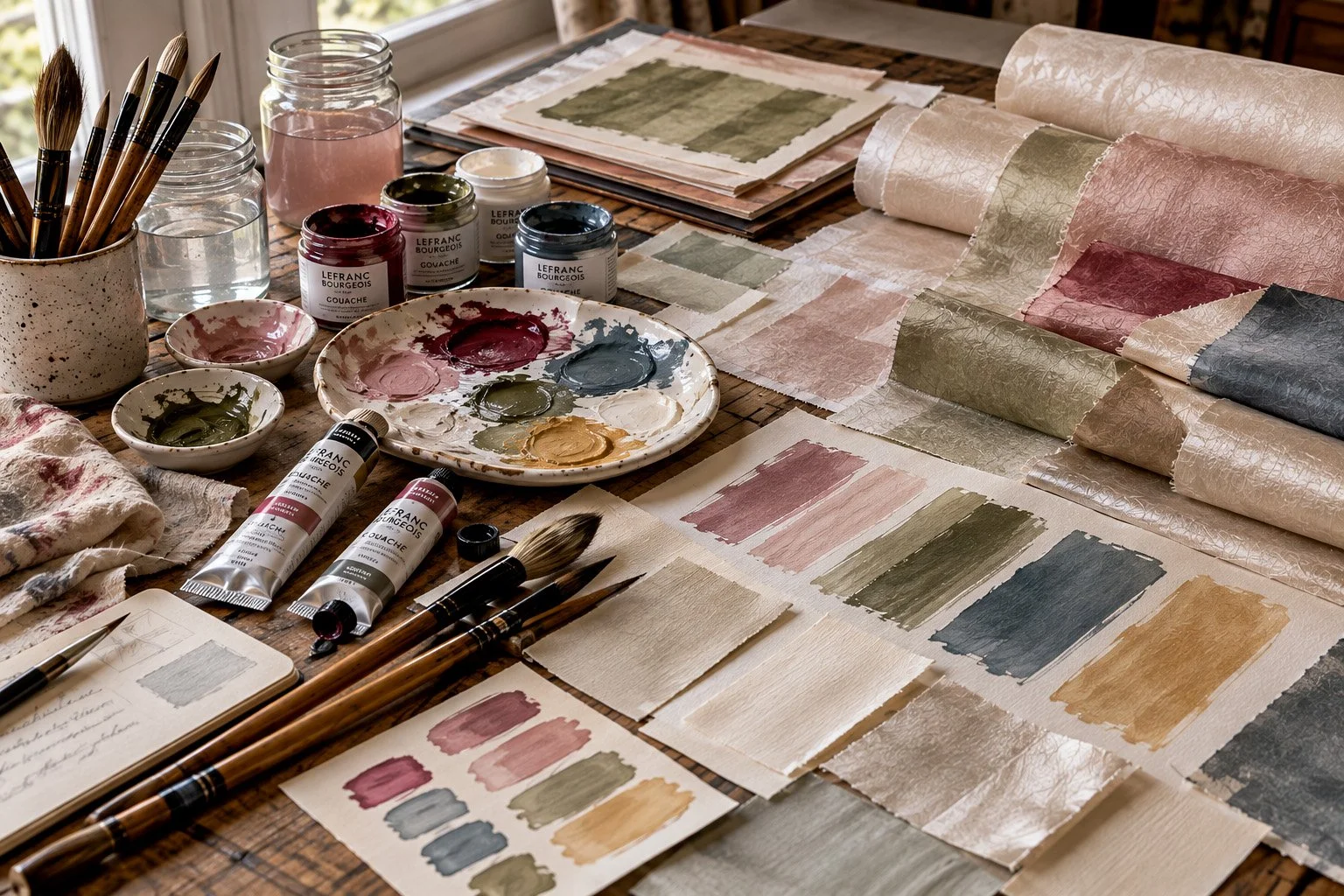
Testing paper-backed silk, gouache, colour and different surfaces in the studio.
A Workshop in Liguria
And this is where the idea of workshops in Liguria began. I can already see them quite clearly. A small group rather than a large class. A table covered with drawings, brushes, pigments, samples and different surfaces. People working, talking, comparing what is happening in front of them. Enough structure to give the day direction, but enough freedom for somebody to wander off in an unexpected direction and discover something better.
I would teach what I know, of course. I think I have a great deal to offer now. But I do not imagine it as knowledge travelling neatly in one direction. That would probably be the least interesting version of it.
Put a group of curious people together and ideas begin to move very quickly. Somebody asks a question you had never thought to ask. Somebody approaches a problem completely differently. Somebody uses a material in a way you would have dismissed and suddenly it works.
You teach. You watch. You learn as well. That exchange is becoming as important to me as the idea of teaching itself.
Perhaps because so much creative work happens privately, there is something very attractive about opening part of that process up. Not performing it, and not turning it into a formula, but working alongside other people and allowing the conversation to become part of the making.
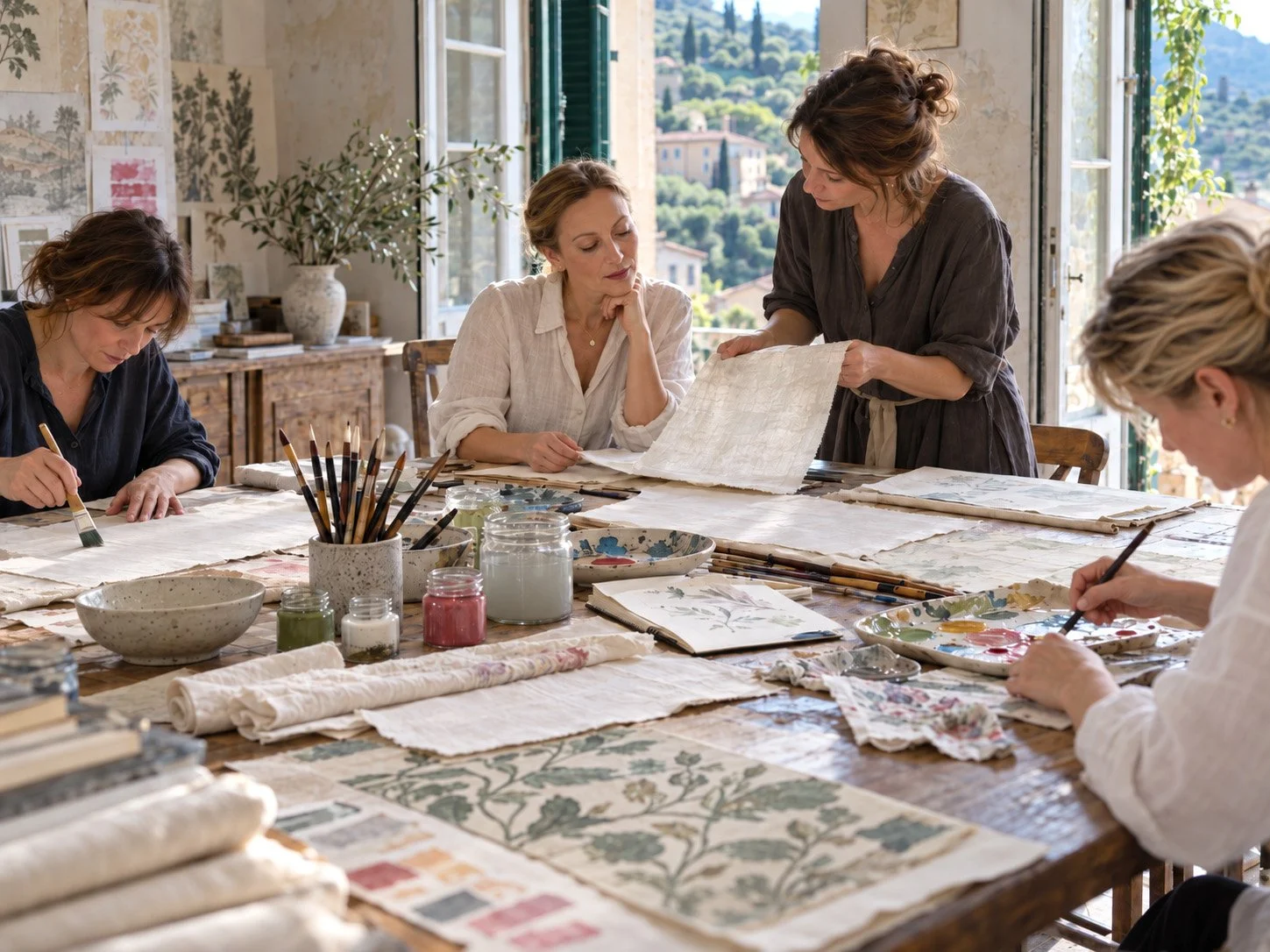
Ligurian workshop — making, testing materials and exchanging ideas around the table.
Why Liguria
Liguria feels like the right place for it. There is visual material everywhere here: faded painted facades, fragments of decoration, old plaster, stone, shutters, churches, gardens, the colours of the sea and the rather extraordinary Ligurian light. It is difficult to live here without noticing surfaces.
I like the thought of that entering the room too. The idea is no longer quite as vague as it was when it first appeared.
I know there are things I want to teach. I have begun thinking about the materials, the scale of the group, the kind of space I would want to create and what people might actually make while they are there. There is still a great deal to work out, and that is part of what interests me.
I am not only thinking about how to pass on what I know. I am also learning how to shape the whole experience around it — how to make it useful, generous, stimulating and, above all, worth coming to Liguria for.
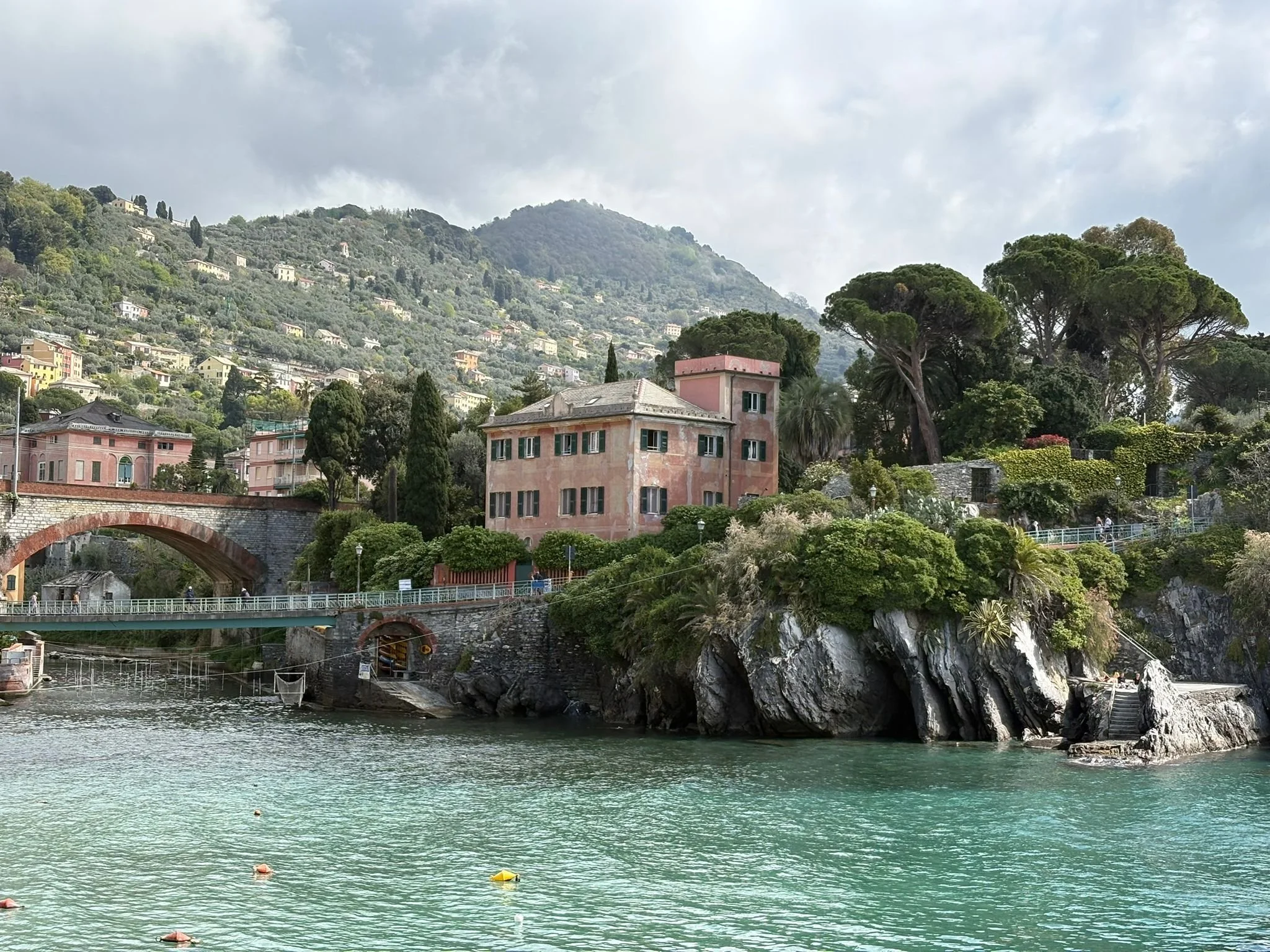
Genova Nervi on the Ligurian coast
Learning to Share the Process
There is another part of this which comes rather less naturally to me. I know that opening up the studio process also means learning to show more of it. Filming, sharing work in progress, perhaps making videos that allow people to see how something develops rather than only seeing the finished result.
I understand the value of that very clearly. I am simply much more comfortable with a brush in my hand than a camera pointed at me. That, I suspect, will be another part of the learning process.
If I am asking other people to arrive curious, experiment, make mistakes and work outside what already feels familiar, then perhaps I should be prepared to do some of that myself. Learning how to communicate the process, not just make the work, will be part of the experience for me too.
At the moment all of those thoughts are beginning to settle into something more solid. This is usually the stage I enjoy most: when an idea has moved beyond fantasy, but is still open enough to change.
I can see the table now. I can see the materials. I can imagine the conversations, the questions, the moments when somebody discovers something neither of us expected.
What I do not know yet is exactly what form all of it will take. And perhaps that is where the conversation becomes interesting.
If you have ever imagined joining something like this, I would genuinely like to know what you would hope to learn, what you would want to make, or what would make a workshop feel genuinely worthwhile to you.
I have no shortage of ideas of my own — that has never really been the problem. The harder part is giving them shape. And this one is beginning to have one.