Painting from Life: Janette Hayhoe on Colour, Pattern and Domestic Space
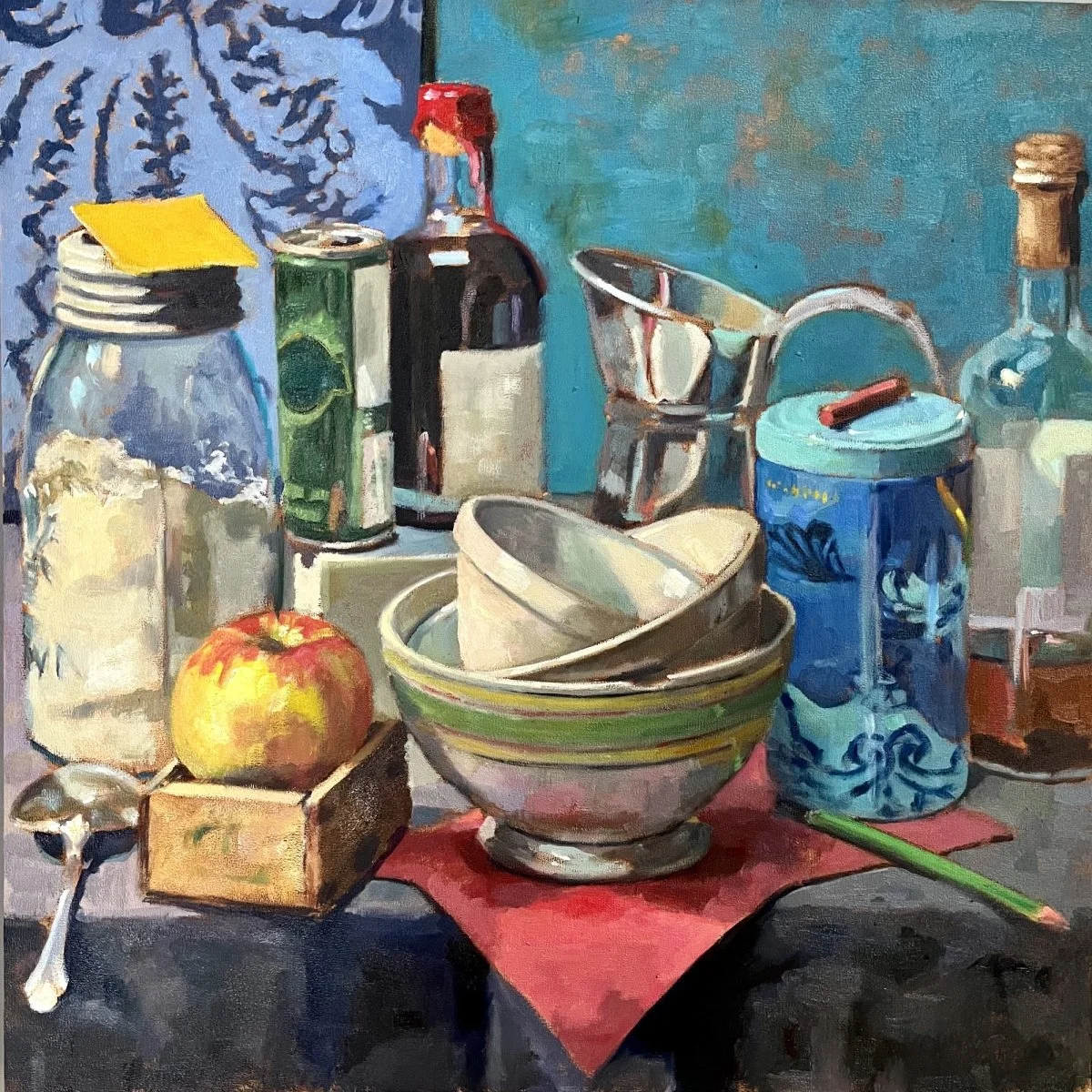
Still Life with Bowls, oil painting.
Janette Hayhoe
I was familiar with Janette Hayhoe’s paintings before I knew her well, and I became a fan quite quickly. What attracts me to her work, beyond the quality of the painting itself, is her sense of colour and the objects she chooses to paint. She notices things many of us would walk past without giving them much thought, and then makes them worth looking at.
Janette is an artist, an interior designer, and a friend. This spring, I joined her painting course at Circle of Misse in the Loire Valley, and it gave me the chance to see not only how she paints, but how she teaches others to look. That became the starting point for this conversation: colour, pattern, interiors, France, and the emotional life of ordinary objects.
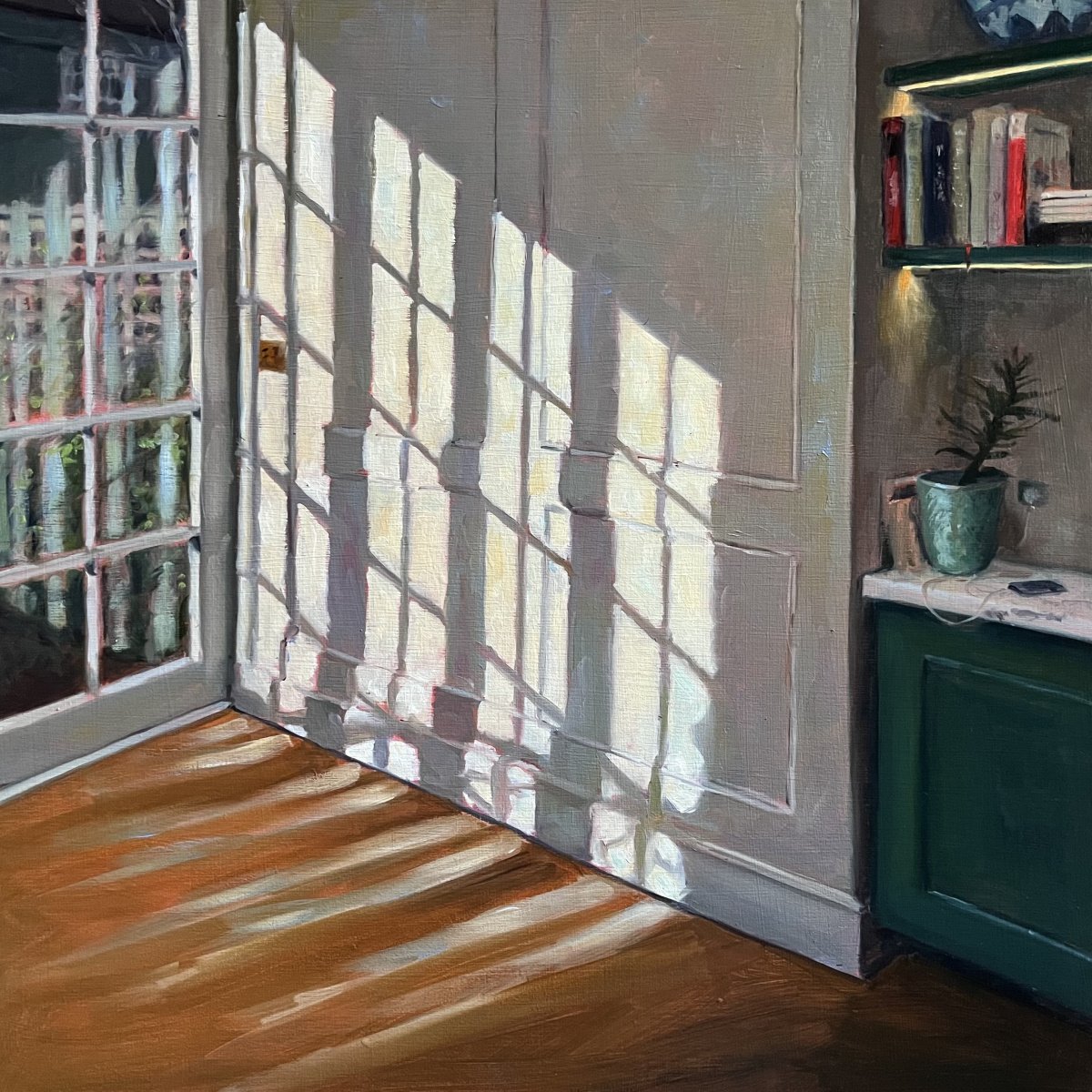
Breakfast Room, oil painting.
Janette Hayhoe
At Circle of Misse
Circle of Misse was the right setting for that kind of conversation. It is not a glossy, over-designed retreat, but a place where creative work, food and hospitality seem to belong together. The house is in Missé, on the southern edge of the Loire Valley, and Circle of Misse hosts creative holidays, courses and retreats, with writing and painting on one side and Loire Kitchen, its culinary and hospitality side, on the other. The food was a serious part of the pleasure. Aaron, our host, cooked with real assurance, moving comfortably between different cuisines, but never in a way that felt like a performance. Many of the recipes seemed to carry a place, a journey, or a memory with them, and often there was a story behind what arrived at the table.
That made the meals feel personal as well as excellent — part of the rhythm of the week, and not separate from the painting at all. In fact, it felt very close to the world Janette paints: a table after lunch, a stack of dishes, cloth, pattern, light, conversation, traces of people who had just been there. In her hands, any of that could become the beginning of a painting.
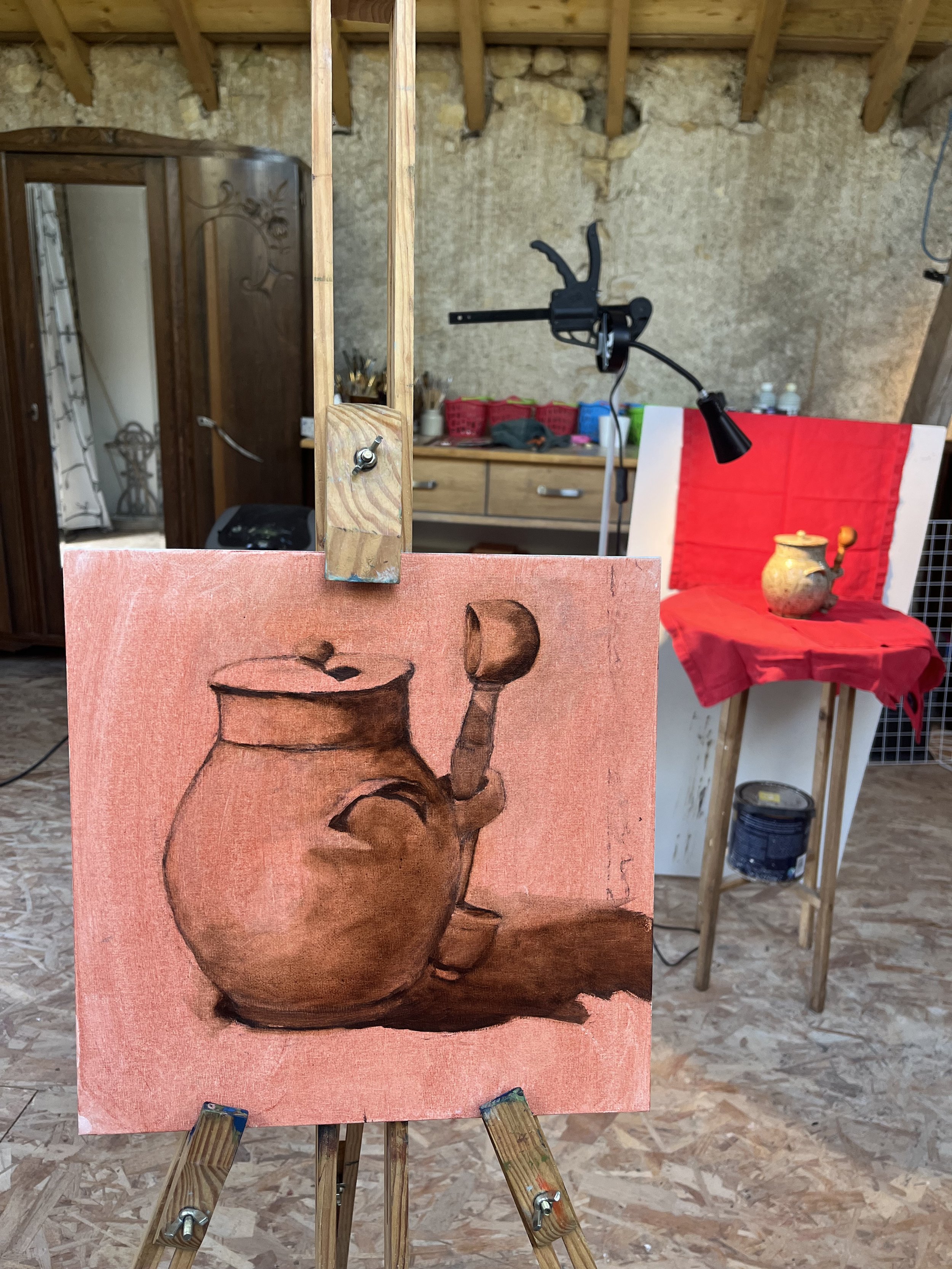
Nataliya Andrienko, Olive Jar Study,
painting from life at Circle of Misse.
Learning to See Colour
So when I asked Janette about colour, she did not speak about it as something added to a painting. She spoke about attention, and about painting from life. Her training was classical, and for her the eye sees differently from a camera. It keeps finding reflected tones, warmth, coolness and small shifts that only appear when you stay with the subject.
Then came the line that stayed with me.
“You look at a white object, like a porcelain object,” she said, “and it is either reflecting colours, or there is warmth and coolness. Everything is in there. To paint a white object, I need a full palette.”
That explains a great deal about Janette’s paintings. Her colour is not decorative. It comes from looking.
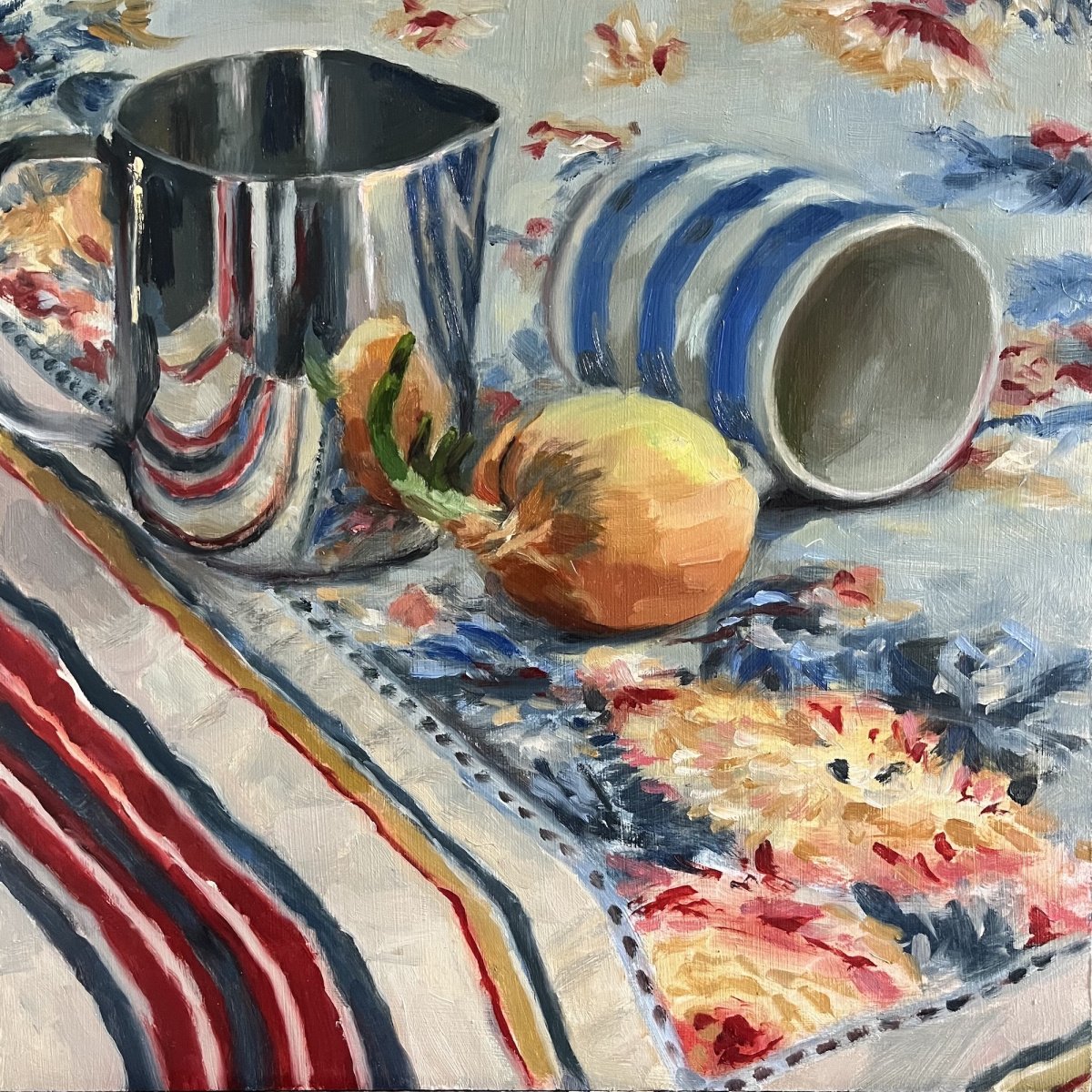
Sprouting Onion, oil painting.
Janette Hayhoe
The Light of the Loire Valley
Because Janette trained and lived in France, and because the course took place there, I wanted to ask whether France itself had changed the way she sees colour. Was it the place, the light, the landscape — or was that sense of colour already part of her? She was careful not to make it too romantic.
“That’s hard to say,” she said. “I suppose the area in France where I lived, the Loire Valley, is known by artists as having a particularly wonderful light. The quality of light is lovely. It has a softness.”
But she returned to the most important thing.
“A lot of what painting is,” she said, “is training your eyes to see.”
That was very much the feeling of the course. We were in France, with all the pleasure that brings — the landscape, the buildings, the changing weather, the possibility of painting outside — but the real work was not simply to record what was in front of us. It was to learn how to look.
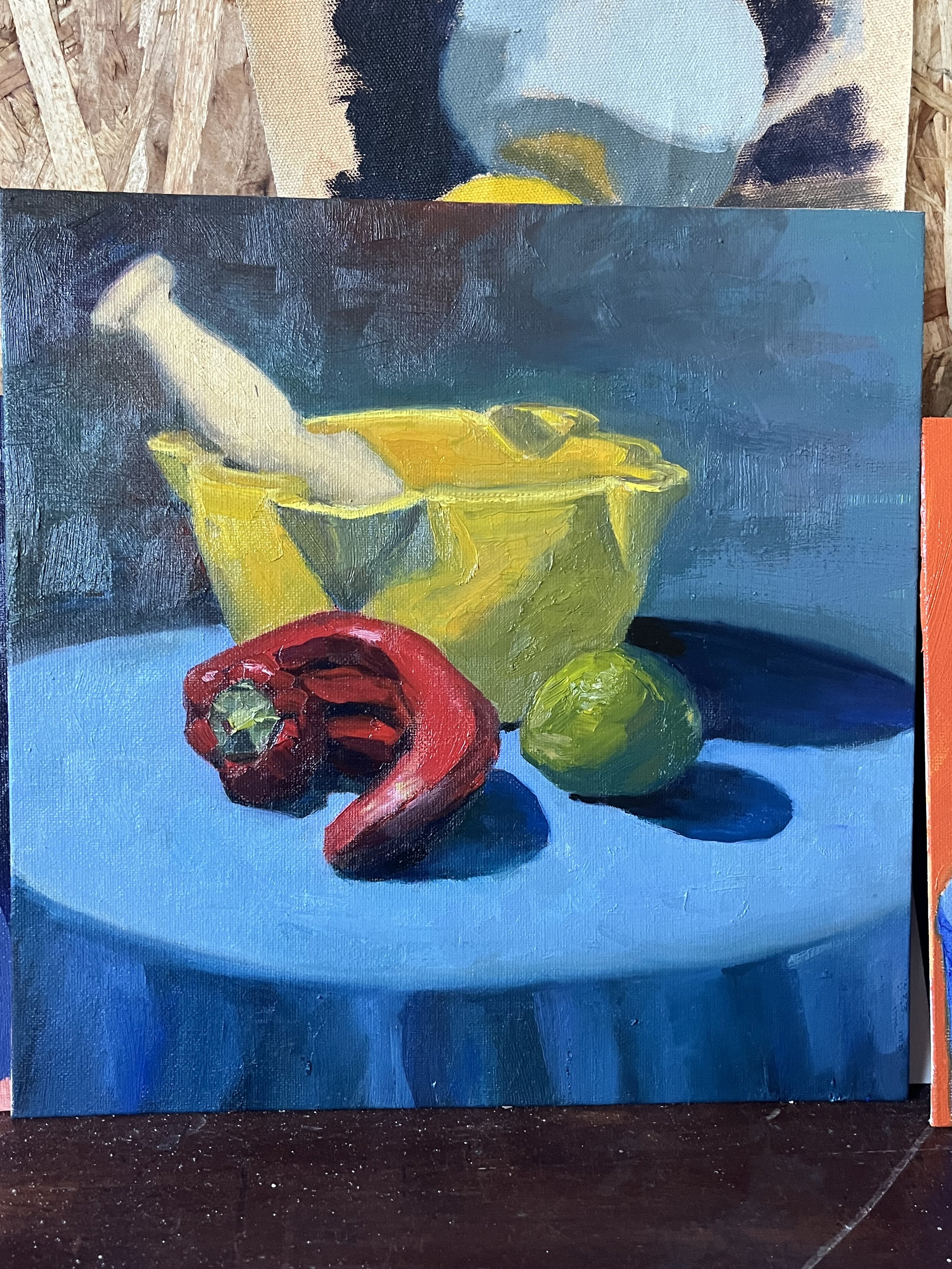
Nataliya Andrienko, Pepper and Lime Study, painting from life at Circle of Misse.
Janette told me that her courses in France began mostly with plein air painting, because working outside there is such a joy. Now, with studio space as well, the course can move between landscape and still life depending on the weather.
“The principles are basically the same,” she said. “The drawing, the colour theory, creating form, creating three dimensions on a two-dimensional surface. It is much the same whether you are painting landscape or still life.”
It sounds straightforward when Janette says it. Having been there and tried it, I can confirm that it is not straightforward at all.
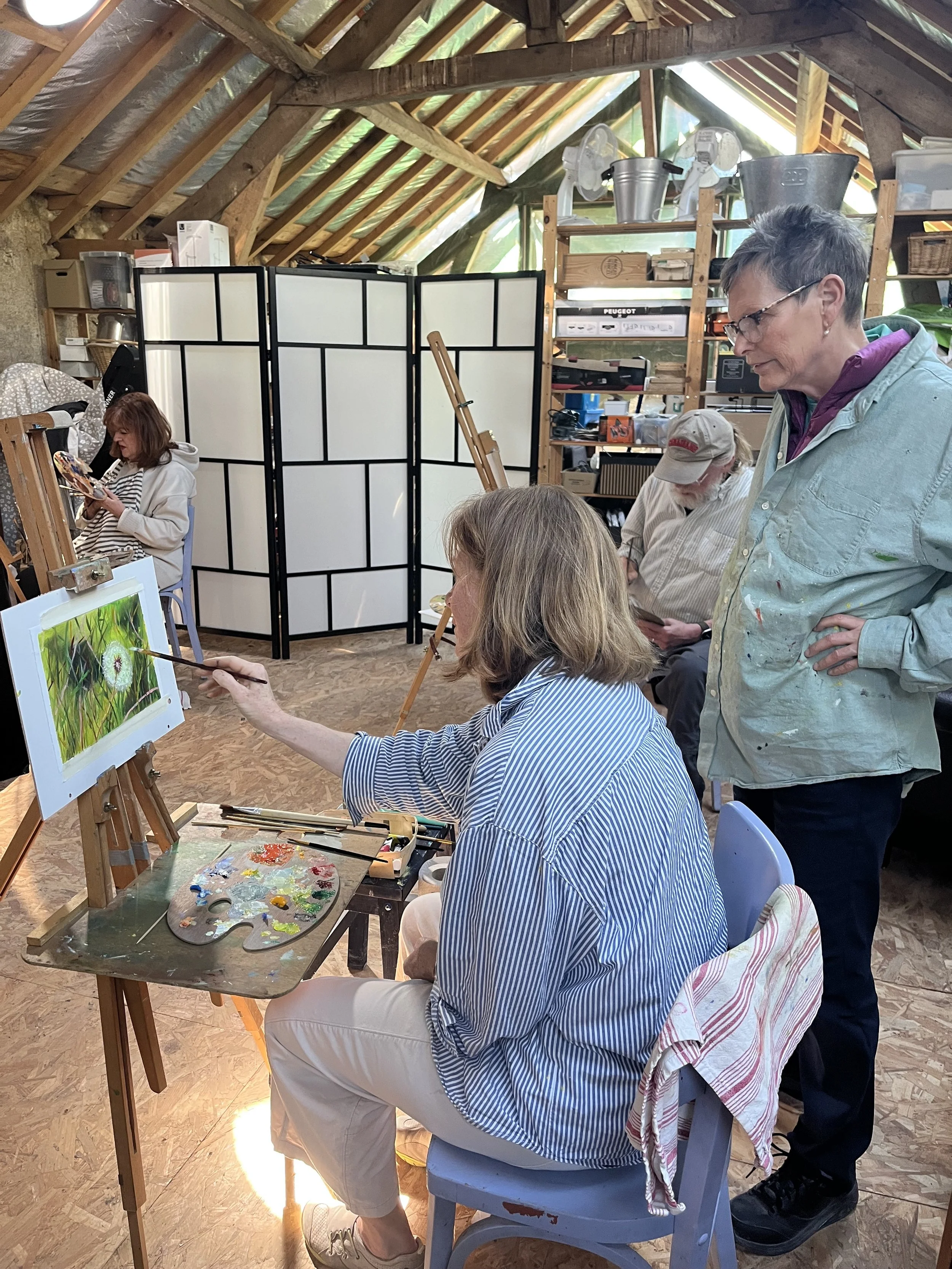
Janette Hayhoe teaching in the studio at Circle of Misse.
Pattern and the Life of Interiors
One of the things I have always loved in Janette’s paintings is her use of pattern. It appears again and again: in cloth, ceramics, interiors, backgrounds, table surfaces and domestic objects. But it never feels as though it has been placed there only to decorate the painting. It feels connected to the life of the objects and the space around them.
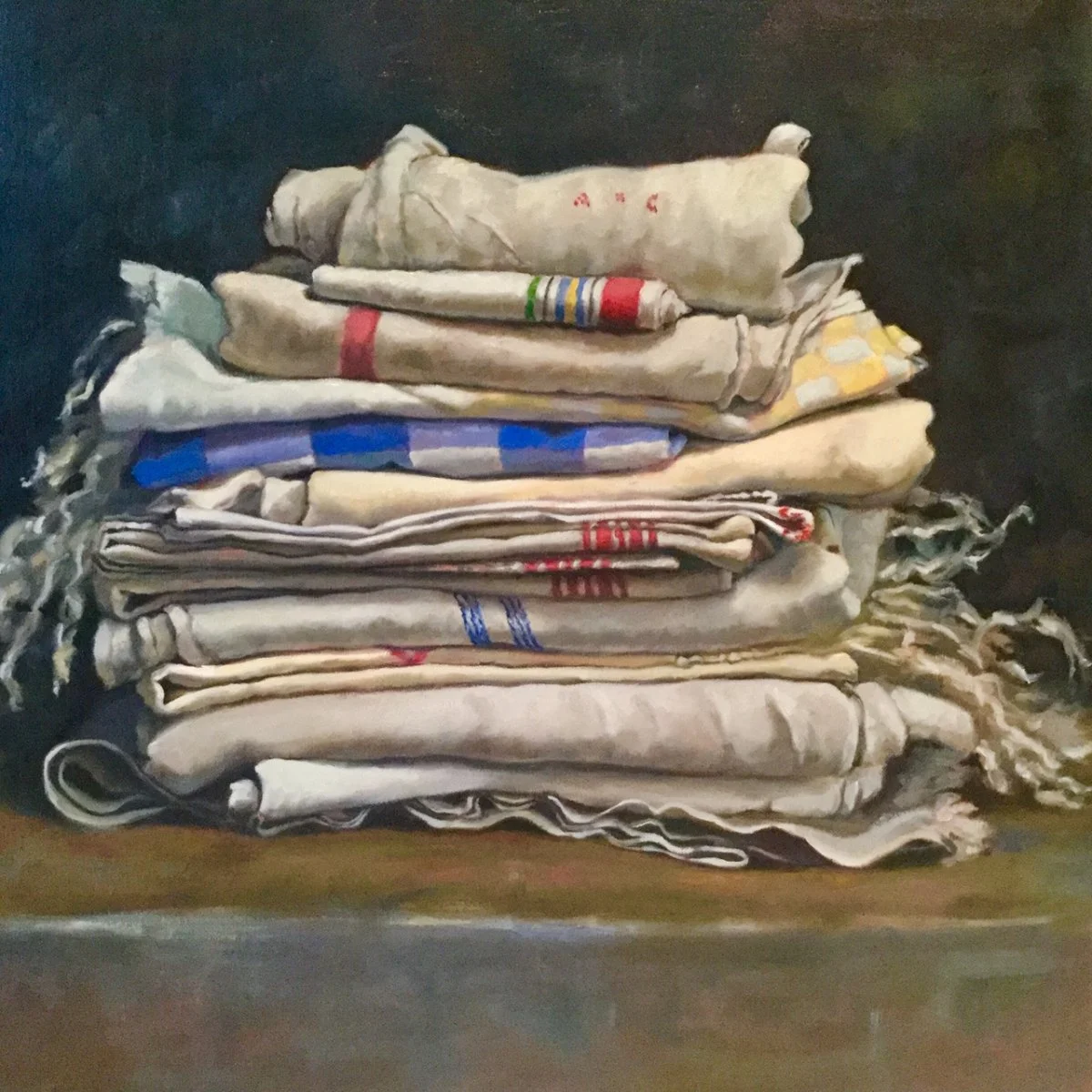
Stacked Linens II, oil painting.
Janette Hayhoe
This makes sense because Janette is not only a painter, but an interior designer. She has spent years thinking about rooms, fabric, furniture, light, surfaces and how all these elements affect the feeling of a place.
When I asked her about pattern, she said:
“I think the love of pattern is probably coming from my love of interiors and design.”
But again, she brought the conversation back to light.
“With interiors, it is often about light as well,” she said. “How it comes into a space, whether it is through a window or a doorway. That is often what I am looking at.”
That is what makes her interiors interesting to me. They are not simply paintings of rooms or objects arranged inside rooms. They are paintings of relationships: between light and surface, object and memory, pattern and feeling.
What interested me even more was that Janette did not separate pattern from domestic life. It was not only a visual device. It belonged to the rooms we occupy, the fabrics we live with, the objects we keep, and the way a home can hold more than one feeling at the same time.
What a Room Can Hold
From there, Janette began talking about domestic space — not as something automatically cosy or pretty, but as something more complicated.
“As a woman,” she said, “I think we respond to the domestic space. It says something about how you feel about the space you occupy.”
She spoke about trying to create an affect for the viewer — a feeling, not just an image. That felt important, because it moved the conversation away from subject matter alone. A bowl is not only a bowl. A pillow is not only a pillow. These objects can carry memory, comfort, discomfort, tension, or something more private, depending on who is looking.
“I’ve painted bowls and people say, ‘Oh, my grandmother had a pudding bowl like that.’”
That is where everyday objects become personal. They carry associations, even when the artist does not explain them.
But Janette also said that domestic space is not always comforting. It can be welcoming, but it can also feel slightly off. It can hold tension.
“There can be tensions,” she said. “In every domestic set-up, there can be tensions.”
She gave the example of stacked objects, where the arrangement itself can suggest something precarious. She also spoke about a series of eggshell paintings, drawn to their fragility and to the idea of “walking on eggshells”.
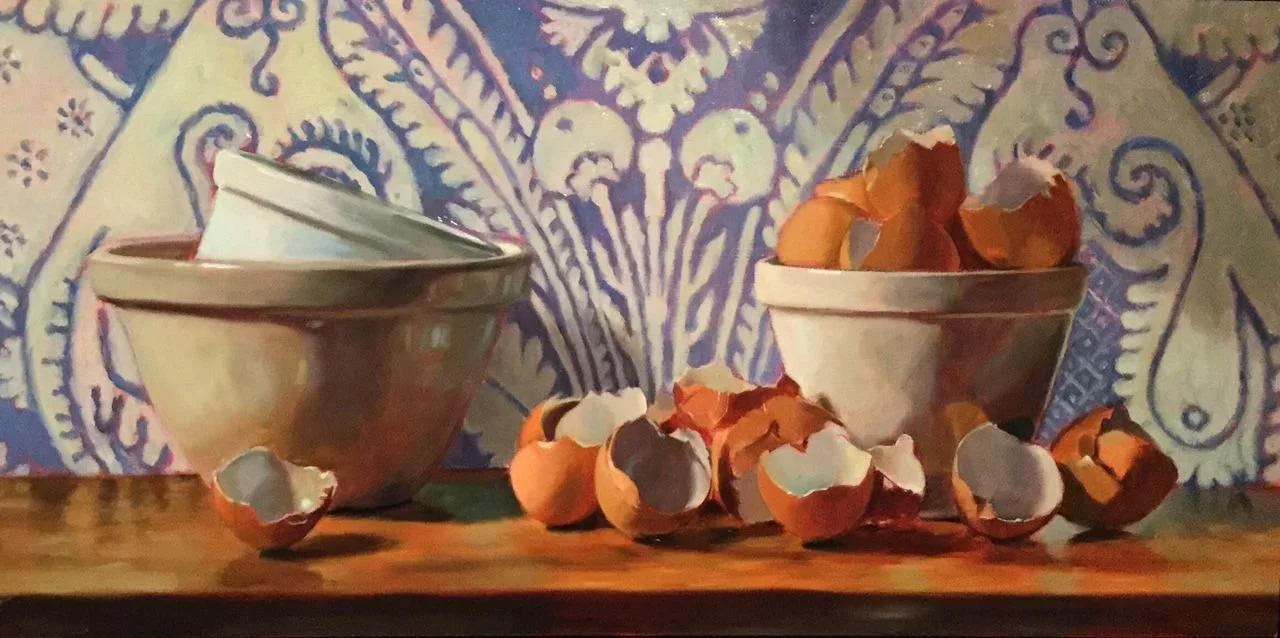
More Egg Shells, oil painting.
Janette Hayhoe
That image stayed with me. Eggshells are ordinary. We throw them away without thinking. But in a painting, they can become something else: fragile, exposed, slightly uncomfortable.
She also described a series of paintings of pillows. In one, the pillows were neat and orderly. In another, they became dishevelled. Then they were torn, old feather pillows, with the feathers coming out. In the final painting, they were packed away in a plastic bag.
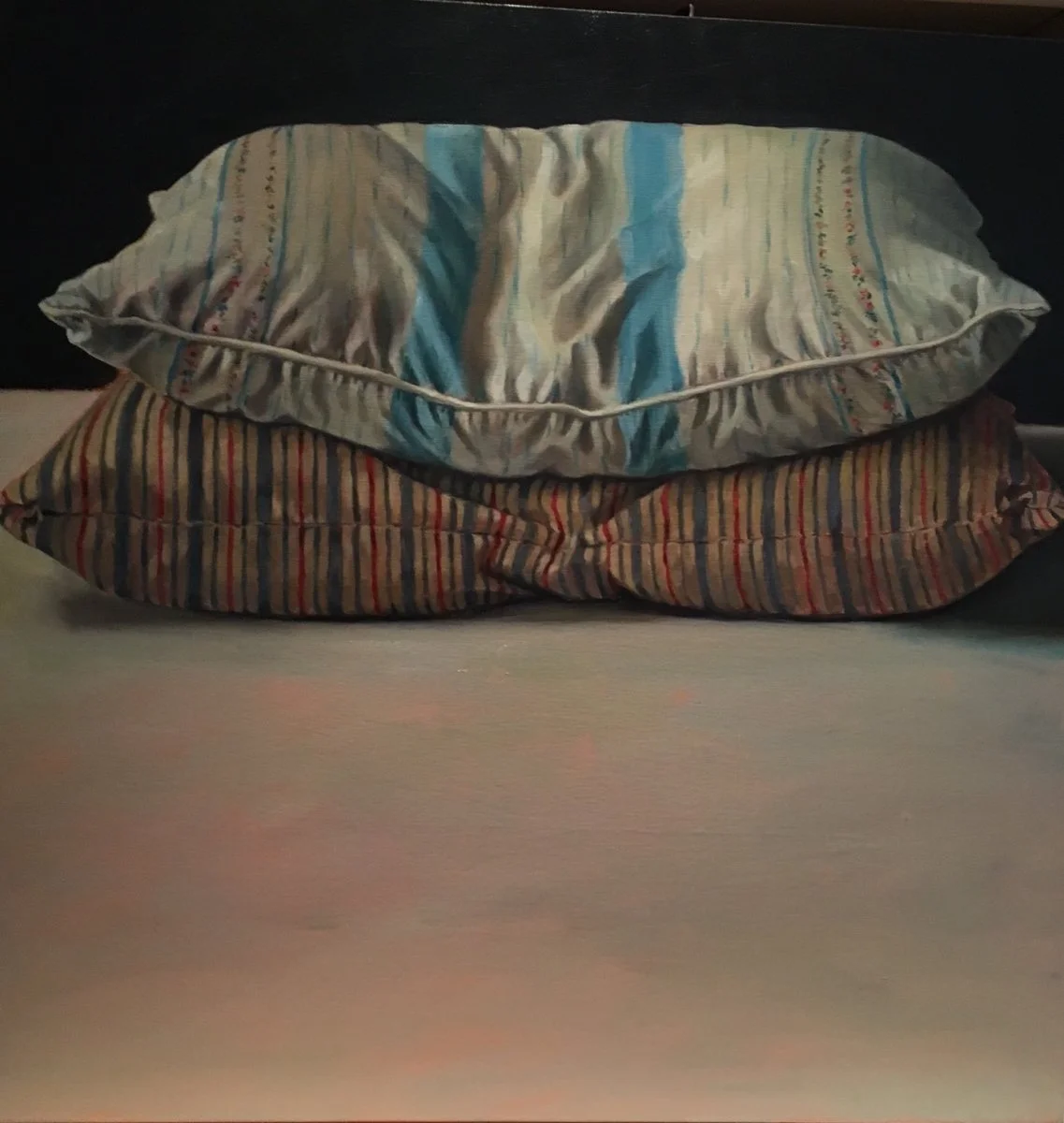
Pillows III, oil painting.
Janette Hayhoe
“These things can happen in relationships too,” she said.
I found that fascinating, because it changes how you look at the work. At first, you might see a domestic object. Then slowly you realise it may also be about comfort, disorder, strain, fragility, or something coming apart.
Room for the Viewer
Janette said that sometimes there is a subtext in the work, but she does not want to force it too strongly onto the viewer.
“Sometimes I like to leave it open enough that the viewer can bring their own subtext to it,” she said. “Or maybe there isn’t one for them.”
That openness feels important. A painting may come from something very personal for the artist, but once it is seen by someone else, it becomes part of their experience too. A subject that was upsetting to the artist might look beautiful to another person. A chipped bowl might remind someone of family. A room filled with light might feel comforting, or it might feel unsettling.
So perhaps that is what Janette’s paintings offer: not one fixed meaning, but a place where colour, light, pattern and memory can meet.
Near the end of our conversation, I tried to summarise it back to her: through light, colour and everyday objects, the same artwork can offer very different experiences depending on who is looking at it.
“Yes,” she said. “Absolutely.”
And then she added something that felt like the right place to leave the conversation.
“You always want to have room for the viewer too.”
That line says a great deal about her paintings. They are carefully observed, but not closed. They are personal, but not private. They invite you in, but they do not tell you exactly what to think.
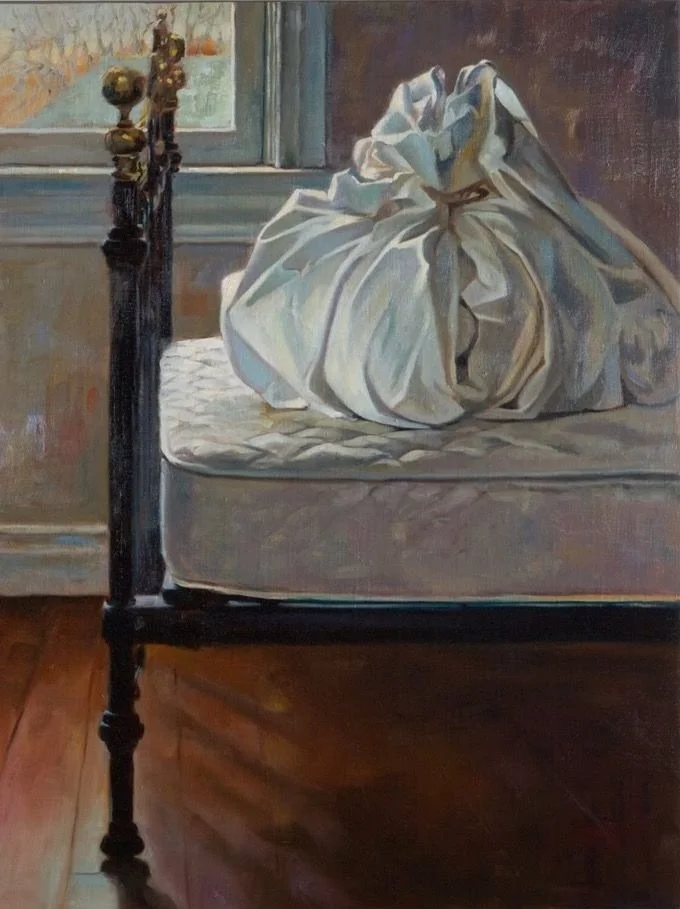
Bundled, oil painting.
Janette Hayhoe
You can see more of Janette Hayhoe’s work on her website, and I have also linked the Circle of Misse course page, where she teaches painting in France. I feel fortunate to have shared that week through Janette’s teaching, her work, the place itself, and the people gathered there. It is an experience I will not forget.
Further links:
Janette Hayhoe Interiors
Circle of Misse
Loire Kitchen / Circle of Misse